






There are some things sitting in our kitchen that we use so often, we almost stop noticing them.
Hing is one of them.
A tiny pinch goes into dal, kadhi, sabzi or tadka, and suddenly the whole kitchen smells different. But have you ever wondered what hing actually is?
Here is the first surprise.
Hing does not come from a seed or a leaf. It comes from the underground part of a plant.
WHERE DOES REAL HING COME FROM?
Hing, also called heeng or asafoetida, comes from several species of the Ferula plant, which belongs to the celery family.
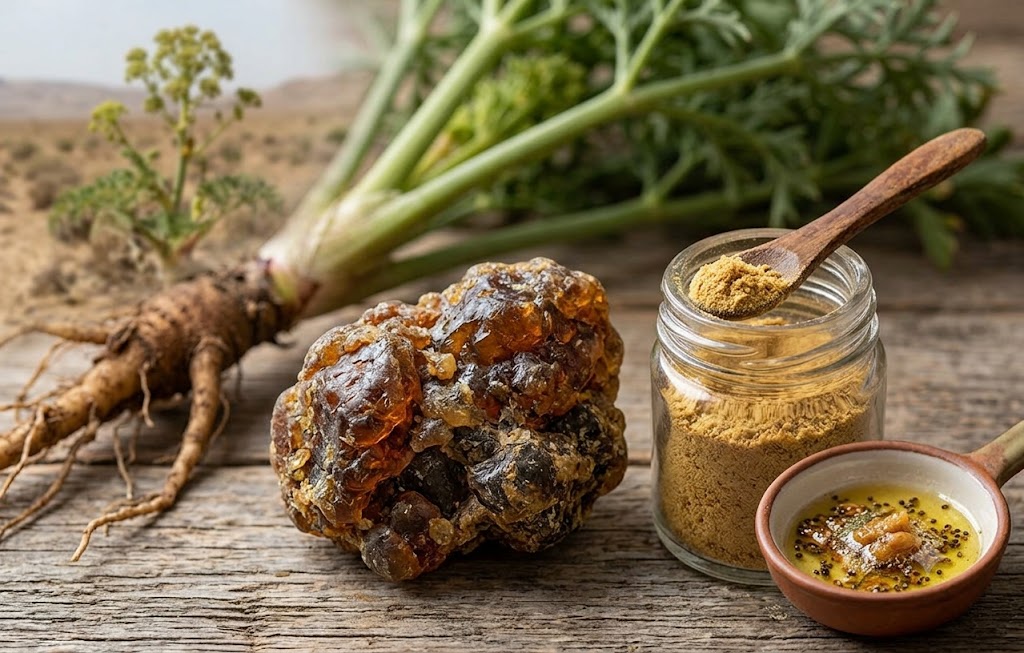
The part used as a spice is a dried oleo-gum-resin collected from the plant’s underground rhizome and thickened root.
The plant has traditionally been associated with regions stretching from the Mediterranean to Central Asia. For India, Afghanistan and Iran have historically been major sources of asafoetida.
So that little bottle in your kitchen has quite a journey behind it.
REAL HING DOESN’T START AS A YELLOW POWDER
This may surprise many of us.
The asafoetida we commonly buy is usually a powder. But the raw spice can be found as resinous lumps, tears or masses.
Its natural colour can also vary. Depending on the variety and material, asafoetida may appear pale, yellowish, reddish or dark.
And the smell?
Very strong.
Spices Board describes asafoetida as having a pungent odour linked to sulphur compounds. That powerful smell is one reason pure asafoetida is not normally used in the same convenient form as the powder sitting in our spice boxes.
SO WHY IS OUR HING USUALLY A MIXTURE?
This is where the word “compounded” becomes important.
FSSAI recognises compounded asafoetida, also known as Bandhani Hing, as a product made using one or more varieties of asafoetida along with ingredients such as gum arabic, edible starches or edible cereal flour.
In simple words, the concentrated resin is formulated into a product that is easier to handle, measure and use in everyday cooking.
So seeing words like “compounded asafoetida” on a packet does not automatically mean the hing is fake.
It means you are looking at a different, recognised food product.
BUT THERE IS A BIG DIFFERENCE BETWEEN COMPOUNDED AND ADULTERATED
This is the part consumers should remember.
FSSAI has separate requirements for asafoetida and compounded asafoetida. For asafoetida, the standard sets limits including a maximum 1% starch. Compounded asafoetida is allowed to contain edible starches or cereal flour as part of its formulation, while also having to meet specified quality requirements.
So the presence of starch or flour in a compounded product is not, by itself, proof of adulteration.
The better habit is simple:
Read the label. Check the ingredients. Buy a properly labelled product that meets the applicable food standards.
FSSAI’s labelling rules have also required compounded asafoetida containers to indicate the approximate composition of edible starch or edible cereal flour used in the compound.
WHY DOES HING SMELL SO DIFFERENT AFTER COOKING?
This is perhaps the most fascinating part.
Raw asafoetida can smell almost too strong. But add a tiny amount to hot oil or ghee and let it cook for a moment.
That sharp smell changes.
It becomes warmer, deeper and much more familiar.
Suddenly, you understand why Indian cooks don’t reach for a spoonful.
They reach for a pinch.
Hing is not a spice you need in quantity. It is a spice you need to respect.
CAN YOU TEST PURE HING AT HOME?
Be careful with those internet tricks.
Colour alone cannot tell you whether hing is genuine. Smell alone cannot prove purity either. A product’s formulation and concentration can affect both.
And if someone tells you that burning hing, mixing it with water or performing another kitchen experiment can definitively prove its purity, take that claim with caution.
Food authenticity is ultimately a testing question, not a magic trick.
FSSAI even has laboratory methods for checking asafoetida for things such as foreign resins.
So the next time you open that little hing container, remember what you are actually holding.
Not just a powder.
But a spice that begins with the resin of an underground root, travels through an old international trade route, gets carefully processed and formulated, and finally reaches an Indian kitchen.
And then, with one tiny pinch, it changes the personality of an entire dish.
From a fierce-smelling resin to the familiar aroma of dal and tadka, hing has travelled a surprisingly long way.
Maybe that is why the smallest things in our kitchen sometimes have the biggest stories.
Subscribe Deshwale on YouTube


