




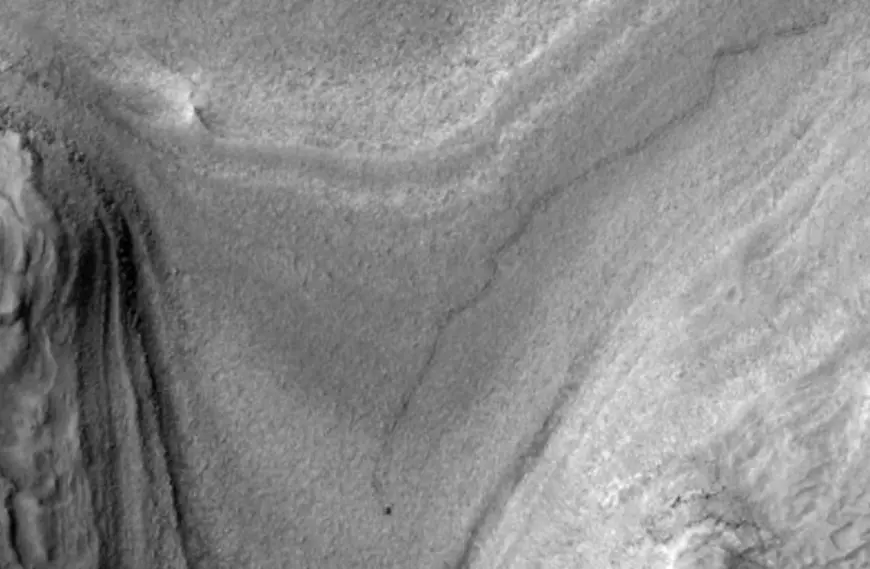
Imagine looking down from space and spotting a tiny robot doing its job on another planet. Sounds like sci-fi, right? Well, NASA just made it real. For the first time ever, the space agency has captured an image of its Perseverance rover from orbit, and it is mind blowing.
Wait, How did they even do that?
NASA’s Mars Reconnaissance Orbiter (MRO) has been circling the Red Planet for years, snapping high resolution pics with its HiRISE camera. But catching a moving rover? That is tricky. The MRO had to zoom in at just the right moment while flying over Jezero Crater, where Perseverance is busy hunting for ancient Martian life.
And guess what? The rover is not alone. The pic also shows its little helicopter buddy, Ingenuity, parked nearby. Talk about a family photo!
Why this pic is a big deal
This is not just a cool space selfie. It is proof of how precise space tech has become. The HiRISE camera captured Perseverance mid mission, with its tracks visible in the Martian dust. Scientists can use these images to track the rover’s path, plan future routes, and even spot interesting rocks from above.
Plus, it is a rare ‘hello’ from orbit. Normally, we see Mars rovers through their own cameras. But this? This is like a satellite waving at its ground based pal.
What is perseverance up to?
While NASA’s orbiter was playing paparazzi, Perseverance was doing what it does best: science. The rover’s digging up soil samples, scanning rocks, and storing them for a future mission to bring back to Earth. Yep, we might get actual pieces of Mars in our labs someday.
And Ingenuity? The tiny chopper, originally meant for just five test flights, has now done dozens. It is basically the little engine that could, scouting ahead and helping Perseverance avoid Martian potholes.
What is next?
More epic pics, hopefully. With tech this sharp, NASA might grab more rover snapshots from space. And who knows? Maybe one day, we will see astronauts waving back from the Martian surface.
For now, this image is a reminder humans have robots on another planet, and we are watching them from space.
