




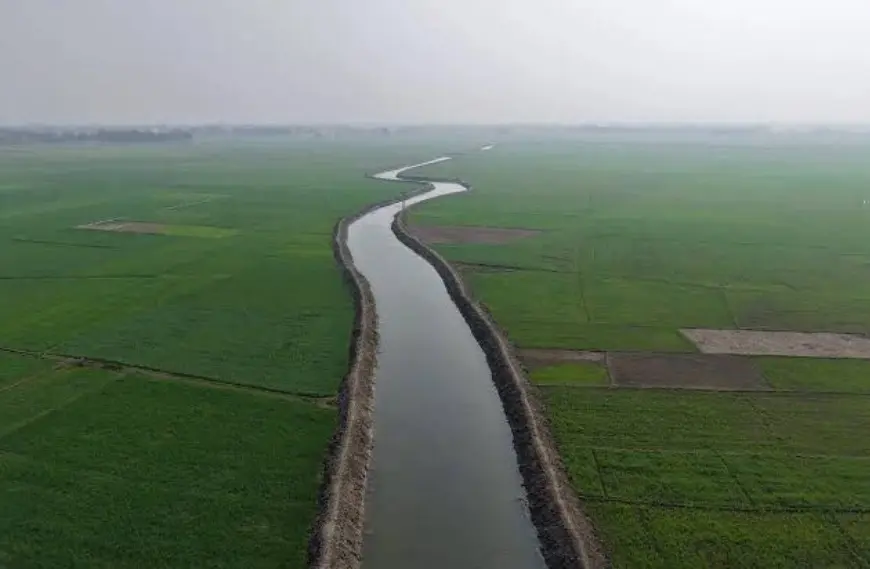
In Varanasi, a river that had once disappeared from the landscape is now making a remarkable comeback. The Matuka River, which had dried up over the years due to encroachments, neglect, and poor rainfall, is slowly reviving. The revival, now benefiting over 5,000 farmers in nearby villages, marks a significant achievement in water conservation for the region. Once again, water from the Matuka is flowing through fields, helping farmers irrigate their crops and recharge the groundwater table. The restoration work, carried out by the district administration and local gram panchayats, has not only brought this vital water source back to life but has also breathed new hope into the agrarian economy of Varanasi’s Sewapuri area.
A river rooted in history
Long before pipelines and treatment plants, the rivers of Varanasi shaped its very identity. The Varuna River, after which the city gets part of its name, holds a place not just on maps but in mythology, literature, and memory. Mentioned in the Vedas, the Varuna was once considered sacred, flowing from the east of the city into the Ganga. Along its banks rose ancient settlements, temples, and vibrant communities. It served not only as a water source but as a witness to the city’s spiritual and social evolution over thousands of years.
Once dotted with ghats and regularly used for religious rituals, the Varuna was where generations came to pray, bathe, and cremate their dead. In many ways, it mirrored the cultural heartbeat of Varanasi. But with urban sprawl, pollution, and neglect, the river’s voice was nearly lost, reduced to a drain in many stretches.
A Lifeline Returns to the Fields
Step just a few kilometres outside the city and you’ll find wheat swaying gently in fields that were barren not long ago. For farmers in villages near the Varuna, the river’s revival has been a quiet revolution. Years of dry canals and over-drilled groundwater had pushed many to the brink. But with treated water now flowing through the Varuna, irrigation has returned to places that had almost given up hope.
The change is visible, and deeply personal. Crops are thriving again. Tube wells are refilling. Farmers talk not of miracles, but of steady, real progress. One local summed it up simply: “If the river stays alive, so will we.”
From wastewater to water wisdom
What’s making this revival possible is not rain or dams. It’s innovation, and a shift in mindset. Every day, treated water from sewage plants is channelled into the Varuna. Instead of polluting the Ganga downstream, this filtered water now helps recharge the local ecosystem.
It’s a win for water conservation in a country that desperately needs more of them. The river’s flow has boosted groundwater levels, cooled nearby areas, and reduced pressure on borewells. In a landscape where most rivers are shrinking, this one is being restored, not with fanfare, but with foresight.
Rediscovering a river’s soul
But the Varuna is more than a water source. It’s part of the spiritual and cultural heartbeat of Varanasi. Mentioned in scriptures, remembered in songs, the river once hosted rituals, prayers, and childhood swims. For generations, it was a boundary, a guide, and a symbol.
As water returns, so does memory. Locals are clearing old ghats and pathways once buried under waste and overgrowth. Temples near its banks are seeing life again. Elders recall festivals by the water and speak of a time when the Varuna mattered. Now, that time is returning — and with it, a sense of pride.
Powered by people, not just policy
While government schemes laid the groundwork, it’s the people of Varanasi who’ve kept the momentum going. From school children planting trees to shopkeepers organising cleanup drives, the city’s residents have taken ownership of the river.
Change didn’t come overnight. It started with small groups picking up plastic, reporting sewage leaks, and encouraging others to do the same. Gradually, the river became a shared concern, and a shared achievement.
This community-led effort is a reminder: restoring the environment is not just about funding. It’s about belief. When locals defend a river, they protect more than a waterway, they protect their future.
Adapting to a changing climate
Climate change is not a far-off threat in this part of India. Droughts are longer. Rains are harder to predict. In this context, reviving a river is not just nice, it’s necessary.
The Varuna project helps the region adapt. By recharging aquifers and stabilising local temperatures, it offers resilience in uncertain times. It supports biodiversity, reduces erosion, and gives farmers a buffer against extreme weather. These may not be headline-grabbing wins, but they matter, deeply and urgently.
Reconnecting with identity
In many ways, the Varuna’s revival is about reconnection, with land, with history, with each other. For younger generations, it’s a chance to see the river their grandparents once crossed on foot during harvest season. For the elderly, it’s a homecoming.
Watching a dry stretch slowly turn into a flowing stream is not just environmental progress. It’s emotional. It’s like watching a city remember who it is.
The flow of hope
What’s happening in Varanasi is a story of restoration, not just of a river, but of culture, community, and confidence. It shows that saving a river doesn’t have to be about grand engineering. Sometimes, it’s about small steps taken together, cleaning a ghat, clearing a path, trusting the water will return.
And when it does, it brings more than life to the fields. It brings a city back to itself.
