



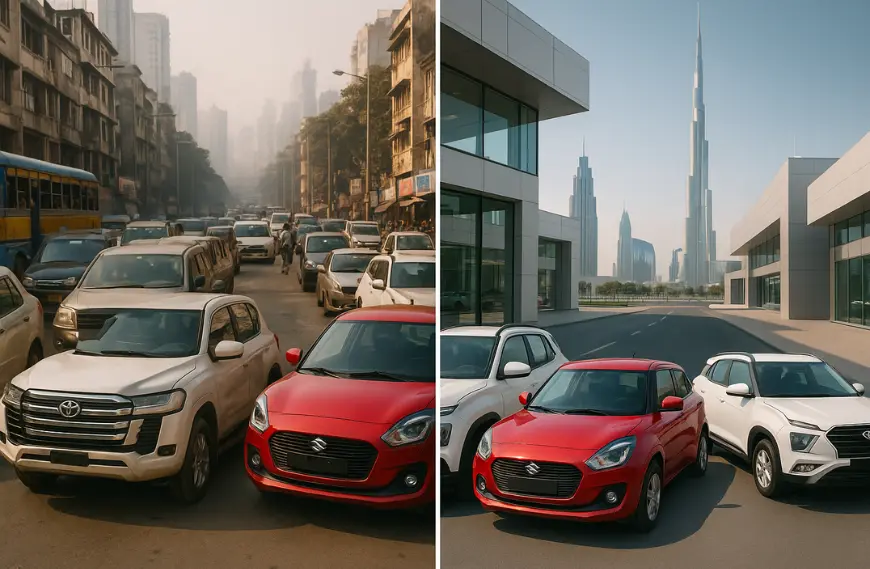
Picture this: you are standing in a gleaming showroom in Mumbai, eyeing a Toyota Land Cruiser that costs a cool ₹2 crore. Your heart races, but so does your wallet’s panic. Now, imagine the same car in Dubai, where it is yours for just ₹30 lakh less than a fifth of the price. Or consider a BMW X5, a ₹1 crore dream in Delhi, but a mere ₹55 lakh in the US. For Indian car buyers, these price gaps are not just numbers; they’re a gut punch, a reminder of a global divide that makes owning a car luxury or ordinary feel like a privilege reserved for others. This is the story of why cars cost what they do, how they shape dreams, and what it means for the Indian buyer, told through the voices of enthusiasts, experts, and everyday drivers.
The Indian dream: Cars as status and struggle
In India, a car is more than transport, it is a symbol of success, a milestone for families, and, for some, a lifelong aspiration. For 28 year old software engineer Arjun Mehra from Bengaluru, saving for a Maruti Suzuki Swift was a two-year journey. “I paid ₹8 lakh for my Swift in 2024. It is my first car, my pride,” he says, grinning. “But when I heard it costs half that in Dubai, I felt cheated.” Arjun’s story echoes across India, where high taxes and import duties inflate car prices, making even modest hatchbacks a stretch for the middle class.
Luxury cars, meanwhile, are in a league of their own. Take the Toyota Land Cruiser, a favorite among India’s elite. Priced at ₹2.31-2.41 crore in 2025, it is a status symbol for Bollywood stars and business tycoons. Investment banker Sarthak Ahuja, who analyzed luxury car prices, was stunned by the disparity. “A ₹2 crore Land Cruiser in India is just ₹30 lakh in Dubai,” he told *Business Today* in 2025. “It’s the same car, same engine, same everything. The difference? Taxes.” Similarly, the BMW X5, starting at ₹97 lakh in India, retails for $65,000 (₹55 lakh) in the US. “It’s not just about money,” Ahuja adds. “It’s about feeling exploited.”
Why the price gap? taxes, duties, and more
India’s car prices are a cocktail of high taxes, import duties, and local regulations. Fully imported cars (Completely Built Units, or CBUs) face customs duties of 60-100%, plus a 28% GST and additional cess, pushing prices skyward. For example, a Land Cruiser imported to India incurs duties that nearly double its base cost. Locally assembled cars, like the BMW X5, fare better but still carry GST and state taxes. Compare this to Dubai, where import duties are a mere 5%, or the US, where duties range from 2.5-25%, and the math becomes painfully clear.
“Duties in India are designed to protect local manufacturing,” explains automotive analyst Priya Sharma. “But they hit luxury buyers hardest because those cars are often imported.” Even mass-market cars like the Maruti Suzuki Swift face GST and road taxes, which add 30-40% to the base price. In contrast, Dubai’s tax-free environment and bulk ordering keep prices low. “A Hyundai Creta, ₹11-20 lakh in India, is about ₹7-10 lakh in Dubai,” Sharma notes. “It’s no wonder NRIs buy cars abroad.”
Global snapshots: How other countries fare
To understand India’s plight, let us travel the globe. In Dubai, a tax haven, cars are a bargain. A Toyota Corolla, ₹15-18 lakh in India, costs ₹10-12 lakh. Luxury models like the Range Rover Sport, ₹2 crore in India, drop to ₹80 lakh. “Dubai’s low duties and high demand mean dealers can negotiate,” says expat dealer Vikram Singh. The US, with moderate duties, is similar. A Honda Civic, ₹18-22 lakh in India, starts at $25,000 (₹21 lakh). Luxury SUVs like the Mercedes-Benz GLE, ₹1.12 crore in India, are $62,000 (₹52 lakh).
Europe, however, is less forgiving. High VAT (20-25%) and emission taxes push prices closer to India’s. A BMW 3 Series, ₹71.5 lakh in India, is €60,000 (₹55 lakh) in Germany, though it often includes premium features like air suspension absent in Indian models. “Indian variants are stripped down to cut costs,” laments @CarLoverIndia. “We pay more for less.”
The Indian buyer’s dilemma: Buy or Wait?
For Indian buyers, the price gap poses tough choices. Some, like Arjun, settle for what’s affordable locally. Others, like NRI businessman Vikrant Patel, buy abroad. “I got a Land Cruiser in Dubai for ₹35 lakh and shipped it to India,” he says. “Even with duties, I saved ₹50 lakh.” But importing isn’t always practical. India’s homologation rules and taxes can erase savings.
Enthusiasts dream of policy changes. “If duties dropped to 20%, luxury cars would be 30-40% cheaper,” says Sharma. “But it is unlikely. The government wants to boost ‘Make in India’.” For now, buyers rely on financing or wait for local production. BMW’s Chennai plant, for instance, keeps the X5’s price below ₹1 crore, a rare win.
A road ahead: Hope amid the divide
Despite the frustration, there’s hope. India’s growing middle class and booming SUV market 129 models in 2025, per CarDekho are pushing brands to localize production. Maruti Suzuki’s ₹8-20 lakh range and Hyundai’s ₹11-25 lakh SUVs dominate, offering value if not Dubai-level prices. Electric vehicles, like the Tata Nexon EV (₹14-20 lakh), promise lower running costs, though import duties keep premium EVs like the BMW iX (₹1.01 crore) out of reach.
For Indian buyers, cars remain a journey of aspiration. As Arjun puts it, “My Swift isn’t just a car; it’s my freedom. Maybe one day, I’ll afford a BMW X5-here or in Dubai.” Until then, the price divide is a reminder of a world where dreams come with a hefty tax.
Price comparison chart: Luxury and ordinary cars (2025)
Luxury cars
| Car Model | India (₹) | Dubai (₹) | US (₹) | Germany (₹) |
| Toyota Land Cruiser | 2.31–2.41 Cr | 30–50 Lakh | 80–90 Lakh | 90 Lakh–1 Cr |
| BMW X5 | 97 L–1.11 Cr | 50–60 Lakh | 55 Lakh | 60–70 Lakh |
| Mercedes-Benz GLE | 1.11–1.16 Cr | 60–70 Lakh | 52 Lakh | 65–75 Lakh |
| Range Rover Sport | 2–2.4 Cr | 80 Lakh | 85 Lakh | 90 Lakh–1 Cr |
| BMW 3 Series | 71.5 Lakh | 40–45 Lakh | 38 Lakh | 55 Lakh |
Ordinary cars
| Car Model | India (₹) | Dubai (₹) | US (₹) | Germany (₹) |
| Maruti Suzuki Swift | 8–10 Lakh | 4–5 Lakh | 12 Lakh | 15–18 Lakh |
| Hyundai Creta | 11–20 Lakh | 7–10 Lakh | 20 Lakh | 22–25 Lakh |
| Tata Nexon | 8–15 Lakh | 5–7 Lakh | N/A | N/A |
| Toyota Corolla | 15–18 Lakh | 10–12 Lakh | 18 Lakh | 20–22 Lakh |
| Honda Civic | 18–22 Lakh | 12–14 Lakh | 21 Lakh | 25–28 Lakh |
