



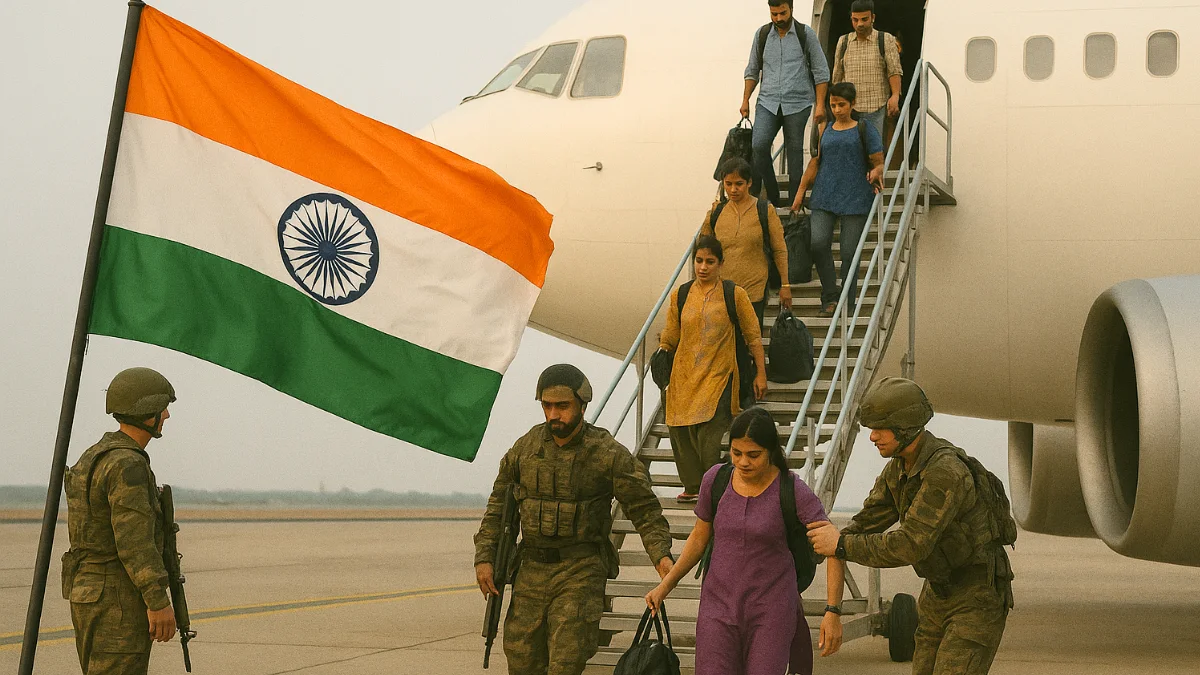
When the world turns uncertain, India stands firm – not just with words but with action. Whether it is war, disaster or a sudden crisis in a distant land, India has time and again proven that it never abandons its people. From deserts under siege to skies filled with conflict, Indian evacuation missions have become powerful symbols of courage, compassion and commitment. These operations are not just about flights and logistics; they are about families reunited, lives saved and a nation that refuses to leave its citizens behind, no matter how far they are from home.
First let’s understand the Evacuation, when danger strikes far from home – whether due to war, natural disaster, or civil unrest – governments often step in to bring their people back to safety. This process is known as civilian evacuation.
Civilian evacuation is the organised removal of non-combatants, mostly citizens, students, tourists, and professionals from dangerous zones. These areas may be war-hit, disaster-prone, or politically unstable. The main aim is to protect lives, especially when local conditions make survival or escape difficult.
Evacuations may involve aircraft, ships, or ground vehicles, depending on the region and threat level. Often, military and diplomatic efforts work together to safely navigate complex foreign environments.
Why is it Carried Out?
Evacuations happen when:
- A country descends into war or civil unrest.
- Natural disasters strike without warning.
- Terrorist attacks create unsafe environments.
- Epidemics or pandemics disrupt travel and daily life.
The purpose is not only humanitarian but also strategic. It reinforces the government’s duty to its citizens and showcases national strength, commitment, and global reach.
The Political Perspective
Evacuation missions are more than rescue operations; they’re a show of diplomacy and preparedness. They improve the government’s global image and strengthen trust among citizens. A well-executed evacuation can be seen as a sign of political maturity and international cooperation.
Countries like the United States, China, France, Israel, and Russia have also conducted high-scale civilian evacuations. These operations often involve complex coordination with foreign governments and display both military strength and logistical expertise.
India’s Major Civilian Evacuation Missions
India has emerged as a global example in this field. From Kuwait in 1990 to Iran in 2025, the Indian government has consistently acted to bring home its citizens in crisis.
Here are the most significant operations:
Kuwait Airlift (1990)
After Iraq invaded Kuwait, over 1,70,000 Indians were trapped in the war zone. In response, India conducted the largest civilian airlift in history, using Air India and other aircraft to bring them home. The mission earned a place in the Guinness Book of World Records and remains one of India’s most ambitious rescue efforts.
Operation Sukoon (2006)
As conflict broke out between Israel and Lebanon, India launched its first major naval rescue. Known as the ‘Beirut Sealift’, it evacuated 2,280 people, including nationals of Nepal and Sri Lanka. It became the largest naval evacuation since World War II’s Dunkirk.
Operation Safe Homecoming (2011)
When civil war erupted in Libya, India launched this mission to evacuate 15,400 citizens. Air India and Indian Navy ships played a key role in transporting people to safety.
Operation Maitri (2015)
Following the devastating Nepal earthquake, India acted swiftly to help its neighbour. The mission rescued over 5,000 Indians and also 170 foreign nationals. It also delivered medical and relief supplies, reinforcing India’s role as a responsible regional power.
Operation Raahat (2015)
As Yemen descended into chaos, India evacuated 5,600 people despite the country being under a no-fly zone. Indian Navy ships and Air Force aircraft navigated the danger zone to carry out the mission.
Operation Sankat Mochan (2016)
During the South Sudan civil war, Indian Air Force planes rescued citizens from Juba. This mission ensured the safe return of many Indians amid heavy fighting.
Brussels Evacuation (2016)
After deadly terrorist attacks in Brussels, 242 Indians, including 28 airline crew, were brought home safely by Jet Airways.
Operation Nistar (2018)
When Cyclone Mekunu hit Yemen’s Socotra Island, 38 stranded Indians were rescued by INS Sunayna. The mission highlighted India’s rapid disaster response capabilities.
Operation Samudra Setu (2020)
Part of India’s Covid-19 response, this naval mission brought home 3,992 Indians from countries like Maldives and Iran. Four Navy ships sailed over 23,000 km in 55 days, proving India’s maritime strength.
Vande Bharat Mission (2020–2021)
Launched during the Covid-19 pandemic, this was India’s largest peacetime repatriation. Over 60 lakh Indians returned from across the globe using Air India and other airlines in multiple phases.
Operation Devi Shakti (2021)
After the Taliban takeover of Afghanistan, India swiftly evacuated hundreds of its citizens and Afghan allies using Indian Air Force aircraft. The mission stood out for its timing and precision.
Operation Ganga (2022)
During the Russia–Ukraine war, thousands of Indian students were trapped. India launched Operation Ganga to bring them back safely. Buses, trains, and flights were used, often with the help of neighbouring countries like Poland and Hungary.
Operation Kaveri (2023)
The civil war in Sudan left over 3,000 Indians stranded. India evacuated them using military and commercial aircraft, showcasing its deep coordination and response under pressure.
Operation Sindhu (2025)
India’s latest evacuation effort, Operation Sindhu, was launched in response to the escalating conflict between Iran and Israel. As the situation worsened, India acted swiftly to evacuate nearly 2,500 – 3,000 Indian citizens, including students and professionals. With the operation now nearing completion, a few final flights are scheduled to bring back those still stranded. This mission once again highlights India’s unwavering commitment to the safety and well-being of its people, no matter where they are in the world.
Beyond Borders: India’s Humanitarian Missions
India’s role in international crisis response goes beyond evacuating its citizens. In times of natural disasters or refugee crises, India has stepped up to offer help to others as well.
- Operation Insaniyat (2017): As thousands of Rohingya refugees fled Myanmar into Bangladesh, India sent food, medicine, and basic supplies to assist in the humanitarian crisis.
- Operation Dost (2023): When a devastating earthquake hit Turkey and Syria, India rushed in search and rescue teams, medical aid, and relief materials, offering a helping hand to two nations in grief.
- Operation Maitri (2015): In addition to evacuating Indians from Nepal, India extended medical help and logistics support to the people of Nepal during their darkest hour.
These missions reflect not just India’s logistical ability, but also its compassion. In a world shaken by violence and disasters, such actions remind us of the human values that bind us together.
India’s civilian evacuation missions are not just rescue operations – they are acts of commitment, diplomacy, and technical skill. These efforts save lives, strengthen global partnerships, and build trust in the government’s ability to act fast and effectively.
From the deserts of Kuwait to the war zones of Sudan and Ukraine, and from the earthquake-hit regions of Nepal to the shores of Iran, India has shown that wherever an Indian is stranded, the nation will answer their call.
But more than that, India has proven something greater: in moments of crisis, humanity matters most.
