



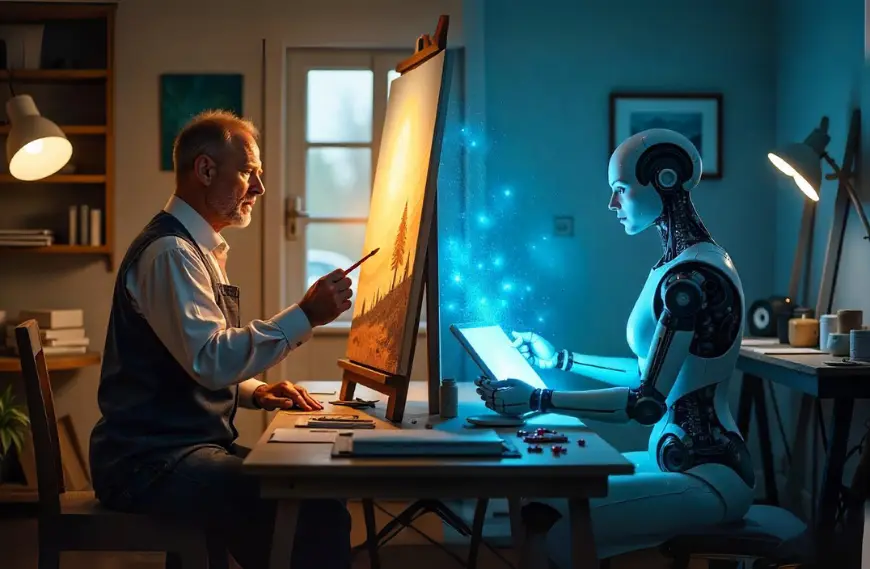
A painting glows onscreen. Vibrant, surreal, flawless. Created not by a brush, but by code. AI tools like DALL-E 4 and Midjourney churn out art in seconds. Galleries display AI works. NFTs sell for millions. But artists cry foul. Their styles, scraped without consent, fuel these algorithms. Is AI art a creative leap or a digital heist? This is the battle for art’s soul.
The AI Art Boom
AI art exploded in 2024. Midjourney’s user base hit 20 million. DALL-E 4 generates photorealistic portraits from text prompts. “It’s like magic,” says tech enthusiast Arjun Patel. Galleries in London and Dubai showcase AI works. An AI-generated piece, Cosmic Dream, fetched $1.2 million at auction. Brands use AI for ads, saving millions. The future feels here.
But there’s a shadow. AI models train on vast datasets, billions of images scraped from the web. Artists like Priya Sharma, a Mumbai illustrator, see their work mimicked. “AI can mimic my style, but it can’t feel what I feel,” she says. A 2025 lawsuit against Stability AI alleges theft. On X, #StopAIArt trends, with creators demanding justice.
The Ethical Quandary
The core issue: consent. AI companies scrape public art without permission. DeviantArt and ArtStation report 80% of their images used in datasets. Artists lose control, income, identity. “It’s exploitation,” Priya argues. Yet, AI defenders see progress. “This is just a new tool, like Photoshop,” says coder Liam Chen. The debate splits the art world.
Legally, it’s murky. Copyright law lags behind tech. A 2025 US ruling deemed AI art “non-human,” denying it copyright. But what about the human art it’s built on? Fair use is debated fiercely. In Europe, GDPR offers some protection, but enforcement is weak. Artists feel powerless, their work a ghost in the machine.
Cultural Shifts
AI art reshapes culture. Galleries mix human and AI works, blurring lines. Collectors chase novelty, NFTs thrive on blockchain hype. But traditional artists struggle. In India, muralists lose ad contracts to AI. “My craft is dying,” Priya laments. Yet, some embrace AI, blending it with human touch. Hybrid art festivals pop up in Berlin, Seoul.
On X, opinions clash. Artists post #AIArtIsTheft, sharing copied works. Tech fans counter with #AIArtIsArt, showcasing stunning creations. The public is torn, 60% admire AI art’s beauty, per a 2025 YouGov poll, but 55% say it’s unethical. Creativity’s definition is at stake.
Human Impact
Priya’s story is telling. Her vibrant illustrations, once viral, now compete with AI knockoffs. “Clients want cheaper, faster,” she says. In London, painter Tom loses commissions. But others adapt. Seoul’s Hana uses AI to sketch drafts, then paints by hand. “It’s a tool, not my soul,” she says. The divide grows, adapt or be left behind.
Communities form. Artists’ unions in the US push for data transparency. Online collectives, like #ArtistsAgainstAI, rally on X. Techies, meanwhile, build open-source AI tools, democratizing access. The fight isn’t just about art, it’s about power, ownership, and what it means to create.
The Future of Creativity
Where next? Regulation is key. The EU drafts AI ethics laws for 2026. Artists demand “opt-in” data policies. Tech firms resist, citing innovation. Solutions emerge, blockchain to track art origins, or AI watermarks for transparency. But change is slow. “We need to redefine creativity,” Priya says. “Or lose it.”
AI art is here to stay. It’s a tool, a mirror, a thief. It forces us to ask: what is art? A human heart? A coded prompt? The answer shapes our future. For Priya, Tom, Hana, it’s personal. For the world, it’s existential.
