




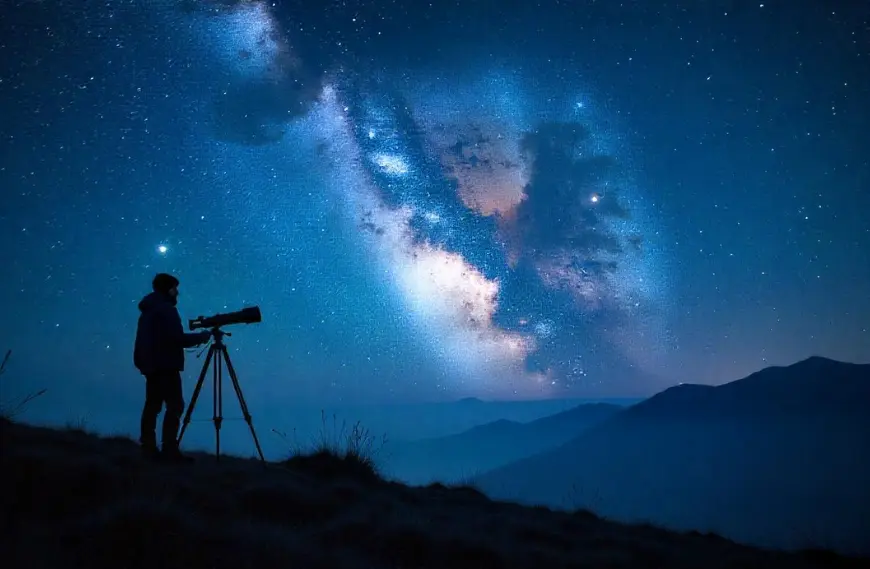
Twinkling dots. Endless pinpricks of light. The night sky hosts more stars than we can ever count. Yet humans have tried. We have gazed. We have tallied. We have calculated. And still the numbers stagger the mind.
On a clear night away from city lights, you might see up to two to three thousand stars with the naked eye from your location. Across the entire sky, about six thousand are visible without a telescope. At a dark-sky reserve, the view improves. Stick your eye to a modern telescope and you unlock millions more. But even telescopes have limits. Their fields of view are small. They glimpse only narrow patches.
So how do astronomers count stars in the galaxy? They use sampling. Imagine a meadow filled with flowers. You take a small square metre plot. Count the blooms within. Then multiply by the meadow’s total area. The same principle applies. Astronomers count stars in a representative patch of sky. They adjust for the Milky Way’s disc thickness. They account for dust that obscures distant stars. Then, using these sample counts and corrections, they statistically extrapolate to estimate the galaxy’s total star count.
Most estimates put the Milky Way’s stellar population at between one hundred billion and four hundred billion stars. That’s 1 × 10^11 to 4 × 10^11. The range arises from uncertainties in how many dim, red dwarf stars lurk in the shadows. Red dwarfs are small. They burn dimly. They outnumber brighter stars. Yet they are hard to detect beyond a few dozen light-years.
“In many ways, red dwarfs are the dark matter of ordinary starlight,” says Dr Elisa Quintana of NASA’s Goddard Space Flight Center. “They dominate by number but evade easy counting.” By studying nearby red dwarfs and modelling their distribution, astronomers refine their estimates. Recent data from the Gaia mission has sharpened our census of these faint suns within a few hundred light-years.
From Our Galaxy to the Universe
But our galaxy is only one among perhaps two trillion in the observable universe. How many stars lie beyond the Milky Way? Astronomers again use sampling, this time on deep-field images. In 1995, the Hubble Space Telescope trained its eye on what appeared to be a blank patch of sky. It imaged thousands of galaxies in a tiny region. The resulting Hubble Deep Field revealed that every speck, every dot, zas in fact a galaxy, each containing billions of stars.
Following that success, Hubble’s Ultra Deep Field drilled even deeper. It peered back some thirteen billion years. It showed galaxies as they were just a few hundred million years after the Big Bang. Each galaxy glowed with starlight. Yet counting individual stars in these distant beacons is impossible. Instead, astronomers measure the galaxy’s total brightness and infer its star count based on stellar population models.
Combining galaxy counts with average stellar counts per galaxy yields an estimate: around 10^22 to 10^24 stars in the observable universe. That is ten sextillion to one septillion stars. To express that in full: 10,000,000,000,000,000,000,000 stars at the low end. At the high end: 1,000,000,000,000,000,000,000,000 stars. Such numbers defy comprehension. Yet they emerge from thoughtful sampling and robust statistical methods.
Even these staggering figures may be underestimates. Many faint dwarf galaxies escape detection. Many low-luminosity stars and brown dwarfs remain hidden. Brown dwarfs are substellar objects with insufficient mass to sustain hydrogen fusion like true stars. They glow dimly in infrared. Only infrared surveys can spot them. Missions like WISE (Wide-field Infrared Survey Explorer) have found thousands, but many more likely lurk undiscovered.
So when you look up on a clear night, remember: you see a mere handful of stars. Perhaps three thousand at best. Yet beyond your sight lie billions more in our galaxy. Beyond that, trillions upon trillions across the deep cosmos. And many of these stars, as we’ve now discovered, do host planet, worlds orbiting alien suns.
Counting stars teaches us about our place in the universe. It reveals the vastness of creation. It shows us how small we are. And yet how remarkable: our minds can grasp these oceans of light through clever methods and patient observation.
Next time you step outside after dark, pause. Let your eyes adjust. Take in the Milky Way’s milky band. Remember the billions of suns behind that glow. Think of Hubble reaching across thirteen billion years to glimpse infant galaxies. Picture the infinite tapestry of stars that stretches beyond the horizon of the observable universe.
We may never name each star. We may never catalog them all. But we can count their numbers. We can measure their light. We can map their distribution. And in doing so, we connect with something grand. We touch the vastness. We honour the stars that light our night. We affirm our yearning to know.
