




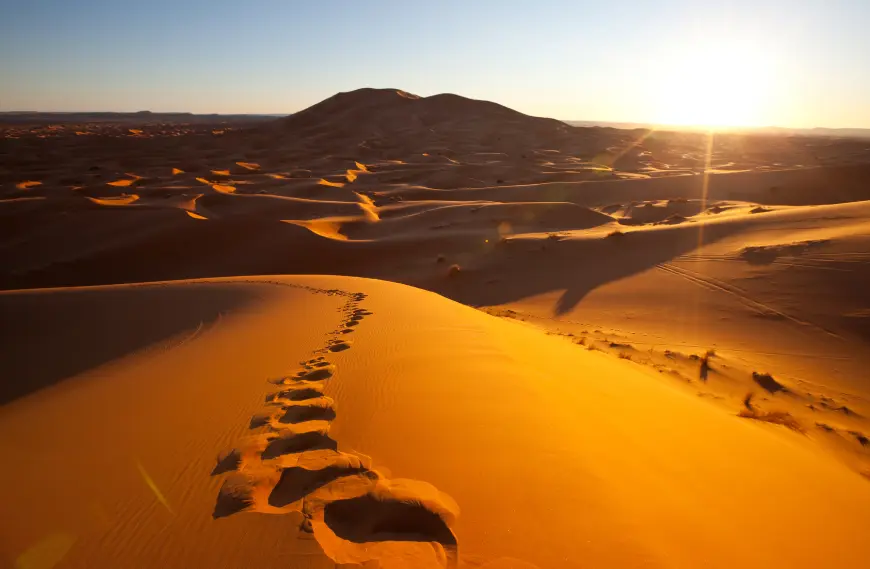
Deserts aren’t just places of harsh beauty — they are vaults of time, hiding secrets from Earth’s deep past and humanity’s lost chapters. Beneath shifting sands lie fossils of giant beasts, forgotten empires, and clues to vanished climates.
Fossils Frozen in Time
Deserts are prime fossil grounds because arid conditions often slow decay. In Egypt’s Wadi Al-Hitan (Valley of the Whales), skeletons of ancient whales lie exposed, proving this desert was once a shallow sea.
The Gobi Desert’s Flaming Cliffs have yielded Velociraptor skeletons and the first dinosaur eggs discovered by paleontologists, revolutionising our understanding of dinosaur reproduction.
Lost Civilisations
Beneath the Sahara, satellite imagery reveals ancient river channels and roads that once connected trading cities. Archaeologists have found remnants of towns along old caravan routes, showing the Sahara was once a hub of commerce.
In Central Asia’s Taklamakan Desert, explorers uncovered well-preserved mummies with European features, evidence of ancient Silk Road cultures that blended East and West.
The Power of Shifting Sands
Moving dunes can cover or uncover ruins. In Libya, parts of the Roman city of Leptis Magna were protected by sand drifts for centuries, preserving mosaics and columns that remain breathtaking today.
The sands of Saudi Arabia’s Rub’ al Khali (Empty Quarter) are rumoured to hide the lost city of Ubar, sometimes called “Atlantis of the Sands,” though its exact location and nature remain debated.
Clues to Past Climates
Deserts contain ancient lakebeds, petrified forests, and fossils of creatures that once thrived in wetter times. These archives show how regions like the Sahara oscillated between green savannah and desert due to shifts in Earth’s orbit.
As archaeologist Dr. David Mattingly said: “The desert is not timeless emptiness; it is a restless archive, preserving moments of lost worlds for those who know how to read its sands.”
