



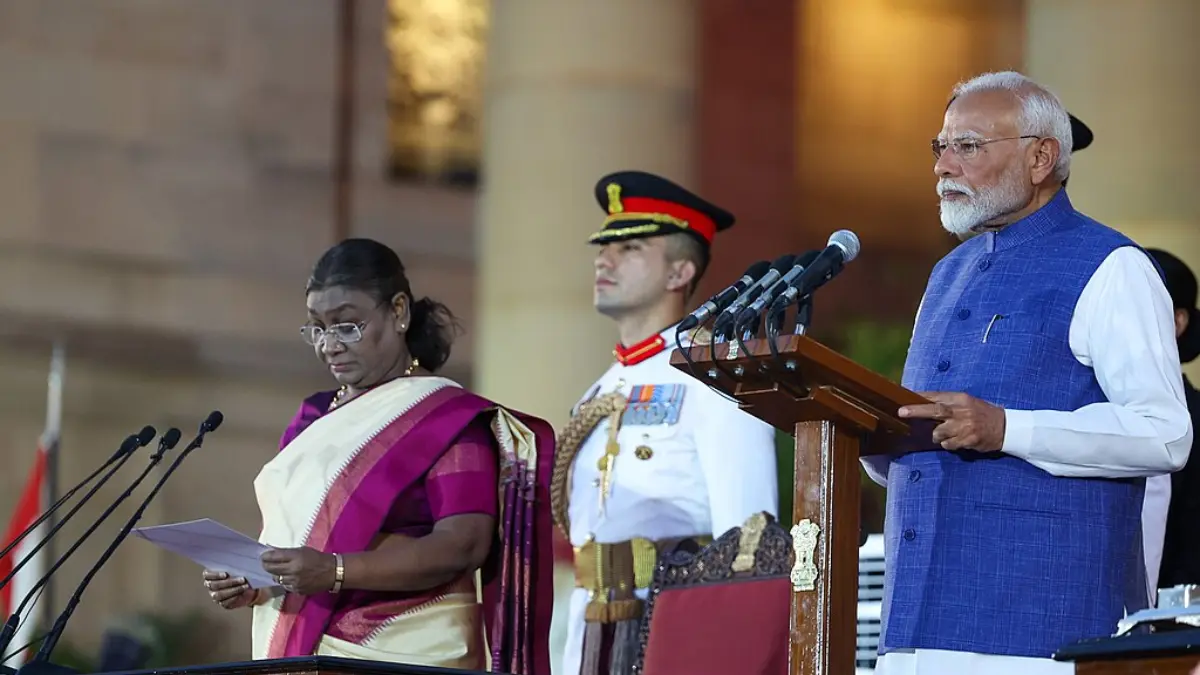
Narendra Modi has officially become the second-longest serving Prime Minister in India’s history, completing 4,078 uninterrupted days in office as of 25 July 2025. With this, he has overtaken Indira Gandhi’s record of 4,077 days of continuous service. Only Jawaharlal Nehru, India’s first PM, has served longer without a break.
But this milestone is not just about time in office. It reflects a powerful personal and political journey, one that started in the small lanes of Gujarat and now stands at the heart of India’s leadership.
Humble Beginnings in Vadnagar
Narendra Modi was born on 17 September 1950 in Vadnagar, a town in present-day Gujarat. His family belonged to a modest background. In his early years, he helped his father sell tea at a railway station and later ran a tea stall with his brother. These years instilled in him a strong work ethic and grounded understanding of daily struggles.
He completed his schooling in Vadnagar in 1967. Teachers described him as an average student, but he stood out as a gifted debater with a flair for theatre and performance. He often took on powerful, larger-than-life roles in school plays, an experience that would later shape his commanding public persona.
Education and Academic Path
In 1978, Modi received a Bachelor of Arts (BA) degree in political science from the School of Open Learning at Delhi University. In 1983, he earned a Master of Arts (MA) degree in political science from Gujarat University as an external distance learning student, graduating with a first class. However, both degrees have been the subject of controversy, with questions raised about their authenticity. Despite public debate, Modi has stood by the legitimacy of his academic records.
Political Roots and Rise in BJP
Modi’s political journey began in his teens when he joined the Rashtriya Swayamsevak Sangh (RSS). Through his RSS work, he gained organisational skills and ideological training, which helped him enter mainstream politics.
In the 1980s, he officially joined the Bharatiya Janata Party (BJP). Initially working behind the scenes, Modi played a crucial role in building the party’s support base across Gujarat and later, other states. His dedication eventually earned him a key leadership position in the party.
In 2001, he was appointed as the Chief Minister of Gujarat following a leadership crisis. Many doubted his lack of administrative experience, but Modi quickly silenced critics by focusing on development, industrial growth, and infrastructure. He went on to win three consecutive state elections in 2002, 2007, and 2012.
Three Consecutive National Victories
In 2013, the BJP named Modi as its Prime Ministerial candidate for the 2014 Lok Sabha elections. He led the party to a massive victory, securing a clear majority. This was the first time in 30 years that a single party had done so.
He repeated this success in 2019 and again in 2024, becoming the first non-Congress Prime Minister to win three straight terms. His consistent success reflects not only his personal popularity but also the strong support for his brand of governance and leadership.
Policy Milestones and National Impact
Modi’s long tenure has seen the launch of several major schemes and reforms. These include Swachh Bharat Abhiyan, Jan Dhan Yojana, Digital India, Ujjwala Yojana, and Ayushman Bharat. His economic and foreign policies have focused on digital infrastructure, self-reliance, and strong ties with both Western and Asian powers.
Controversial decisions such as abrogating Article 370, the Citizenship Amendment Act, and the construction of the Ram Mandir have drawn sharp reactions. Supporters call them historic corrections. Critics argue they challenge India’s secular framework. Regardless, these moves have shaped Modi’s image as a decisive and bold leader.
The 2024 Mandate and Coalition Politics
In the 2024 general elections, the BJP fell short of a full majority. Yet Modi managed to retain power with the help of NDA allies. While his mandate was smaller than before, his grip on power has remained strong.
Even within coalition dynamics, Modi continues to dominate public discourse, national policy direction, and international representation. His role as the face of Indian leadership remains unchanged.
Personal Style and Daily Discipline
Narendra Modi is known for his strict personal routine and image control. He begins his day early with yoga, avoids long holidays, and often works late into the night. This disciplined lifestyle is regularly projected as part of his public persona.
He maintains constant public communication through Mann Ki Baat, rallies, and social media. His oratory style, combining nationalism, tradition, and modern aspirations, has helped him remain popular across diverse voter bases.
Though he rarely discusses his personal life, Modi once publicly acknowledged that he was married in his teens. However, he chose a life of separation and public service. His family members have stayed out of politics, further strengthening his image as a leader focused on the nation over personal gain.
A Legacy Taking Shape
Narendra Modi’s record-breaking tenure has changed Indian politics. It has ended the long-standing dominance of the Congress in terms of uninterrupted leadership and ushered in a new era of personality-driven politics.
His critics remain vocal, and his policies remain debated. But there is little doubt that he has altered the way Indian democracy operates – making it more centralised, more media-savvy, and more personality-driven.
If he completes his current term, Modi will come close to breaking Jawaharlal Nehru’s all-time record. Whether or not he overtakes it, he has already secured a unique place in India’s political history as a leader who rose from the grassroots, stayed connected with the masses, and redefined the idea of leadership in modern India.
