




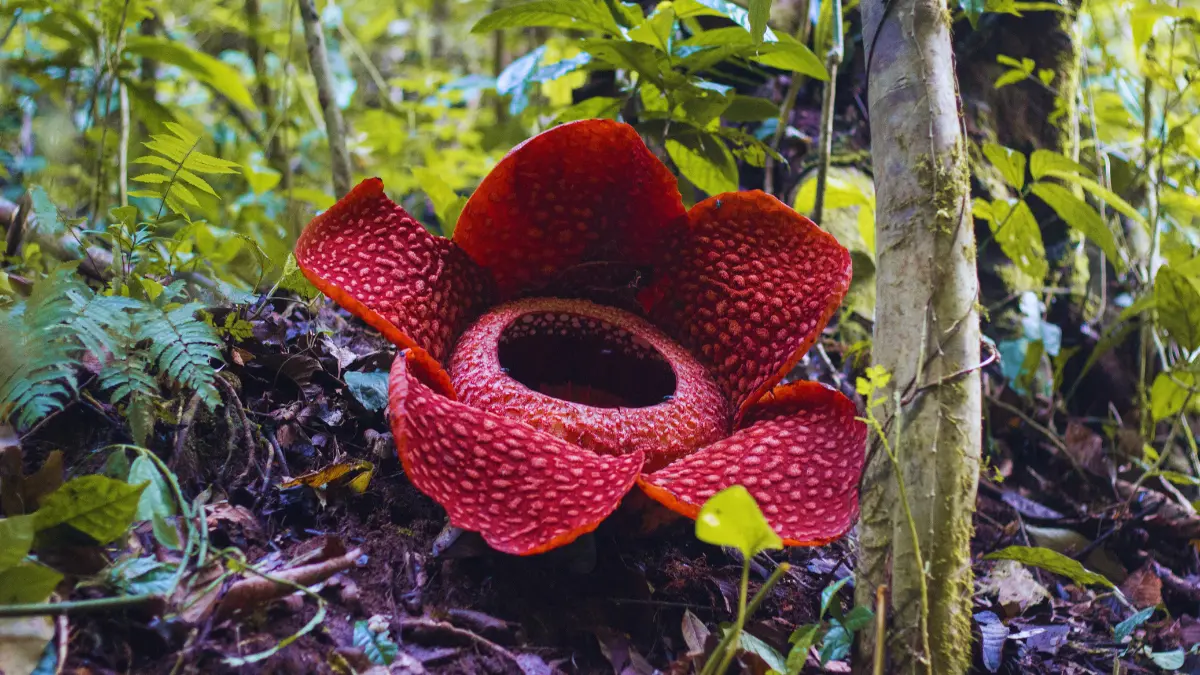
Hidden in the rain-soaked jungles of Sumatra and Borneo is a plant unlike any other. Rafflesia arnoldii, known as the corpse flower, is the world’s largest single bloom, stretching nearly a metre wide and weighing as much as a small dog. With no leaves, roots, or stems, it lives entirely as a parasite, emerging only briefly to unleash a gigantic, foul-smelling flower that lures unsuspecting insects.
A Parasitic Mystery
Rafflesia is a holoparasite. It lives entirely inside vines of the Tetrastigma genus, stealing nutrients. For most of its life, it stays hidden as microscopic threads inside the host.
When ready to bloom, it emerges as a bud that slowly swells. After months, it opens into a massive flower unlike anything else.
A Smell That Lures Flies
The flower emits a strong stench of rotting meat. This smell tricks carrion flies into thinking it is a dead animal. These flies help pollinate the plant.
Its reddish petals, speckled and flesh-like, add to the illusion. This strategy is key to its survival.
A Bloom That Fades Fast
The bloom lasts only 3 to 7 days. After this, it collapses into a dark, slimy mess. Its short life and remote habitat make it one of the rarest sights in nature.
Cultural Roots and History
Rafflesia was first recorded in 1818 by Joseph Arnold. It was named after him and Sir Stamford Raffles. In local folklore, some communities see it as mystical or sacred.
Role in the Rainforest
Though it is specialised, Rafflesia supports rainforest diversity. It attracts unique pollinators and plays a small but vital part in this ecosystem’s web of life.
Its odd biology has fascinated scientists exploring plant evolution and extreme adaptation.
Endangered and at Risk
Rafflesia is Endangered on the IUCN Red List. It faces major threats:
- Logging and palm oil farming destroy its habitat.
- Host vines decline due to forest fragmentation.
- Over-collection for tourism and research worsens its numbers.
Eco-tourism, when managed responsibly, can help protect both the flower and the local economy.
Why It Matters
Rafflesia defies our idea of what plants are. It is a rootless, leafless parasite that blooms giant flowers for a few short days.
Its survival is tied to rainforest health. If these forests vanish, so will one of nature’s strangest marvels.
