



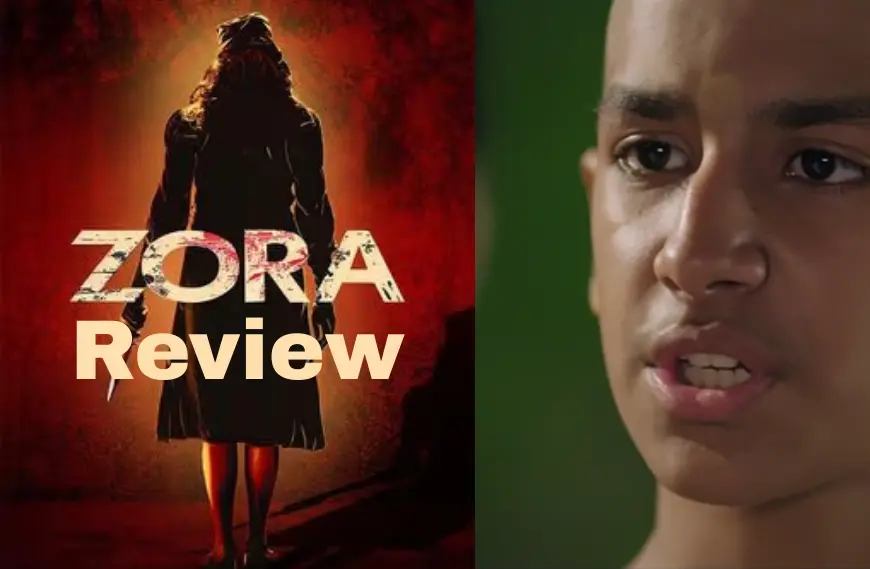
Rajiv Rai and, before him, his father Gulshan Rai, have both delivered some of Bollywood’s most gripping suspense thrillers. The list is long. Even during the promotions of Zora, the booklet handed out to the press proudly showcased a lineage of such illustrious films. From Johny Mera Naam (1970) to Gupt (1997), the cinematic legacy of this father-son duo is unforgettable. Rajiv Rai has been largely absent from Bollywood for over two decades. So when he re-emerged with Zora, naturally, there was excitement and expectation. But the moment Zora ended, one couldn’t help but wonder: why did he even make this film? When he clearly has the capability to deliver something far more powerful and entertaining—what happened here?
Zora is set entirely in the pink city of Jaipur and spans a timeline from 2003 to the present day. In Jaipur, we meet the honest cop, Virat Singh (Vikas Goswami), who is murdered brutally while exposing a fake stamp paper scam. The killer is a mysterious woman named Zora. Her face has either never been seen or, if seen, never lived to be described.
Today, Virat’s son Ranjit Singh (Ravinder Kuhar) is a police officer himself. While his father was a braveheart, Ranjit, in the eyes of his colleagues, is timid and ineffective. Officers like Iqbal Sheikh (Karan Veer) and Commissioner (Tarun Kumar Chauhan) consider Ranjit to be useless. Meanwhile, the city is plagued with crimes, but with a strange twist. Hardened criminals are being killed before the police can arrive at the scene. An unknown figure seems to be punishing them, leaving behind no trace, no clue, no mistake. Who is this vigilante delivering justice? And who is Zora, whose name still echoes across a series of crimes even two decades later?
In a suspense thriller, the most critical element is who the criminal is and how the crime was committed. In Zora, the central question is: who is this woman committing all these murders? And when that truth is finally revealed, when the suspense unfolds, there was potential for the audience to be left stunned. But that shock value only works if the storytelling up until that point has some strength. Perhaps during the early discussions of the film, this twist alone seemed powerful enough to justify making the movie. But so what? Nothing on screen eventually carries the weight it promises.
While the premise, at first glance and from what you have just read, may sound intriguing—Zora is riddled with flaws. Rather than listing them all, it’s important to understand why Zora turns out to be Rajiv Rai’s weakest film.
One, this film doesn’t feel like it belongs in 2025—not from any angle. In fact, regional filmmakers across India are currently producing far better films than this. Sadly, Zora feels so outdated it would struggle to stand even against the random, rushed Bhojpuri thrillers of the 1990s.
Two, from the story to the cast, the treatment to the background score—on every front, the film is shockingly underwhelming. If you are wondering whether this reviewer holds a grudge against Rajiv Rai—absolutely not. On the contrary, this writer adores Rai’s many films. Like Tridev, Vishwatma, Mohra (who can forget that shock—that blind Sandeep Jindal, the character so brilliantly portrayed by Naseeruddin Shah, could actually see?), and Gupt have rightfully earned him a place in audiences’ hearts. Which is exactly why Zora is so disappointing. When a filmmaker of this calibre delivers something so weak, it deserves serious scrutiny.
Three, in any kind of film, it’s the script that breathes life and dynamism into it. On that front, Zora is hopelessly poor. Written by Rai and Rasheed Rangrez, the script is full of so many faults that pointing them out becomes meaningless—because there’s hardly anything else but faults.
Four, the cast. There’s not a single recognisable face in the entire film. Lead or supporting, all the actors are virtually unknown. That alone isn’t a problem—many successful films have introduced new or lesser-known actors. The issue is that almost all of them here are either poor performers, or seem worse due to the weak script and sloppy filmmaking.
Five, the filmmaking itself is a serious problem. Reportedly made on a very tight budget (around ₹ 2 crore), the film constantly reveals its limitations. The lack of cinematic power is visible in every frame.
Six, Zora feels like it’s stuck 20–30 years in the past. That would be acceptable if the film had achieved its core objective—justifying the audience’s two-hour investment. But instead, the film remains locked in its own world, never truly breaking free. In the end, two parties suffer: the film itself and the audience.
Seven, the only song in the film (as well as the background score by Viju Shah) feels dated. Despite being sung by a popular singer like Palak Muchhal, the song doesn’t strike any chord emotionally. One wishes the music, like in Rai’s earlier films, had played a stronger role. Instead, the song here—clearly inspired by earlier hits like Tu Cheez Badi Hai Mast Mast—are strictly average.
Eight, direction—where is it? One honestly struggles to believe that Zora was directed by Rajiv Rai. Fans will find that hard to digest. Why wouldn’t they? Even Rai’s lesser works like Pyaar Ishq Aur Mohabbat or Asambhav had far more technical quality and emotional weight than this. There’s no comparison.
Let’s stop the list of shortcomings here. The bottom line is: Rajiv Rai can still make a brilliant, massy entertainer if he truly wishes to. He has the skill, the experience, the network, and the resources. He doesn’t need to make a subpar film. Put simply, the one decision he must make now is this—never again make a film like Zora.
Even though the film ends by announcing a sequel titled Zora Zorawar, one can only hope it turns out better. May God make it so.
Rating: *
