



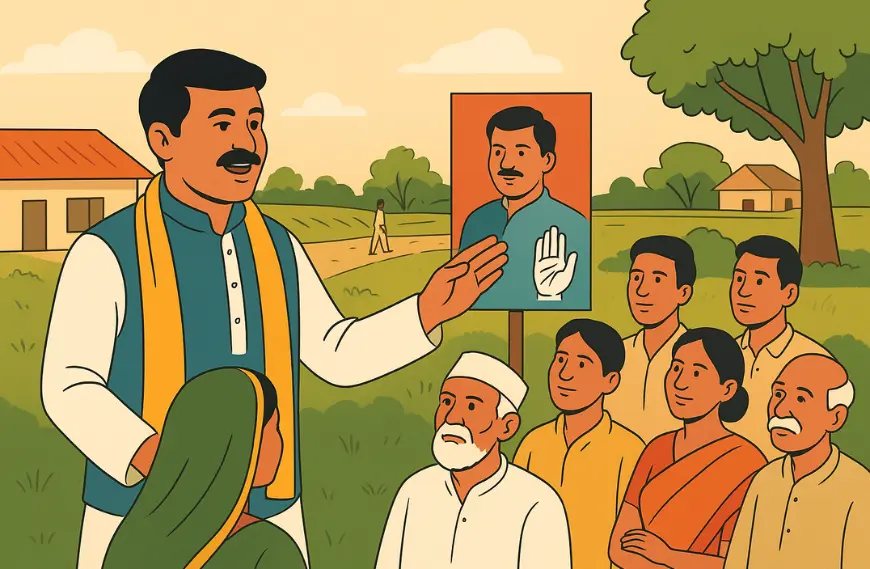
When elections arrive in India, television channels show us massive rallies, giant posters, and strong speeches by national leaders. From Delhi to state capitals, political parties try to project their big names as vote-winners.
But the reality in villages is very different. The final choice of voters is rarely based only on the faces they see on TV. Instead, it is the local leaders, the sarpanch, the mukhiya, the MLA candidate, or even the active party worker who carry real influence. In rural India, elections are not just about ideology or national promises. They are about relationships, trust, and everyday problems.
Villagers vote for the person they know
In rural India, politics is highly personal. Villagers don’t make decisions only by asking, “Who will run the country best?” Instead, they think, “Who stood with me when I needed help?”
For example:
- If a farmer’s field needed water, who actually spoke to the irrigation officer?
- If a family was stuck in a police matter, who came to the thana to help?
- When a marriage or funeral happened, who showed up, even for a few minutes?
In most cases, the answer is not the Prime Minister, not the Chief Minister, but the local neta who live among them. Villagers see this leader almost daily. That familiarity creates trust, and in politics, trust is everything.
Accessibility builds trust
Big leaders may visit villages only during election time perhaps once in five years for a rally. They come in helicopters, give a speech, wave, and leave. But local leaders are always accessible.
- They attend local festivals and fairs.
- They visit homes when someone is sick.
- They are present at weddings, small functions, and religious ceremonies.
- Villagers know they can knock on their door without hesitation.
This accessibility builds a direct human connection. A villager may never get a chance to speak directly to a national leader, but they can always approach the local leader. This constant presence makes villagers feel that this person is ‘ours’ and that bond cannot be replaced by a distant face on TV.
Social & Community ties
In many rural areas, caste, community, and kinship networks still play a very important role. A local leader from the same caste or community is often seen as “one of us.”
- People believe such a leader will naturally understand their struggles.
- They think he or she will represent their interest better in higher offices.
- Even if another candidate has a stronger party background, social identity often tips the balance.
For instance, in states like Bihar and UP, caste-based loyalty is often stronger than any promise made in national manifestos. This emotional connection is something that national leaders cannot easily build, because they are far removed from the village’s social fabric.
Big promises vs. Everyday needs
National leaders usually talk about big projects like highways, airports, bullet trains, and smart cities. These ideas sound impressive but feel distant to a villager whose main concerns are much simpler and immediate:
- Will my crops get insurance this year?
- Will the irrigation canal near my field finally get repaired?
- Will the village school get enough teachers?
- Will the health centre have a doctor and basic medicines?
Local leaders act as the bridge between these small needs and the government system. They:
- Follow up with officials.
- Explain schemes to villagers in simple language.
- Sometimes spend from their own pocket to solve urgent issues.
This practical, hands-on support is why villagers trust them more than distant national figures. For them, action today matters more than big promises for tomorrow.
Parties know the ground reality
Even national parties like BJP, Congress, or regional players know this truth very well. That’s why they invest months in selecting the right local candidate.
- A star campaigner or a big name may draw massive crowds at rallies.
- But if the local candidate is weak, arrogant, or disconnected from people, those crowds don’t turn into actual votes.
- On the other hand, a strong local leader with a reputation for accessibility can win, even if national leadership is less popular in that region.
This is why local ticket distribution is such a tense process within parties. Everyone understands that the local face is the key to victory.
Examples from across India
This trend is visible in almost every state:
- Bihar & UP: The mukhiya or MLA often has more influence than party slogans. Villagers vote for the person, not the party.
- Maharashtra: Cooperative leaders, especially those connected to sugar mills, can sway entire districts. Their influence is local but very strong.
- Northeast India: Tribal councils, church leaders, and student unions often shape results more than any national figure.
- Kerala: Local panchayat leaders play a vital role in guiding voters towards parties.
These examples show that across India, rural politics runs on ground-level relationships, not just high-level speeches.
It’s about People, not just politics
For villagers, voting is not an abstract choice between ideologies. It is a practical decision: ‘Whose door can I knock on when I am in trouble?’
This is why personal reputation matters more than political manifestos. A respected local leader may not have big money or posters, but their goodwill is their biggest campaign tool. Villagers reward this loyalty with votes.
National leaders may dominate newspapers, social media, and television. But in rural India, elections are decided in the mohallas, panchayat meetings, and village fields.
The true power lies with the local leaders, the ones who never forget their people, who attend their functions, who solve their problems, and who share their joys and sorrows.
In India’s democracy, the ballot is not just about choosing a government, but about choosing trust. And in villages, that trust almost always rests with the local neta.
