





In Mandya district of Karnataka, a quiet man has been doing something extraordinary for decades. His name is Anke Gowda, and people call him the Guardian of Knowledge. Why? Because he has built one of the largest private book collections in India. His library, known as Pustaka Mane or “House of Books,” holds close to two million books and periodicals.
It sounds almost unbelievable. One man, not a government or a rich institution, has gathered this mountain of wisdom. But it is true. And the story of how he did it is as inspiring as the library itself.
The Humble Beginnings
Gowda did not grow up surrounded by money or privilege. His parents were farmers in Haralahalli, a small village. Life was simple, and books were not easy to find. But from childhood, he was drawn to them. He bought whatever he could afford, even if it meant sacrificing small pleasures.
Later, he studied Kannada literature at university. That gave him not just academic grounding but also a sense of responsibility. He realised books are not just for reading and forgetting. They are voices from the past. They are guides for the future. Someone had to keep them safe. He decided that someone would be him.
Building Pustaka Mane
For years, Gowda worked as a time-keeper in a sugar factory. His job was modest, but his mission was not. He spent much of his salary on books. While others invested in land or houses, he invested in pages.
He travelled across towns, visited second-hand bookshops, picked up discarded titles from libraries, and even bought old magazines in bulk. Slowly, the collection grew. What started with a few shelves in his home turned into rooms full of books. Eventually, the sheer scale demanded a separate building. That building is today’s Pustaka Mane.
What the Library Holds
Walking into Pustaka Mane is like stepping into a universe of ideas. There are books in over 20 languages, from Kannada and Sanskrit to English and French. Shelves carry novels, science texts, history volumes, and children’s stories. There are rare editions of the Bhagavad Gita, piles of Gandhi-related works, and even decades-old magazines that capture the mood of India’s past.
The collection is not just vast but diverse. Gowda made sure to include both mainstream literature and regional voices. This makes the library a treasure chest for researchers, students, and curious visitors. It is, in many ways, a parallel national library created by one man’s passion.
Why It Matters
In our age of quick Google searches, one might ask: why preserve so many books? Gowda has a simple answer. Digital can disappear. Formats change. Links vanish. But a book, once printed and cared for, stays.
His library proves the point. Many of the works in Pustaka Mane cannot be found online. Some are out of print, some forgotten, and some exist only in fragile editions. For students working on culture, language, or history, this place is priceless. For ordinary readers, it is a reminder that knowledge is not just information but a living heritage.
The Sacrifices Behind the Dream
It is easy to imagine a rich collector funding such a project. Gowda is not that man. He gave up savings, sold land, and chose a life of simplicity to keep buying books. He and his wife, Vijayalakshmi, still live within the library compound, surrounded by the collection they have nurtured together.
The sacrifices are not just financial. The physical upkeep of millions of books is exhausting. Cataloguing alone is a never-ending task. Many books remain in unopened bags, waiting to be sorted. Yet, he never complains. He only worries about one thing: what will happen to the library after him.
Recognition and Challenges
His work has not gone unnoticed. In 2014, the Government of Karnataka honoured him with the Rajyotsava Award. Scholars and writers frequently praise him as a custodian of culture. Yet, recognition does not always translate into support.
The library needs better infrastructure. Termite protection, fire safety systems, and climate control are urgent. Financial help has trickled in, but not at the scale needed. Some philanthropists and organisations have stepped forward, yet Gowda’s vision of turning Pustaka Mane into a true national library is still far from reality.
A Living Legacy
Despite the hurdles, Gowda remains undeterred. He welcomes visitors, encourages young people to read, and hopes that one day, his library will be formally integrated into the nation’s cultural institutions.
For him, it is not about fame or wealth. It is about ensuring that the voices of countless writers, thinkers, and dreamers do not vanish with time. In that sense, he has already succeeded. His library stands as a living legacy, an act of love that will inspire generations.
What We Can Learn
The story of Anke Gowda is not just about books. It is about values. It shows that true wealth is not always measured in money but in the knowledge we safeguard. It reminds us that one individual, even without great resources, can create something that touches an entire society.
Closing Thought
In a country as diverse as India, where every region has stories to tell, Pustaka Mane ensures that these voices are not lost. And in a world that often moves too fast, Gowda’s devotion is a lesson in patience, purpose, and passion.
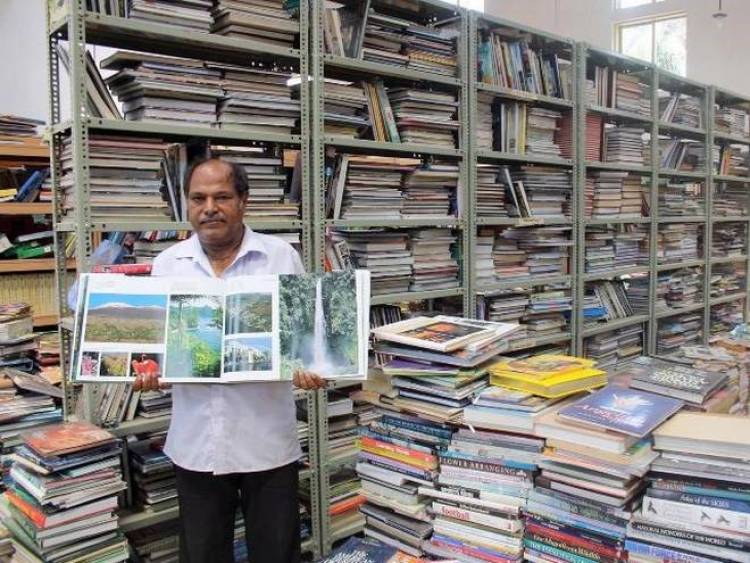
So when we call Anke Gowda the Guardian of Knowledge, it is not just a title. It is a truth earned through decades of sacrifice and vision. His Pustaka Mane is more than a library. It is a reminder that preserving knowledge is preserving humanity itself.
And thanks to him, India now has a treasure of nearly two million books waiting to be read, remembered, and passed on.
