



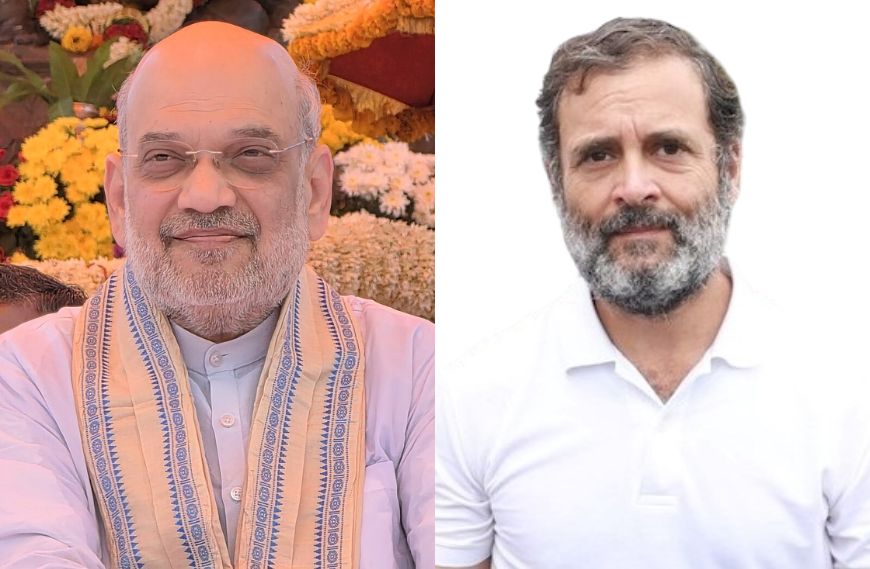
In Bihar, two very different political visions have come into sharp focus. Amit Shah from the Bharatiya Janata Party (BJP) and Rahul Gandhi from the Indian National Congress (INC) are campaigning hard ahead of the state elections. Their speeches and strategies reveal not just party rivalry, but two contrasting approaches to leadership and governance.
Two roads to the voter
Amit Shah has focused on infrastructure, stability and large-scale development. He has promised metro lines in Patna, an AIIMS (All India Institute of Medical Sciences) in Darbhanga and upgrading airports in the region. These are big commitments, and they signal his intent to bring high-end projects to Bihar. Shah’s narrative also emphasises nationalism and strong governance, suggesting that a firm hand is needed to deliver growth.
On the other hand, Rahul Gandhi has framed his campaign around social justice, inclusive growth and the restoration of rights. He has criticised what he calls the concentration of wealth (referring to “five to ten billionaires”) and erosion of democracy under the current regime. His speeches highlight unemployment, rural distress and the idea that public policy should benefit the many, not just the few.
Messaging and mastery
Both leaders know that words matter. Shah did not hold back when he accused the opposition of being a “thug alliance” (using the phrase thug bandhan) and portrayed the BJP as the only stable option. Gandhi, meanwhile, used strong images of control and empire. He claimed the BJP era was one in which decisions were taken from above and imposed. The contrast is vivid: one leader projects power and infrastructure; the other promises voice and agency to the common citizen.
Ground reality meets grand promises
Bihar has its own set of unique challenges. It continues to deal with migratory labour, floods, weak infrastructure, and agrarian distress. While Shah’s project-heavy promises may excite urban and semi-urban voters, Gandhi’s focus on justice and redistribution may ring truer in rural belts. The test will be in how voters weigh visible infrastructure against invisible equity.
The stakes are national
What happens in Bihar won’t stay in Bihar. The state is often seen as a barometer for national politics. A strong showing by either camp could shift momentum ahead of future general elections. That is why these speeches and campaigns matter far beyond Patna.
Which vision will win?
In the end, voters in Bihar will choose between two approaches: one that emphasises rapid development backed by strong leadership, and one that insists on fairness, rights and inclusion. There is no one right choice for everyone, but the outcome will send a message to India about what kind of politics the nation wants to embrace.
