




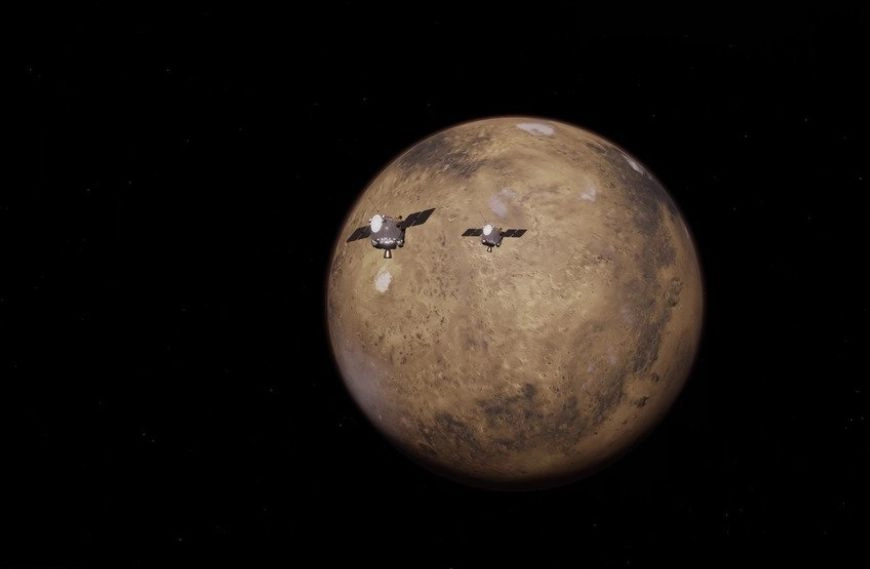
Imagine two small spacecraft travelling all the way to Mars, built at a fraction of the cost of traditional space missions. That is exactly what NASA’s new mission, ESCAPADE, is about. It represents a fresh and more efficient approach to exploring the Red Planet, one that focuses on smart design, collaboration, and affordability.
Scheduled to launch on 9 November 2025, the twin spacecraft, affectionately named ‘Blue’ and ‘Gold,’ will embark on their journey to Mars aboard Blue Origin’s New Glenn rocket. This marks the first time NASA will use this commercial heavy-lift vehicle for an interplanetary mission. After a year in Earth orbit followed by a cruise of almost ten months, the pair is expected to reach Mars around September 2027. Once there, they will orbit the planet together before splitting into two separate paths. This dual approach will allow scientists to study Mars’ atmosphere and its interaction with the solar wind from different angles at the same time.
The main goal of the ESCAPADE mission is to understand how Mars lost most of its atmosphere over billions of years. Scientists believe the solar wind, a stream of charged particles from the Sun, played a big role in stripping away the planet’s air. The two spacecraft will measure magnetic fields and charged particles around Mars to learn how these forces interact. By studying these processes, NASA hopes to uncover how Mars changed from a warm, water-rich planet into the dry and cold world we see today. This knowledge could also help prepare for future human missions to Mars.
What makes ESCAPADE truly special is not just its science, but its cost. The mission is part of NASA’s SIMPLEx programme, which aims to build smaller, faster, and more affordable space projects. ESCAPADE’s total budget is under 80 million US dollars, which is far less than typical Mars missions that often cost hundreds of millions. It shows that deep-space exploration no longer has to be a dream reserved only for large, expensive missions. Instead, smart engineering, commercial partnerships, and lean planning can deliver meaningful science on a modest budget.
Using Blue Origin’s New Glenn rocket is also an important milestone. It symbolises how the partnership between government space agencies and private companies is reshaping the future of space travel. NASA’s collaboration with private firms like Blue Origin not only reduces costs but also speeds up innovation, paving the way for more frequent and flexible missions in the coming years.
When ESCAPADE begins collecting data, scientists will get a rare, three-dimensional view of Mars’ magnetosphere something no previous Mars orbiter has been able to do. One spacecraft will follow behind the other and then move into a slightly different orbit. Together, they will track how solar particles hit and escape Mars’ thin atmosphere over time. These findings could help us better understand how planetary atmospheres evolve and even how Earth might respond to changes in its own space environment in the far future.
ESCAPADE’s ‘budget’ approach is more than a financial choice; it’s a shift in mindset. By showing that meaningful science can be done with smaller missions, NASA is encouraging a new era of exploration, one that is more inclusive and more sustainable. Smaller missions can launch more often, involve more universities and smaller countries, and test bold new ideas without massive risk or cost. It’s a reminder that discovery isn’t always about size or expense, sometimes it’s about creativity and timing.
When the twin spacecraft finally reach Mars, they will work for about 11 months in their primary science phase, gathering valuable data and insights. Their success could open the door for more affordable missions to the Moon, asteroids, and even beyond. For young engineers and dreamers, ESCAPADE is proof that space exploration no longer needs to wait for billion-dollar budgets; it can happen through collaboration, innovation, and determination.
In many ways, ESCAPADE represents the future of how humanity will explore the cosmos. It is small, smart, and full of purpose. It reminds us that big dreams do not always need big money sometimes, they just need big ideas.
Subscribe Deshwale on YouTube
