





The announcement of an interim trade framework between India and the United States marks a turning point in bilateral economic relations. Or at least, it gives such a feeling for now. After nearly a year of strained negotiations, tariff escalations, and geopolitical friction, both governments have agreed to a compromise that reduces barriers and sets the stage for deeper cooperation. The White House has called it a “historic milestone.” For India, however, the framework is best understood as a pragmatic deal that delivers short-term relief but also introduces long-term vulnerabilities.
Gains: Export Relief and Strategic Positioning
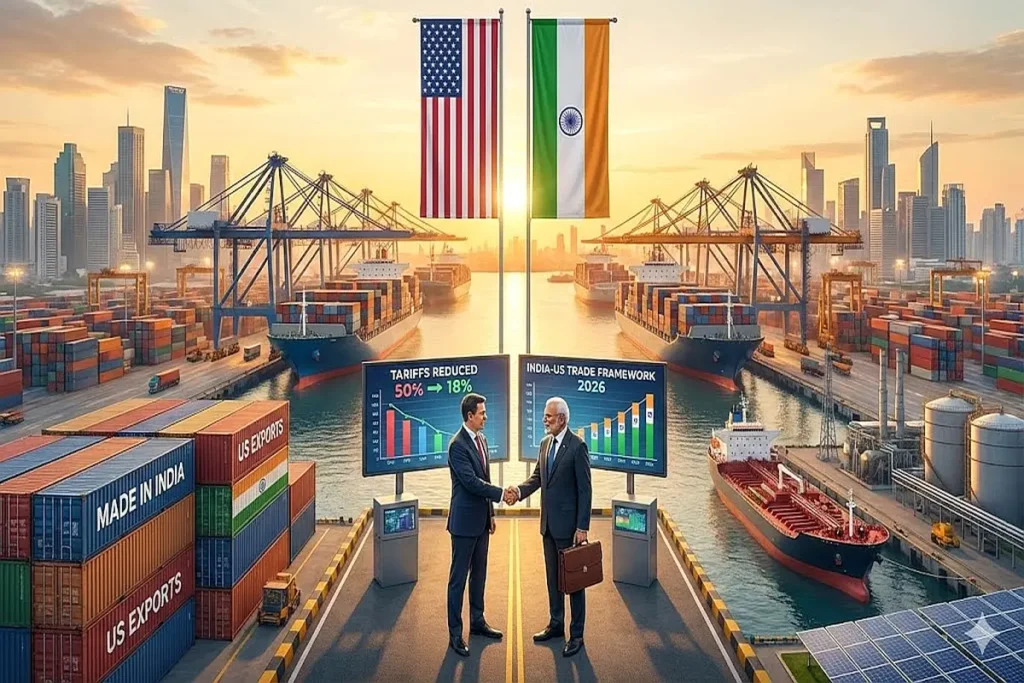
The most immediate benefit for India is tariff relief. US duties on Indian goods, which had risen sharply in 2025 in response to India’s continued imports of Russian oil, will now fall to 18%. Select sectors like pharmaceuticals, gems and diamonds, and aircraft parts, may even enjoy zero tariffs once the framework is finalized. This change restores competitiveness for Indian exporters in textiles, chemicals, machinery, and other labor-intensive industries that had been squeezed under punitive rates.
India’s exporters, particularly small and medium enterprises, stand to gain from renewed access to the US market. With bilateral trade already approaching $190 billion, the tariff cuts could help India expand its surplus and stabilize sectors that employ millions. For policymakers, this is a welcome development at a time when global demand remains uncertain.
Strategically, the framework supports India’s broader economic agenda. It aligns with the “Make in India” initiative by encouraging technology transfers and diversifying supply chains away from China. It also strengthens defence and technology cooperation with Washington, reinforcing India’s role in the Indo-Pacific. Importantly, the agreement preserves safeguards for sensitive agricultural products such as rice, wheat, and dairy, considered very critical for protecting domestic farmers and maintaining political stability. From a social and political point of view, both.
Concessions: Energy and Fiscal Strain
The concessions India has made, however, are substantial. Chief among them is the commitment to halt imports of Russian crude oil. Over the past two years, discounted Russian supplies had accounted for a significant share of India’s energy mix. Replacing this with alternatives from the US or other suppliers will raise costs. While the precise inflationary impact is uncertain, higher energy prices will ripple through the economy, affecting industry and households alike.
Equally significant is India’s pledge to purchase $500 billion worth of US goods over five years. This obligation far exceeds current import levels and will redirect a large portion of India’s foreign exchange reserves toward American products. While such purchases may deepen bilateral ties, they risk crowding out investment in domestic infrastructure and eroding India’s trade surplus. The rupee could face pressure if imports consistently outpace exports.
Tariff reductions on US agricultural and industrial goods also carry risks. Even with protections for staple crops, Indian producers of edible oils, nuts, and processed foods may struggle to compete against cheaper imports. For a country where agriculture remains a major employer, this is not a trivial concern. Opposition parties and farmer groups have already voiced apprehensions that the framework tilts too heavily toward US interests.

The Asymmetry Problem
The framework highlights the structural asymmetry in India-US economic relations. India’s economy, projected at around $4.5 trillion in 2026, is a fraction of the US’s $30 trillion scale. Negotiating from this position, India has limited leverage. The US has used tariffs as a bargaining tool to secure commitments that extend beyond trade, reaching into energy policy and strategic alignment.
This imbalance is not new. India has long sought greater recognition of its role as a reliable partner – democratic, strategically aligned in the Indo-Pacific, and distinct from adversaries like China and Russia. Yet the framework reflects a transactional approach that prioritizes US gains. India’s reliability as an ally has not translated into preferential treatment; instead, it has been met with demands that carry significant economic costs.
Historical Context: India as a Trustworthy Partner
India’s record as a trustworthy partner deserves emphasis. During the Cold War, India maintained a non-aligned stance, balancing superpower interests without direct confrontation. In the post-Cold War era, India has increasingly aligned with US objectives in the Indo-Pacific, participating in the Quad and supporting regional stability. Its democratic credentials and opposition to authoritarian regimes further distinguish it from rivals.
This history suggests that India merits more equitable terms in trade negotiations. Unlike China or Russia, India has consistently sought constructive engagement with Washington. Yet the interim framework echoes tactics used against less cooperative nations, relying on coercive tariffs to extract concessions. For India, this raises questions about whether its alliance value is being fully recognized.
Conclusion: A Pragmatic but Uneven Deal
The interim trade framework offers India short-term relief and strategic alignment with the United States. Tariff reductions will boost exports, support small enterprises, and strengthen supply chain diversification. Defence and technology cooperation will deepen, reinforcing India’s role in the Indo-Pacific.
But the concessions, particularly on energy and mandatory purchases, carry long-term risks. Higher energy costs will strain households and industries. Large-scale import commitments may divert resources from domestic priorities. Agricultural producers could face sharper competition, and India’s trade surplus may erode.
For India, the challenge will be to manage these vulnerabilities while leveraging the framework to expand exports and strengthen its global position. Success will depend on careful implementation and the ability to negotiate more balanced terms in future rounds.
This is not a breakthrough that resolves the structural imbalance in India-US trade. It is, at best, a pragmatic compromise: useful today, but demanding vigilance tomorrow.
