



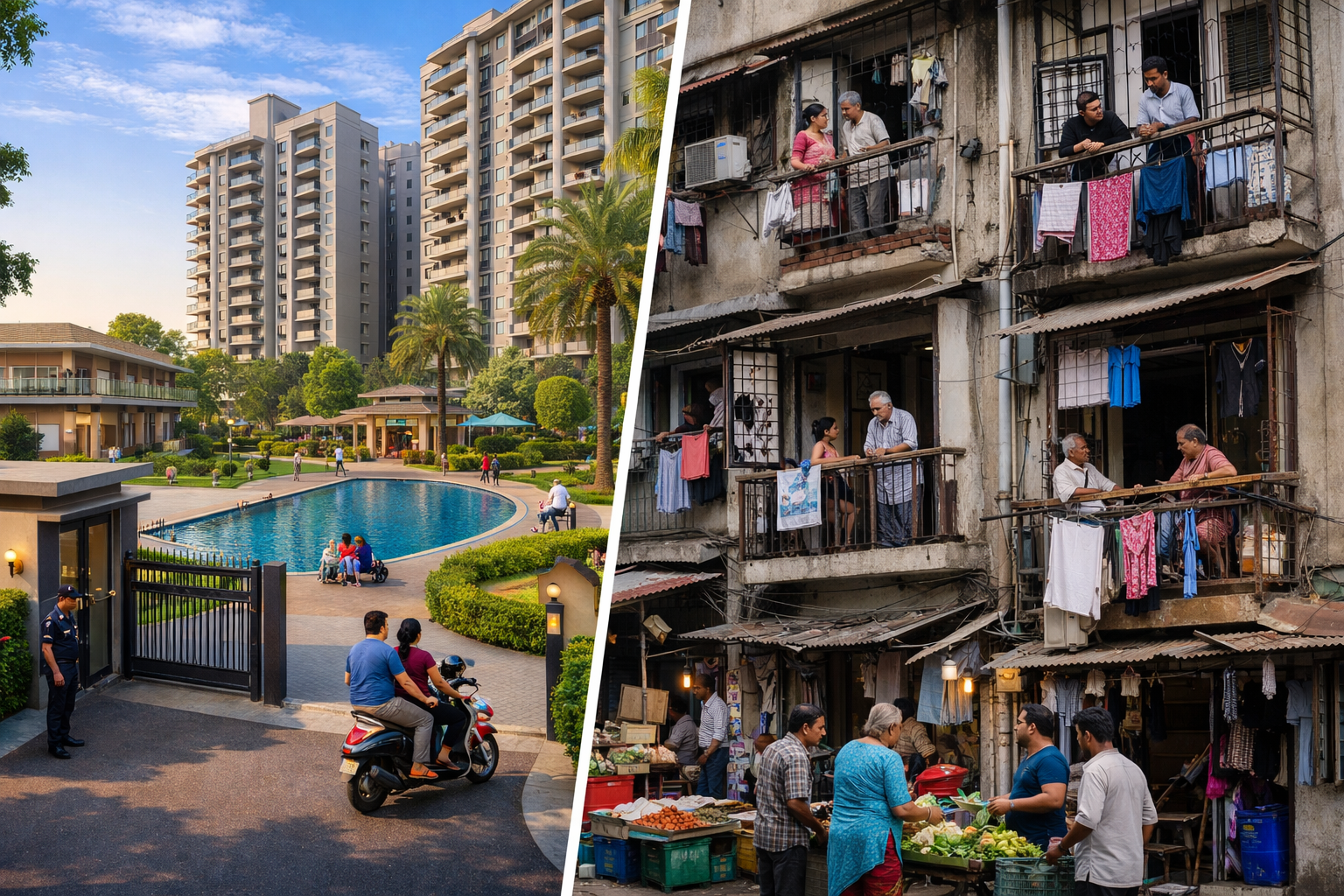
Walk through almost any busy neighbourhood in Mumbai and the city’s distinctive urban character becomes evident. Residential buildings exist alongside factories, offices, shops, markets and roadside hawkers. Life constantly spills onto the streets. Noise, movement and activity rarely pause. While this vitality defines Mumbai, it leaves little room for quiet or mental ease. For many residents, even home offers limited escape from the city’s relentless pace. It is in this setting that gated communities in Mumbai have emerged as an increasingly attractive, and controversial, housing option. As Mumbai expands outward and upward, these enclosed residential developments promise order, security and a better quality of life. Yet they also raise important questions about access, inequality and the nature of urban living in India’s financial capital.
Gated communities are residential developments enclosed by walls or fences with controlled entry points. They typically house multiple apartment buildings or individual homes and offer shared facilities such as gardens, gyms, playgrounds, clubhouses and convenience stores. In Mumbai, such communities now dot areas like Powai, Goregaon, Thane and the extended suburbs.
Security remains the strongest argument in favour of gated communities. Controlled access, CCTV surveillance and round-the-clock guards provide residents with a sense of safety that many open housing societies struggle to offer. For families with children, senior citizens and professionals returning home late, this reassurance brings peace of mind.
Another major advantage is better maintenance and infrastructure. Gated complexes usually employ dedicated teams to manage cleanliness, landscaping, lighting and repairs. Common areas are consistently maintained, and facilities such as lifts, parking spaces and power backups tend to be more reliable than in older societies.
Gated communities in Mumbai also offer shared amenities that are increasingly rare in Mumbai’s crowded neighbourhoods. Gyms, swimming pools, jogging tracks, playgrounds and community halls create a self-contained living environment. This reduces the need to step out for daily recreation and helps residents save time in a city where long commutes are routine.
Social life within gated communities can also be a draw. Festivals, resident events and children’s activities encourage interaction and foster a sense of belonging. For migrants and first-time homeowners, such spaces can make life in a demanding city feel more manageable and less isolating.
Despite their appeal, gated communities come with significant drawbacks. Foremost among them is cost. Monthly maintenance charges can be substantial, covering security, amenities and upkeep. Over time, these expenses often rise sharply, making such housing unaffordable for many middle-income families.
There is also the issue of urban isolation. Mumbai thrives on shared public spaces, street-level interactions and social mixing. Gated communities, by design, limit everyday engagement with the surrounding neighbourhood, creating insulated environments that feel disconnected from the city’s broader rhythm.
Critics further argue that gated developments deepen social and economic divides. While residents enjoy clean roads, private parks and uninterrupted services, public infrastructure outside the gates often remains neglected. This uneven development risks reinforcing inequality and shifting responsibility for urban improvement away from civic authorities.
Accessibility presents another challenge. Many gated communities are located in suburban or peripheral areas where land is available. This often results in longer commutes, greater dependence on private vehicles and increased traffic congestion, particularly during peak hours.
Finally, internal governance can become a source of tension. Disputes over maintenance fees, parking, pets, noise and committee decisions are common. When resident associations lack transparency or participation, the promise of orderly living can quickly unravel.
Gated communities reflect Mumbai’s desire for order within a chaotic urban environment. They offer safety, convenience and comfort, but they also raise difficult questions about inclusivity and civic cohesion. As the city continues to grow, the challenge lies in balancing private comfort with public responsibility, ensuring that Mumbai remains connected, equitable and humane for all who live in it.
Subscribe Deshwale on YouTube
