



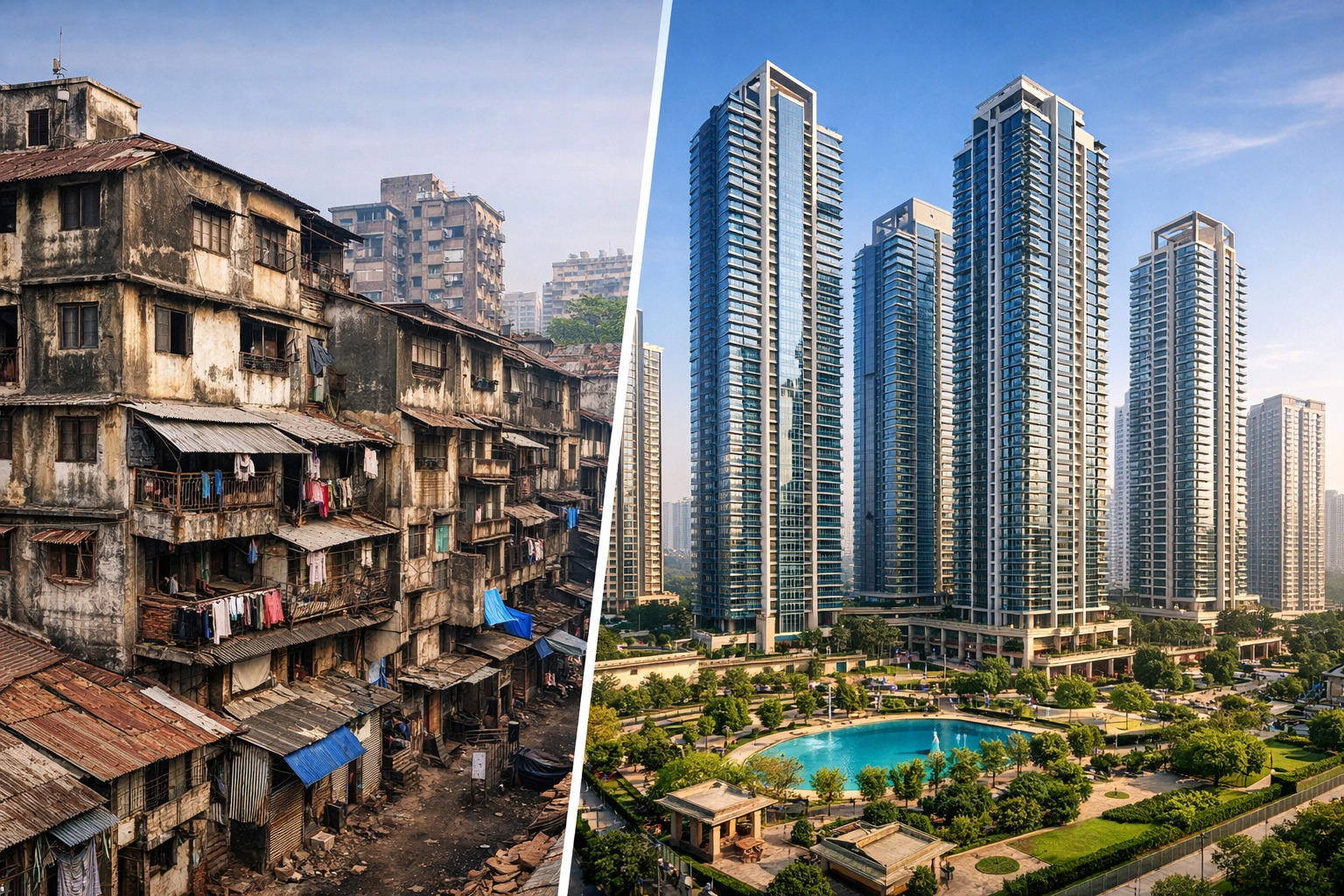
Redevelopment has reshaped many parts of Mumbai in recent years. Old buildings, ageing housing societies and extensive slum clusters are being reimagined into modern structures. According to data from the Slum Rehabilitation Authority, more than 1.5 lakh tenements have been constructed under slum rehabilitation schemes in Mumbai since inception, though a large number remain in progress. Real estate estimates suggest that agreements signed since 2020 could deliver over 40,000 new homes across the metropolitan region by 2030. Redevelopment in Mumbai aims to address chronic housing shortages and improve living conditions. At the same time, the process has stirred debate about its social, political and environmental costs.
For many long-time residents, redevelopment in Mumbai offers clear advantages. Decades-old structures that often lack structural audits and modern fire compliance can be replaced by safer buildings. New constructions usually include better water supply, upgraded electrical systems and improved fire exits. For society members, redevelopment can unlock property value that was long trapped in outdated layouts. In neighbourhoods with narrow lanes and poor drainage, new planning can improve sanitation and reduce health risks.
The state government has pushed redevelopment as part of its broader urban renewal strategy. Policy amendments in recent years have increased permissible floor space index in select zones to make projects financially viable. The Brihanmumbai Municipal Corporation has also reported thousands of buildings classified as old or dilapidated, underscoring the urgency of structural renewal. Authorities argue that faster approvals and higher development potential can accelerate housing supply. Slum rehabilitation remains central to this push, as Mumbai’s population continues to strain limited land resources.
Despite these stated goals, redevelopment has seen uneven results. Slum rehabilitation targets have repeatedly fallen short of annual projections. Thousands of eligible residents still await permanent housing. Delays stem from funding gaps, litigation, consent disputes and stalled clearances. In several housing societies, members have waited years after signing agreements, as projects struggled to secure final approvals. Expectations of quick transformation often give way to prolonged uncertainty.
The process has also exposed social divides within residential communities. Redevelopment requires a high level of consensus. Agreement on builder selection, carpet area allocation, corpus funds and timelines is rarely simple. Differences over risk and reward create camps within societies. In some cases, long-standing neighbourly relationships have frayed. Disputes spill into legal forums. Projects slow down as mistrust deepens.
Political factors shape how redevelopment unfolds. Elected representatives frequently present redevelopment as proof of progress and modernisation. It features prominently in civic campaigns. At the same time, opposition voices highlight stalled projects and allege irregularities in approvals. Across party lines, redevelopment has become intertwined with electoral narratives. Critics argue that political proximity sometimes advantages certain developers. Supporters counter that strong political backing is necessary to cut red tape.
Redevelopment also raises environmental concerns. Demolition generates large volumes of debris. Construction dust affects air quality. Noise disrupts surrounding neighbourhoods. Mumbai already has limited open space per capita. Taller and denser buildings can reduce natural light and ventilation in tight clusters. Without strict enforcement of environmental safeguards, redevelopment may intensify urban stress. Rainwater harvesting, energy-efficient design and waste management systems remain unevenly implemented.
There are, however, documented instances where redevelopment projects have incorporated landscaped courtyards and shared green spaces within dense urban plots. Certain completed society redevelopments in areas such as Lower Parel and Goregaon have included internal gardens and podium-level greenery as part of approved building plans. Some projects guided by integrated township models have also adopted courtyard-based layouts to improve light and ventilation. These examples suggest that design choices can soften the environmental footprint of higher density living. A few projects now include solar panels and wastewater recycling systems. Urban planners note that when redevelopment aligns with sustainable building codes and transparent oversight, outcomes are measurably better.
Public consultation remains critical. Residents often feel that key financial and technical decisions are difficult to fully evaluate. Clear documentation of agreements, transparent disclosure of project timelines and structured mediation can reduce conflict. Professional audits and independent project management oversight can further build trust. Societies that invest time in consensus-building tend to navigate redevelopment more smoothly.
The challenges of redevelopment are significant, but so are its opportunities. Mumbai’s future depends on safer homes, resilient infrastructure and responsible land use. Redevelopment can support that transition if managed with accountability. Government agencies, developers and residents must share responsibility. Lessons from stalled projects should inform better policy design. Successful models should be replicated carefully. With transparent governance and sustainable planning, redevelopment can evolve from a source of friction into a foundation for a more equitable city.
Subscribe Deshwale on YouTube
