




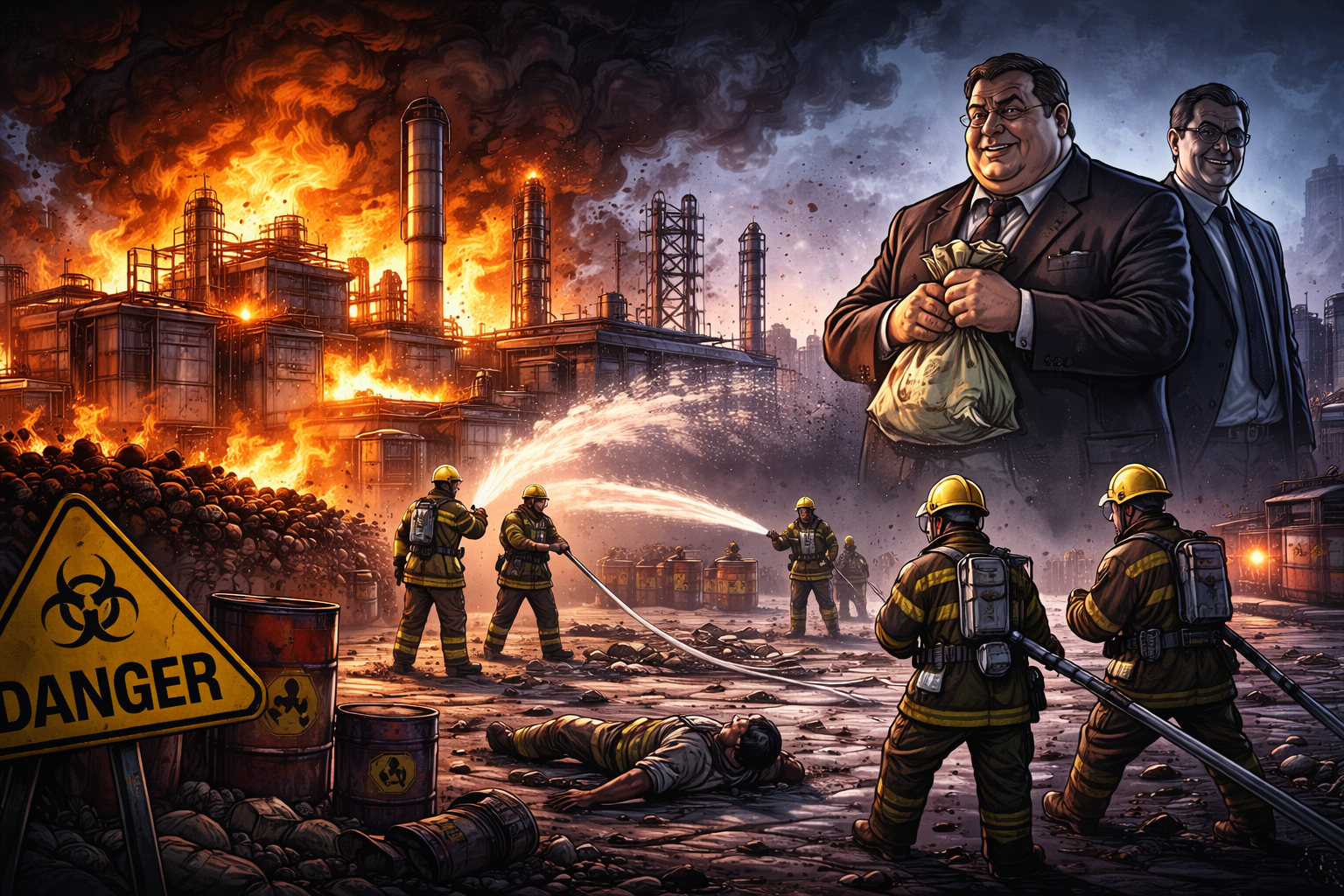
At least seven workers were killed and two others feared trapped after a massive fire broke out at a chemical factory in Bhiwadi’s Khuskheda industrial area in Rajasthan on Monday morning. Around 25 workers were present at the facility when the fire erupted at approximately 9:30 am. Thick smoke was reported around 10 am, and flames quickly engulfed the closed factory, which had stored large quantities of cardboard that intensified the blaze. Firefighters from Khuskheda and Bhiwadi RIICO stations battled the fire for over an hour, bringing it under control after extensive cooling operations.
The tragedy prompted immediate attention from senior officials. Additional District Magistrate Sumita Mishra confirmed that seven charred bodies had been recovered and efforts were ongoing to trace the remaining two. Nearby factories were evacuated as a precaution, and power supply was temporarily cut to prevent further hazards. The exact cause of the fire is still under investigation, with preliminary reports suggesting a possible gas cylinder explosion, although short circuits or other factors cannot be ruled out.
Prime Minister Narendra Modi expressed his condolences, tweeting that the fire mishap was tragic and deeply saddening. He prayed for the speedy recovery of the injured and extended sympathies to the families of the deceased. Former Rajasthan Chief Minister Ashok Gehlot and Leader of Opposition Tikaram Jully also expressed grief over the loss of lives.
The opposition, led by Rajasthan Congress President Govind Singh Dotasra, criticised the government’s handling of industrial safety. Dotasra highlighted the recurring nature of such accidents in India, referencing a similar incident in Ajmer where 16 people died after a chemical tanker overturned. He pointed to systemic issues such as bureaucratic apathy, lax enforcement of safety norms, and insufficient attention to industrial hazards. He suggested that repeated tragedies indicate a failure to value human lives adequately, adding that merely offering compensation to victims’ families cannot replace proper accountability.
Incidents like the Bhiwadi fire raise wider concerns about India’s industrial safety culture. Corruption, human greed, and infrastructural inadequacies frequently combine to create deadly conditions. Fires, chemical leaks, and accidents at factories are disturbingly common, and the scale of such mishaps is often far higher than in first-world countries with stringent industrial regulations. The lack of effective monitoring, poor maintenance of safety equipment, and neglect of fire protocols contribute to unnecessary deaths.
Recent industrial disasters in India include the 2020 Visakhapatnam Gas Leak, 2023 Delhi Factory Fire, 2024 Odisha Alupuram Fire and 2024 Kolkata Chemical Plant Blast.
The tragedy also demoralises the public and workers, reinforcing fears about occupational safety in India. While human oversight remains critical, experts argue that technology, better training, and strict regulatory enforcement are equally necessary. Surveillance systems, automated fire suppression, and real-time risk monitoring could significantly reduce casualties, yet such measures remain limited in many industrial zones.
The Bhiwadi incident is a stark reminder of the urgent need to strengthen industrial safety standards and ensure that human life is prioritised over expediency or cost-cutting. Authorities must act decisively to investigate the incident, enforce accountability, and implement measures that prevent such recurring disasters in India’s industrial sector.
Subscribe Deshwale on YouTube
