



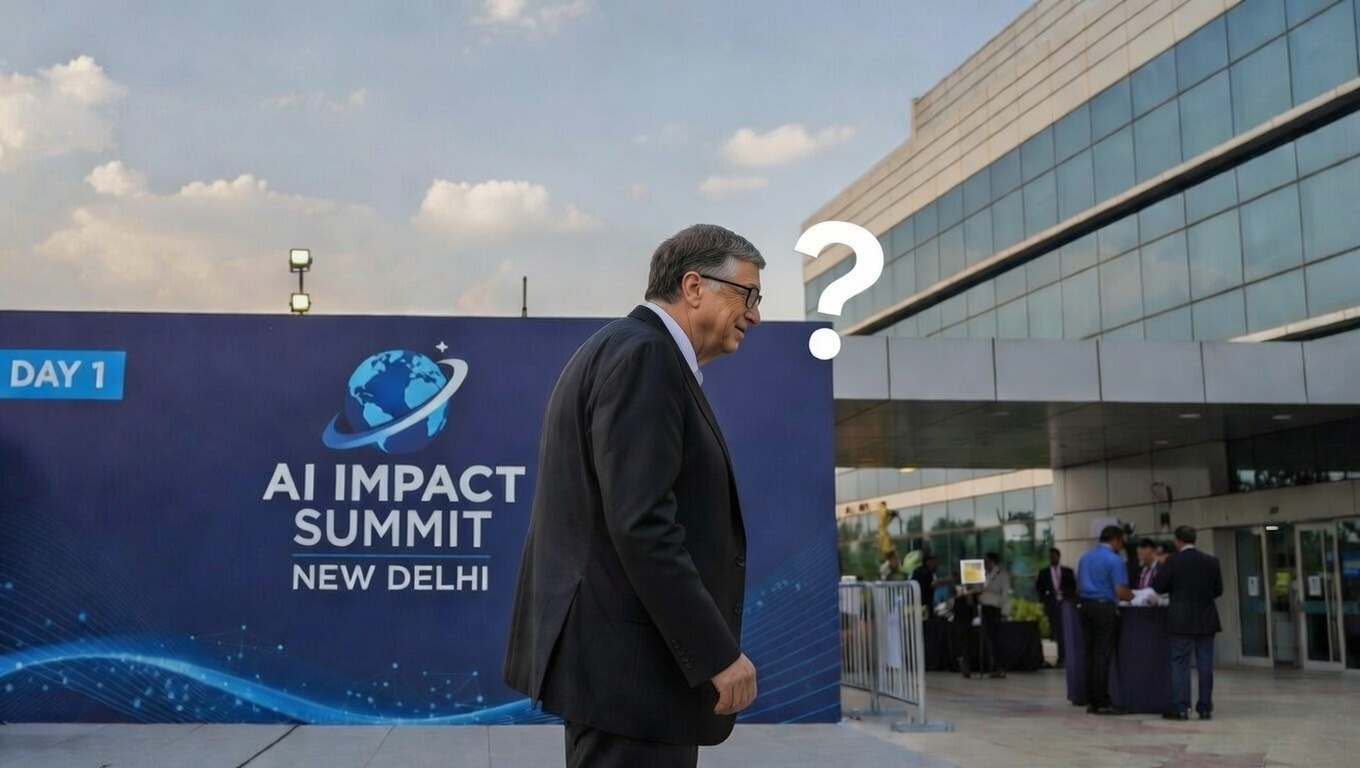
Reports that Bill Gates’ name was no longer listed among expected attendees at a major AI summit in New Delhi have drawn attention, particularly amid renewed discussion in the United States around the so-called “Epstein files.” While there has been no official confirmation linking the two developments, the timing has prompted speculation about whether reputational considerations influenced the decision.
The “Epstein files” broadly refer to court documents and disclosures connected to financier Jeffrey Epstein, whose associations with high-profile individuals have remained a subject of public scrutiny. Gates previously acknowledged meeting Epstein in the past, describing the interactions as a mistake in judgement. Importantly, no charges or legal findings have implicated Gates in wrongdoing related to Epstein. Nevertheless, in the digital age, association alone can carry reputational weight.
The broader impact of the Epstein case on American politics and society has been profound. It intensified distrust toward political and corporate elites, fuelled partisan debate, and reinforced public suspicion about transparency among powerful institutions. The controversy also contributed to a climate in which public figures face heightened scrutiny over past relationships, however indirect. In such an environment, even tangential associations can become politically sensitive.
Against this backdrop, any change in participation by a globally recognised figure such as Gates at a high-profile international event invites attention. If his absence from the AI summit was indeed precautionary, it would reflect the careful reputational calculus that often surrounds major technology gatherings. Governments and organisers increasingly weigh not only expertise but also optics, particularly when public trust in institutions remains fragile.
Gates’ connection to artificial intelligence is longstanding and substantive. Through Microsoft, which he co-founded, he helped lay the foundations of the modern software ecosystem that now underpins AI development. In recent years, Microsoft has committed more than 10 billion dollars in strategic investment toward advanced AI research and partnerships, positioning itself at the forefront of large-scale generative AI systems and cloud-based AI infrastructure. Separately, through philanthropic initiatives, Gates has emphasised the transformative potential of AI in healthcare, climate modelling, agriculture and education. He has argued that artificial intelligence, if governed responsibly, can improve productivity and address global inequality.
The absence of a figure so closely associated with technology leadership could have symbolic consequences for any AI summit. Gates carries not only business influence but also philanthropic credibility in global development circles. His presence often signals continuity between private sector innovation and public interest applications. Conversely, his absence may shift attention toward other industry leaders and alter the event’s narrative focus.
More broadly, the episode highlights the complex relationship between global elites and artificial intelligence. Governments, multinational corporations and influential philanthropies have collectively accelerated AI investment over the past decade. Their motivations are varied. Economically, AI promises productivity gains, industrial competitiveness and strategic advantage. Geopolitically, leadership in AI is increasingly viewed as central to national power. Socially, proponents argue that AI tools can address pressing challenges in public health, energy efficiency and infrastructure management.
However, this rapid push has also triggered concerns about accountability, data privacy and concentration of power. Critics worry that AI development may deepen inequalities if governance frameworks lag behind innovation. Supporters counter that responsible deployment, guided by public policy and ethical oversight, can mitigate risks.
In this context, the scrutiny surrounding prominent individuals reflects a wider demand for transparency in technology leadership. Public trust has become an essential currency in the AI era. Whether or not Gates’ reported absence is directly connected to renewed discussion of the Epstein files, the episode illustrates how reputational considerations intersect with global technology diplomacy.
As artificial intelligence continues to reshape economies and societies, leadership in the field will depend not only on technical expertise but also on credibility. The intersection of politics, public perception and technological ambition ensures that events such as major AI summits are no longer purely technical gatherings. They are also stages where trust, influence and global priorities are negotiated in full public view.
Subscribe Deshwale on YouTube
