




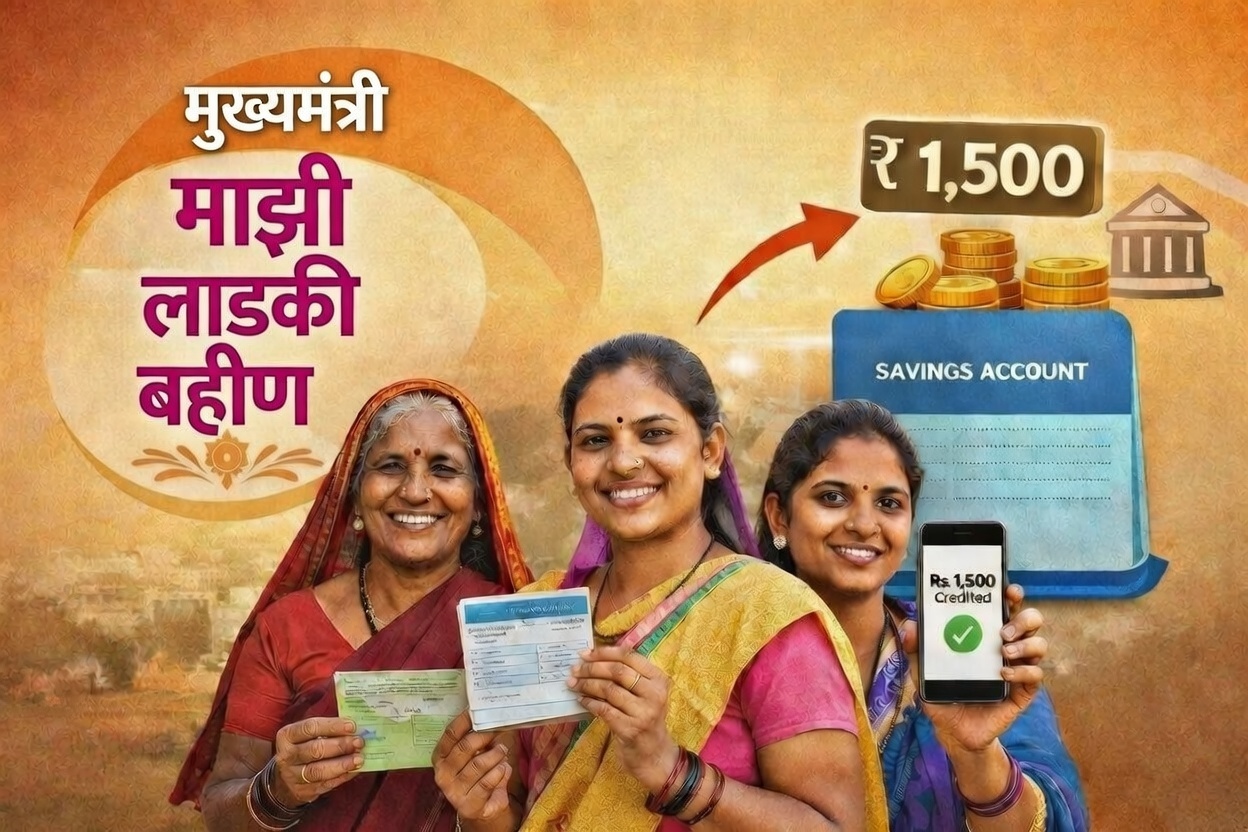
The recent fall in the number of beneficiaries under Maharashtra’s Mukhyamantri Majhi Laadki Bahin Yojana reveals both implementation challenges and deeper questions about India’s welfare priorities. The state’s tally fell by about 86 lakh after a mandatory e-KYC verification drive aimed at removing ineligible claimants. While more than 2.4 crore women were originally enrolled, only around 1.6 crore received the December 2025 stipend because many either submitted incorrect details or missed the verification deadline. A confusing question about government employment in the online form contributed to erroneous self-disqualification, prompting an extension of the cut-off date for corrections.
The scheme was launched in 2024 to provide Rs. 1,500 per month to women aged 21 to 65 from low-income households with an annual family income below Rs. 2.5 lakh. Beneficiaries must link Aadhaar with their bank accounts. Families with government employees or certain asset ownership are excluded in order to target economically vulnerable households.
The sharp drop in beneficiary numbers highlights the tension between expanding welfare and ensuring accuracy. Digital verification, intended to prevent duplication and fraud, has created hurdles for many genuine applicants with limited digital access. Network constraints, authentication failures and portal confusion are common in rural and tribal regions. For women who depend on the stipend for food, medicines or school expenses, even a temporary suspension can cause distress. The state has indicated that alternative physical verification processes may be used in some areas to address these gaps.
Critics argue that the scheme reflects electoral politics as much as social policy. It was a prominent pre-election promise and remains politically significant. Some opposition leaders describe it as fiscally risky and poorly targeted. Others contend that income support for women strengthens household stability and boosts consumption in weaker sections of society. The debate mirrors a broader national trend in which states compete to introduce cash transfer programmes directed at women.
Similar schemes exist in several other states. West Bengal operates the Lakshmir Bhandar scheme, which provides Rs. 1,000 per month to women from Scheduled Caste and Scheduled Tribe communities and Rs. 500 per month to women from the General and Other Backward Classes categories, subject to income conditions. This differential payout has drawn debate. Supporters argue that higher transfers for SC and ST women reflect an attempt to address entrenched social disadvantage. Critics contend that once income ceilings are applied, varying payments by caste category risks creating perceptions of unequal treatment among equally poor households.
Madhya Pradesh runs the Ladli Behna Yojana, which provides Rs. 1,250 per month to eligible women, with periodic increases announced over time. Unlike West Bengal’s model, the Madhya Pradesh scheme does not publicly differentiate the monthly payout by caste category. Eligibility is primarily income-based, though other administrative filters apply. It is therefore seen as less explicitly caste-differentiated in design, even though broader social inequalities may still influence access in practice.
Other states with women-focused cash transfer schemes largely rely on income, age and residency criteria rather than tiered caste-based payouts. While many welfare programmes in India include reservations or targeted components for SC and ST communities, direct monthly income support schemes for women do not uniformly provide higher stipends to SC and ST beneficiaries across the country. West Bengal remains one of the clearer examples of differentiated payment levels.
Supporters of such differentiation argue that caste and poverty are often interlinked and that uniform payments may not adequately compensate for deep-rooted exclusion. Critics respond that once economic thresholds are applied, further segmentation can blur the line between social justice and identity-based entitlement. The constitutional framework permits affirmative action for historically disadvantaged communities, yet the political optics of differential cash payouts remain contested. There is also a wider concern that visible caste-based differentiation in direct income schemes can deepen identity divisions in public perception. When equally poor households receive different payments because of caste classification, it can foster resentment and weaken the sense of shared citizenship. Policymakers must therefore balance corrective justice with the broader goal of social cohesion and national unity.
Most income support programmes available to men are either gender neutral or linked to age, disability or occupation. The Pradhan Mantri Kisan Samman Nidhi scheme provides Rs. 6,000 per year in three instalments to eligible small and marginal farmers, irrespective of gender, though land ownership patterns often result in male recipients. The National Social Assistance Programme includes the Indira Gandhi National Old Age Pension Scheme and the Indira Gandhi National Disability Pension Scheme, which provide monthly pensions to elderly and disabled persons below the poverty line.
Schemes such as state construction worker welfare boards or unemployment assistance programmes are open to both men and women but are tied to specific sectors rather than offering unconditional monthly income support. There is no major state programme that mirrors the structure of Laadki Bahin for economically distressed men.
This structure has prompted debate about whether welfare design should move towards stricter income-based neutrality. Critics argue that poverty affects both men and women and that removing gender filters may appear more equitable in principle. Others maintain that women face lower labour force participation, wage gaps and weaker asset ownership, which justifies targeted intervention. The policy tension lies between universal economic targeting and corrective social targeting.
Concerns have also been raised about caste eligibility in Maharashtra. The Laadki Bahin scheme is structured around income, age and residency criteria rather than caste. Women from the General Category are eligible if they meet the income threshold and other conditions. This income-based approach places Maharashtra closer to the Madhya Pradesh model than to West Bengal’s differentiated payout structure.
Another policy question is whether large-scale cash transfers crowd out long-term development spending. Maharashtra’s annual budget runs into several lakh crore rupees, and women-focused income support schemes account for a significant revenue commitment within that framework. If such transfers expand without proportional revenue growth, they can increase fiscal pressure and reduce capital expenditure headroom. Infrastructure investment in roads, irrigation, education and industrial growth can generate employment and durable economic returns. Direct transfers provide immediate relief but do not automatically create productive assets. A sustainable fiscal framework must balance short-term consumption support with long-term growth priorities.
The Laadki Bahin reduction is therefore not merely a statistical correction. It underscores the complexity of digital welfare delivery, the political appeal of gender-focused schemes, the layered debate over caste differentiation, and the fiscal trade-offs facing Indian states. As governments refine verification processes and eligibility norms, the central challenge will be to protect vulnerable citizens while preserving fiscal stability and development capacity.
Subscribe Deshwale on YouTube
