




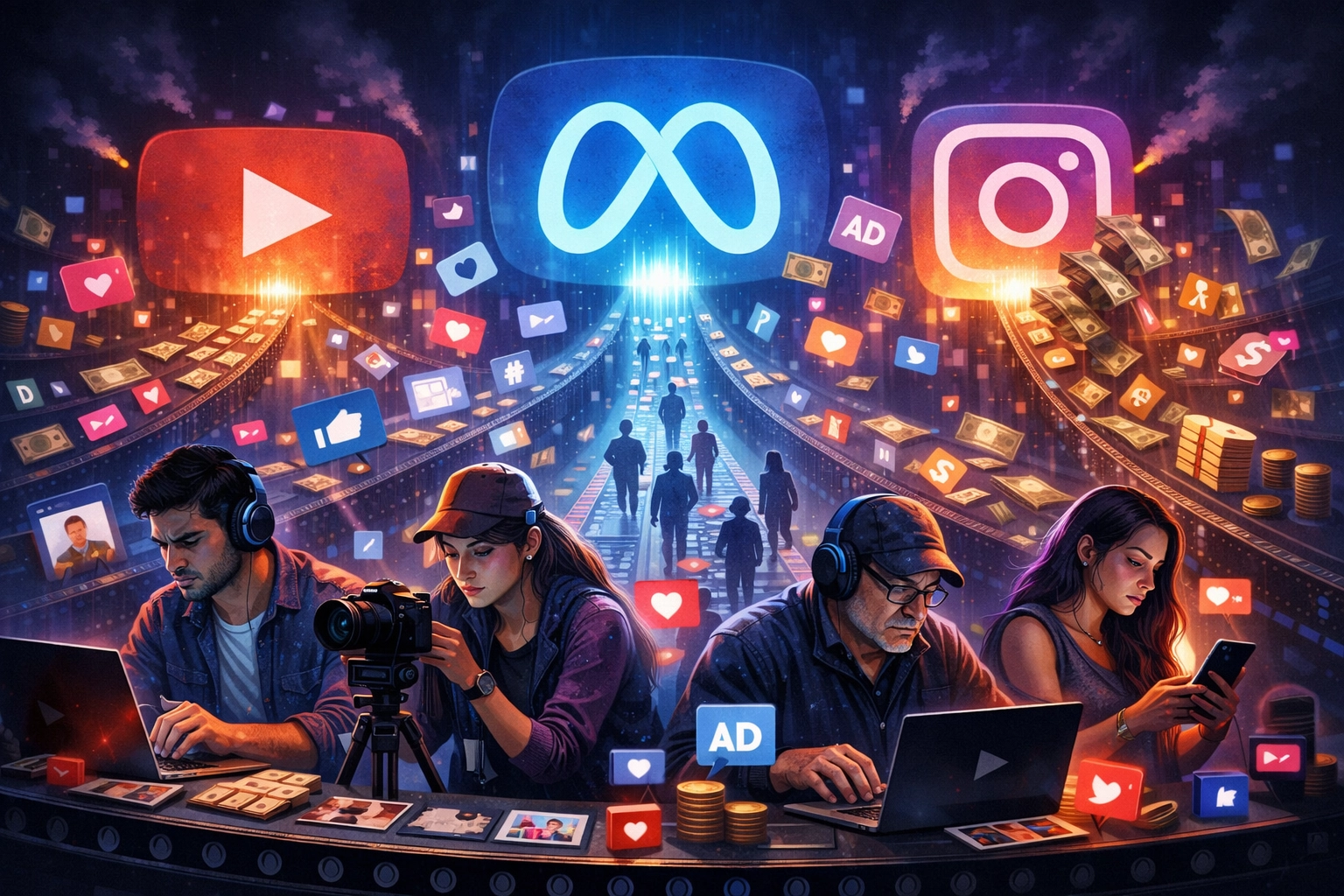
Millions create content. A handful actually earn. Read how the creator’s dream has turned into a factory of unpaid labour for the world’s giant technology companies…
The world now has a creator economy. Create content and earn income. In this, the most valuable asset is not talent. It is quantity… volume. Numerous content companies, platforms owned by giant IT company subsidiaries, are designed to keep users across 195-200 countries endlessly scrolling. For that, they need a constant stream of videos, reels, posts, shorts, livestreams and comments. Where does this stream come from? The uncomfortable truth is that content creators provide it, working like unpaid suppliers, and ‘proudly’ so! Unknowingly, they have become the hands of these companies and volunteers supplying a global content refinery.
Data in this sector reveals the imbalance with startling clarity. According to Riverside’s creator income analysis, only 0.3% of YouTubers earn US$5,000 or more per month (roughly ₹4.1 lakh monthly). Beginners with 1,000+ subscribers may earn between ₹2,500 and ₹25,000 per month from advertising. That’s all. The gap between dreams and reality? A canyon that cannot be crossed.
Yet the creator economy is growing like a monster – faster by night than by day. Its value stood at US$205 billion in 2024 and is projected to reach US$1.34 trillion by 2033 (₹1.1 lakh crore to ₹11.1 lakh crore). The paradox is clear: the market is exploding, yet most creators earn nothing.
If you are among those not earning, don’t feel too bad. Accept the consolation that you are not alone. This is not a personal failure. It is the outcome of a system deliberately built this way.
A gold rush where the shovel earns more than the miner
Every technological revolution has its stories. The Industrial Revolution had factory owners. The app revolution had start-up founders. The creator revolution has creators everywhere, in slums, luxury villas, flights, local trains, street stalls…
YouTube has around 30 lakh monetised channels. Sounds large? Wait. There are tens of millions of channels. Barely 6% ever reach monetisation. Over 90% never cross 10,000 subscribers, not now, not ever.
Monetisation rules are strict. YouTube starts paying only after 1,000 subscribers and 4,000 watch hours annually. Until then, creators wait, supplying free content. In the last three years, YouTube paid US$70 billion (₹5.8 lakh crore) to creators and media companies. Sounds generous. But most of that money goes to a tiny elite. Like music streaming, thousands create songs, a handful become stars.
The attention assembly line
YouTube and Facebook are not media companies. They are advertising infrastructure businesses. Their product is not content, we produce the content and give it to them for free. Their real job is to keep our attention locked in.
YouTube reaches 2.53 billion users. By late 2025, quarterly ad revenue crossed US$10 billion (₹83,000 crore). Meta Reels became a US$50 billion annual business within five years. Yet most creators receive no revenue share. Platforms acquire endless content without commissioning, paying salaries or guaranteeing income. Courtesy: us. Exposure is the “lottery ticket”. Platforms control visibility – therefore they control income.
The illusion of independence
Creators surrender freedom chasing income dreams. Work from anywhere, build a brand, escape the 9-to-5 job. For a few, this dream becomes real. Goldman Sachs says about 4% earn over US$100,000 annually (₹82 lakh). For the rest, income behaves like monsoon rain- uncertain and uneven. If may come or…
And algorithm changes can collapse income overnight. The “Adpocalypse” proved this. Two-thirds of YouTube creators now rely on income outside YouTube. Platforms give visibility; creators must build businesses elsewhere.
Advertising: the hidden engine
Digital advertising is the core profit engine. Programmatic advertising generated US$134.8 billion in 2024 (₹11.2 lakh crore). Memes, vlogs and podcasts keep users glued to screens – more time means more ads, more revenue. In Australia alone, tech companies earn US$26.7 billion annually (₹2.2 lakh crore). Meanwhile creators struggle to earn a few thousand rupees per month. Platforms earn billions daily. Legally not exploitation, economically, it is.
China’s digital independence
Many countries have accepted the dominance of Western tech companies. India could have challenged them but remained a service provider. China did differently. It rejected dependence and built Weibo, WeChat, Baidu, Douyin, TikTok and Alibaba. Today Chinese tech firms rival American giants. Their data stays within national servers. Their revenue fuels domestic growth.
Media’s struggle
Traditional media dominated for decades, then digital arrived. Most failed to adapt. They spend crores producing journalism but earn little. They now supply content to the very platforms taking their advertising revenue. One exception: The New York Times. It built a strong subscription model early. Today it has about 130 lakh users and a turnover of US$2 billion. It succeeded without surrendering to Big Tech.
The creator pyramid
The creator economy is a three-layer pyramid. At the top: superstar creators with massive audiences, brand deals and venture capital. In the middle: semi-professionals earning through sponsorships and affiliate links. At the base: millions creating content regularly and earning nothing. Yet hope persists: “If he can make it then why can’t I?” So, content supply never stops. Platforms don’t need most creators to succeed- only to keep uploading.
When passion becomes unpaid labour
The uncomfortable word is labour. Creators invest time, skill and emotion into research, editing, scripting and marketing. They even pay platforms for promotion. For platforms it is a double benefit. Chit bhi meri, patt bhi meri, sort of. Is this not worse than gig work? At least gig work pays something.
Creators participate voluntarily. Platforms force no one. Yet the system runs on aspiration. Platforms promised creative freedom. They delivered the largest unpaid workforce in history. Social media presence feels compulsory. Hope fuels a smart, systematic mechanism that has turned millions into unpaid workers- and technology companies into the new gods and new Kubers.
Subscribe Deshwale on YouTube
