




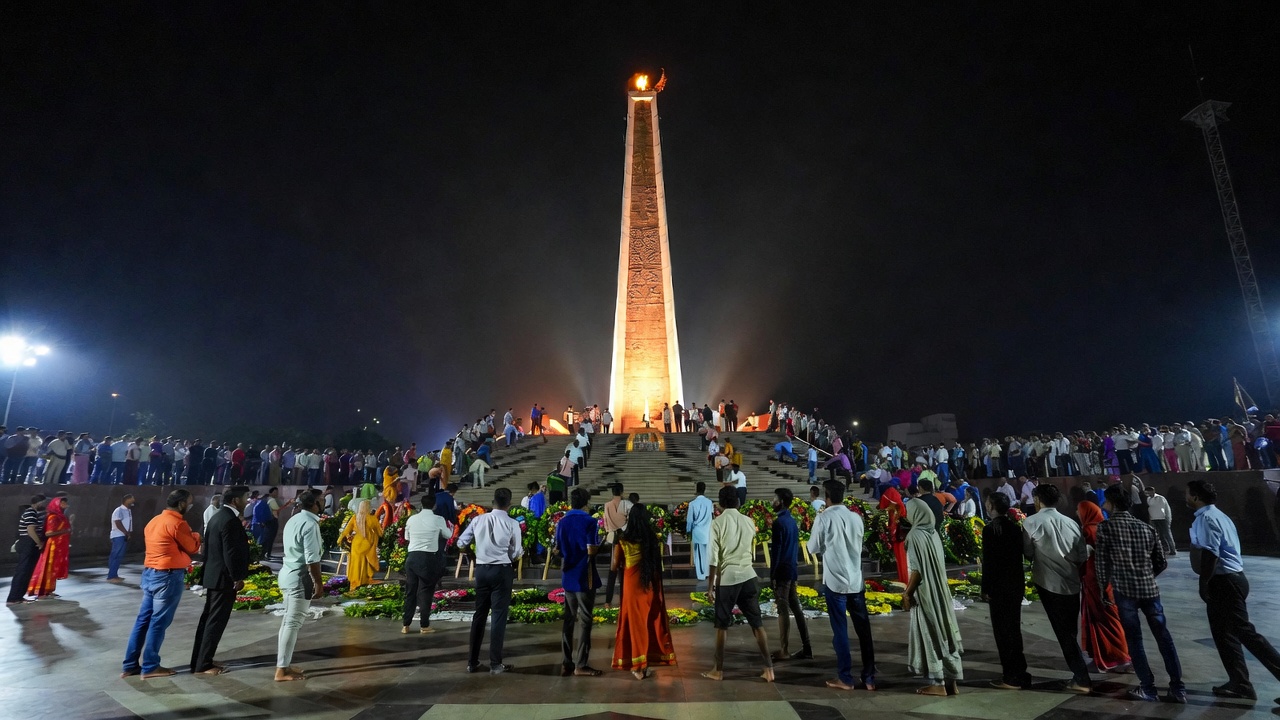
On 21 February 2026, Bangladesh observed Martyrs’ Day, Ekushey February, simultaneously with UNESCO’s International Mother Language Day. The occasion drew nationwide participation, from state ceremonies at Dhaka’s Central Shaheed Minar to grassroots gatherings in rural villages. This report examines the historical foundations of the Language Movement, the geographic and civic scope of the 2026 commemorations, the politically significant attendance of opposition leadership, and the broader implications for national identity and linguistic preservation in a newly elected government’s first weeks in office.
Historical Background: The 1952 Language Movement
The commemorations of Ekushey February are rooted in a decisive episode of resistance against the cultural and administrative policies of the Pakistani state in East Pakistan. Following the partition of British India in 1947, the central government in Karachi moved to impose Urdu as the sole national language, despite Bengali being the mother tongue of the majority of Pakistan’s total population, concentrated in the eastern wing. It is worth pausing on that demographic reality for a moment, because it is one that tends to get lost in simplified retellings. This was not a minority asserting itself against a majority. It was a majority being told that its language was insufficient.
Student-led protests reached a critical juncture on 21 February 1952, when Dhaka police opened fire on demonstrators near the University of Dhaka, who had defied Section 144 to press their demand for Bengali’s recognition as a state language. Five individuals, namely Abdus Salam, Abul Barkat, Rafiq Uddin Ahmed, Abdul Jabbar, and Shafiur Rahman, were killed, transforming the movement into a foundational moment of Bengali nationalist consciousness. The eventual recognition of Bengali as a co-official language of Pakistan, formalized in the 1956 Constitution, is directly attributable to the sustained pressure generated by the movement and the moral authority conferred by these deaths. Whether the Pakistani state ever fully grasped what it had set in motion that February is another question entirely.
Scholars of South Asian nationalism broadly regard the Language Movement as a precursor to the Bangladesh Liberation War of 1971. The assertion of linguistic identity in 1952 laid the discursive and political groundwork for the demand for political autonomy that culminated in independence. Seventy-four years later, this historical sequence continues to inform how Bangladeshi citizens and institutions narrate national identity.
Scope and Character of the 2026 Commemorations
The 2026 observances demonstrated both institutional continuity and broad civic participation. At Dhaka’s Central Shaheed Minar, the principal national memorial rebuilt following its destruction by Pakistani forces in 1971, formal ceremonies began at 12:01am on 21 February, consistent with established practice. The scale of expected attendance necessitated a security deployment of approximately 15,000 police personnel in and around the Shaheed Minar area, with traffic diversions enforced at seven points across the capital and access routes designated to manage the flow of visitors. Wreaths were laid first by state officials, followed by foreign diplomats, representatives of ministries and organisations, political leaders, and the general public in a structured procession that continued through the morning hours.
Beyond the capital, commemorative events were documented across the country’s major urban centres. Rangpur’s Shaheed Minar drew silent crowds in an atmosphere characterised by observers as one of collective mourning. Chattogram hosted cultural programming including recitations, folk music, and theatrical performances drawing on the literary traditions of the Language Movement. Rajshahi marked the occasion with particular significance: the city’s permanent Central Shaheed Minar, constructed on nearly one acre of land at a cost of approximately Tk 7.80 crore and built in the architectural style of the Dhaka monument, was opened to the public for the first time at 12:01am, fulfilling what residents described as a long-standing civic demand. Previously, Rajshahi residents had paid tribute separately at two different sites, which, when you think about it, says something about how long a city can carry a shared grief without a shared place to put it. Institutional observances at universities, including Bangladesh University of Health Sciences, situated the day within educational contexts, reinforcing its function as a site of intergenerational memory transmission.
Notably, the 2026 commemorations also reflected a deliberate inclusivity that extended beyond the country’s Muslim majority. The Bangladesh Hindu Buddhist Christian Unity Council participated formally, and indigenous communities were represented across several regional gatherings. This interfaith and inter-ethnic participation echoes the historical character of the 1952 movement itself, which was not premised on religious identity but on a shared linguistic and cultural heritage.
Political Significance: Leadership Attendance and the Post-Election Context
The 2026 ceremony at the Central Shaheed Minar carried exceptional political weight, taking place just four days after Tarique Rahman was sworn in as Prime Minister on 17 February 2026, making the wreath-laying his first major public act of state. The BNP, led by Rahman, had won a decisive majority in the 13th general election held on 12 February 2026, securing 212 seats in the 350-seat parliament. The result followed 18 months of interim government under Nobel laureate Muhammad Yunus, which had taken power after the student-led uprising that ousted long-time Prime Minister Sheikh Hasina in August 2024. Rahman himself had returned to Bangladesh only in December 2025, ending 17 years of self-imposed exile in London, during which he had faced criminal convictions, subsequently contested, related to a 2004 grenade attack and corruption charges brought under the Hasina government. To say his return was politically charged would be an understatement of some magnitude.
President Mohammed Shahabuddin placed a wreath at the Central Shaheed Minar at 12:01am, with Prime Minister Rahman following at 12:07am, accompanied by his wife Zubaida Rahman and daughter Zaima Rahman. Rahman stood in silent observance before departing at 12:20am. The chiefs of the three armed services paid their respects at 12:19am.
Equally noteworthy was the attendance of Dr. Shafiqur Rahman, Ameer of Bangladesh Jamaat-e-Islami, who laid a wreath at 12:22am as Leader of the Opposition, heading an eleven-party alliance that secured 77 parliamentary seats. The historical relationship between Jamaat-e-Islami and the events of 1971, including documented collaboration by the party’s predecessor organisation with Pakistani military forces during the Liberation War, has long made its role in official national commemorations a contested matter, and that tension does not simply dissolve because an election has been held.
The party’s formal participation in Ekushey February observances as an institutionalised opposition bloc represents a point of analytical tension. It may be read either as evidence of genuine political evolution, or as a pragmatic normalisation facilitated by the post-election power configuration.
Political analysts will note that the symbolic stakes of attending Ekushey February are exceptionally high in Bangladesh. The day is not merely commemorative but constitutive of national legitimacy. Participation by all major political actors, regardless of historical position, signals an attempt to consolidate a shared national narrative under new governing arrangements. Whether this signals durable reconciliation or tactical positioning warrants continued scrutiny.
Cultural Dimensions: Memory, Identity, and Language Preservation
Beyond its formal political dimensions, Ekushey February functions as a significant mechanism of cultural reproduction. Barefoot processions to the Shaheed Minar, a practice observed since the 1950s, continued in 2026, preserving a form of embodied mourning that connects participants physically and symbolically to the events of 1952. In the hours before midnight, artists painted intricate alpana patterns in white, red, blue, and yellow along the paths leading to the memorial, a visual ritual of preparation observed by onlookers gathering ahead of the formal ceremonies. There is something quietly insistent about that image, people painting flowers on a path to a monument for the dead, in the dark, before the clock turns. Oral transmission of family histories relating to the Language Movement was documented across multiple gatherings, particularly in interactions between older participants and younger generations. The wearing of black badges as a symbol of mourning remained widespread.
The day also served as a platform for articulating anxieties about contemporary linguistic pressures. Participants and civil society voices cited the perceived encroachment of English in professional, digital, and educational domains as a present-day challenge analogous in spirit, if not in nature, to the threats that motivated the 1952 movement. The Ministry of Cultural Affairs has responded institutionally through initiatives promoting Bengali in formal education and broadcast media, though the efficacy and scope of these measures remain subjects of ongoing debate among linguists and educators, and it is not clear that institutional promotion alone can reverse trends that are partly driven by economic aspiration rather than cultural hostility.
International Dimension: UNESCO and the 2026 Theme
Bangladesh’s role in the internationalisation of Ekushey February is itself a point of historical significance. Following a proposal initiated by Bangladeshi expatriates in Canada and formally advanced by the Government of Bangladesh, UNESCO proclaimed 21 February as International Mother Language Day on 17 November 1999. The day has since been observed globally, with UNESCO annual themes guiding programming around language diversity and multilingual education.
The 2026 theme, “Youth Voices in Multilingual Education,” reflects a strategic emphasis on intergenerational language transmission and the integration of minority and indigenous languages into educational systems. For Bangladesh, a country with a dominant national language but significant linguistic diversity among its indigenous communities, particularly in the Chittagong Hill Tracts, this theme carries domestic as well as international resonance. The alignment between Bangladesh’s internal linguistic politics and the global framework of the day offers an opportunity for the new government to position itself as both a custodian of the Language Movement’s legacy and a credible participant in multilateral cultural diplomacy, though whether that opportunity is pursued with substance or treated as ceremonial remains to be seen.
Conclusion
Ekushey February 2026 was, by any measure, an extraordinary convergence of history and present politics. For the first time in decades, the day was observed under a government completing its first week in office, led by a prime minister whose return from exile, electoral mandate, and public presence at the Shaheed Minar all arrived within the span of ten weeks. That convergence gave the 2026 observance a quality distinct from prior years: the commemoration functioned simultaneously as national mourning, democratic renewal, and a test of whether newly configured political arrangements could be anchored in shared founding narratives.
The breadth of participation, geographic, civic, religious, and political, attests to the day’s enduring function as a constitutive moment in Bangladeshi national life. The presence of a historically contentious opposition at the Shaheed Minar alongside the governing administration complicates easy readings. It neither confirms lasting reconciliation nor confirms cynical opportunism. It reflects, more precisely, that Ekushey February retains sufficient moral authority to compel attendance from actors whose relationships to the history it commemorates remain deeply unresolved.
That unresolved quality is not a weakness of the day. It is, arguably, the source of its continued power. The Language Movement of 1952 was not a settled event when it occurred; it was a rupture that produced consequences across decades. In 2026, Bangladesh is again in a moment of rupture and reconstruction. The martyrs of Ekushey February did not die for a particular government or party. They died for the proposition that a people’s language is inseparable from their dignity. That proposition remains as contested, and as necessary, as it has ever been.
Subscribe Deshwale on YouTube
