



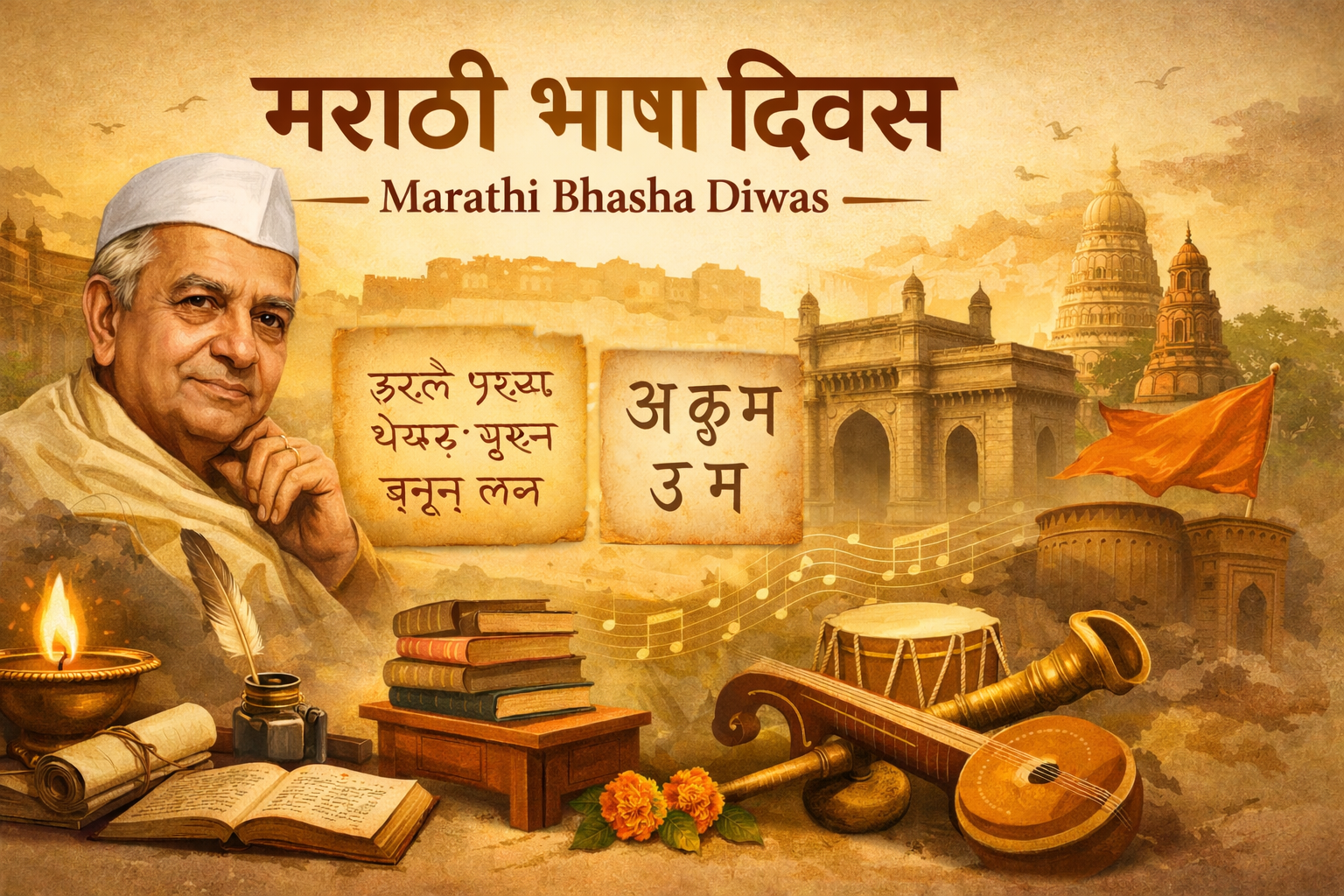
Marathi Bhasha Diwas is observed every year on 27 February to mark the birth anniversary of the celebrated Marathi poet Vishnu Vaman Shirwadkar, widely known by his pen name Kusumagraj. His 1942 poetry collection Vishakha announced an electrifying new voice in Marathi literature, and his 1964 play Natsamrat remains one of the most performed and emotionally devastating works in the Marathi theatrical tradition. On 21 January 2013, the Maharashtra government officially recognised this date as Marathi Bhasha Gaurav Din, a formal acknowledgement of Kusumagraj’s towering contribution to the language and its literature. The occasion has since grown into a broader cultural moment that prompts reflection not just on the language’s present health but on its extraordinary past.
A Language With Deep Roots
Discussions about India’s major languages often foreground Hindi, leaving Marathi’s considerably older literary pedigree underacknowledged in popular understanding. Marathi has attested literary records going back to the 11th and 12th centuries, with the Shilahara copper plates from around 1012 CE considered among the earliest known Marathi inscriptions. The Yadava dynasty, which ruled the Deccan between the 9th and 14th centuries, actively patronised Marathi, and saints like Dnyaneshwar wrote sophisticated philosophical verse in it during the 13th century itself. Standard Hindi, in its current Devanagari and Sanskritised form, was largely a 19th-century colonial-era consolidation. Marathi had a running literary tradition centuries before that project began.
The Question of Dialects
Marathi is far from a monolithic tongue. Across Maharashtra and its neighbouring regions, the language appears in strikingly different forms. Varhadi, spoken in the Vidarbha region, carries a distinctive rhythm and vocabulary that can sound almost like a separate language to a Pune resident. Ahirani is spoken in the Khandesh belt and draws heavily from older Prakrit roots. Malvani, spoken along the Konkan coast, has absorbed Konkani and Portuguese influences over centuries of coastal contact. Thanjavur Marathi, spoken by communities in Tamil Nadu whose ancestors migrated southward with the Bhonsale kings, has preserved features of 17th-century Marathi that the mainland has since lost. Each of these dialects represents a living archive.
How and Why Marathi Was Standardised
The standardisation of Marathi happened gradually, shaped by both political necessity and print technology. The arrival of Christian missionaries in the 19th century played an unexpected role. The American Marathi Mission, working out of Pune, developed early grammars and dictionaries that forced a degree of codification. Simultaneously, newspapers, literary societies and later the colonial education system demanded a consistent written register. The variety spoken around Pune, owing to that city’s historical and administrative prominence, became the de facto standard. This is the Marathi taught in Maharashtra’s schools and examined in university syllabi today.
The Sanskritisation Question
This is where the history becomes genuinely interesting. During the period of Sultanate and later Mughal rule over parts of the Deccan, Marathi absorbed a substantial number of Persian and Arabic words into its everyday vocabulary. Administrative terms, words related to trade, land revenue and governance all came in through the Persian-speaking courts. Words like kayde (rule), hukum (order) and hazir (present) were thoroughly naturalised.
After Maratha political consolidation under Chhatrapati Shivaji Maharaj in the 17th century, a deliberate effort was made to reverse this. Shivaji’s court produced the Rajya Vyavahara Kosha, a glossary that replaced Persian administrative terms with Sanskrit-derived equivalents. This Sanskritisation deepened over subsequent centuries, particularly through 19th and 20th-century literary and reform movements that consciously looked toward classical Sanskrit as a purifying source. The result is a kind of linguistic layering. Modern standard Marathi sits above a substrate of older Persianised vocabulary that still surfaces in rural speech, proverbs and older texts.
Why the Day Still Matters
Marathi Bhasha Diwas is really about keeping that layered history visible. Urban Marathi speakers increasingly code-switch into English, rural dialects face pressure from standard broadcasts and streaming content, and younger generations are less likely to read Warkari poetry or Tamasha scripts. The day nudges a conversation that otherwise gets skipped.
It is, in the end, a modest intervention. But for a language this old, modest interventions have a way of adding up.
| Numbers | Fact |
|---|---|
| 1 | Marathi Bhasha Diwas is celebrated every year on 27 February to honor the birth anniversary of renowned Marathi poet Vishnu Vaman Shirwadkar, popularly known by his pen name Kusumagraj. |
| 2 | Kusumagraj (born 27 February 1912 in Pune) was a celebrated poet, playwright, novelist, and Jnanpith Award winner (1987) who significantly enriched modern Marathi literature. |
| 3 | This day was officially established as Marathi Language Pride Day after Kusumagraj’s death in 1999, with the Maharashtra government issuing a circular in 2013 to promote it widely. |
| 4 | There are two main Marathi language days: 27 February (Marathi Bhasha Gaurav Din / Pride Day) and 1 May (Marathi Rajbhasha Din / Official Language Day, marking Maharashtra’s formation in 1960). |
| 5 | Marathi is one of the oldest Indo-Aryan languages with literature dating back to around 1000 CE, making it (along with Bengali) among the earliest regional literatures in this family. |
| 6 | The language evolved from Maharashtri Prakrit and has roots traceable to about 1,300–1,500 years ago, with some research suggesting origins as early as the 5th century. |
| 7 | The oldest known Marathi inscription is from around 983 CE at Shravanabelagola (Karnataka), reading “श्रीचामुंडराजें करवियले” on a statue base. |
| 8 | Marathi is written in the Devanagari script today, but historically used the unique Modi script (from the 11th–20th centuries) for administrative and literary purposes. |
| 9 | Vivēkasindhu by Mukundaraja (late 12th century) is considered the first major prose work and one of the earliest books in Marathi. |
| 10 | Līḷācarītra is regarded as the first biography written in any modern Indian language, composed in Marathi during the 13th century. |
| 11 | Saints like Sant Dnyaneshwar (13th century), Namdev, Eknath, and Tukaram (16th–17th century) shaped early Marathi literature through bhakti poetry and abhangs. |
| 12 | Marathi has a unique tradition of povadas — heroic ballads popular during the 17th century, especially glorifying Chhatrapati Shivaji Maharaj’s exploits against the Mughals. |
| 13 | Marathi is spoken by over 83–90 million people worldwide, ranking it among the top 15 most spoken languages globally. |
| 14 | It is the official language of Maharashtra (declared under the Maharashtra Official Language Act, 1964, after state formation). |
| 15 | Marathi boasts one of the richest theatrical traditions in India, with modern Marathi theatre flourishing since the 19th century. |
| 16 | In 2017, UNESCO recognized certain Marathi storytelling traditions as part of the Intangible Cultural Heritage of Humanity. |
| 17 | Marathi was the language of the first Indian newspaper, Darpan (started in 1832), highlighting its early role in print media and journalism. |
Subscribe Deshwale on YouTube
