



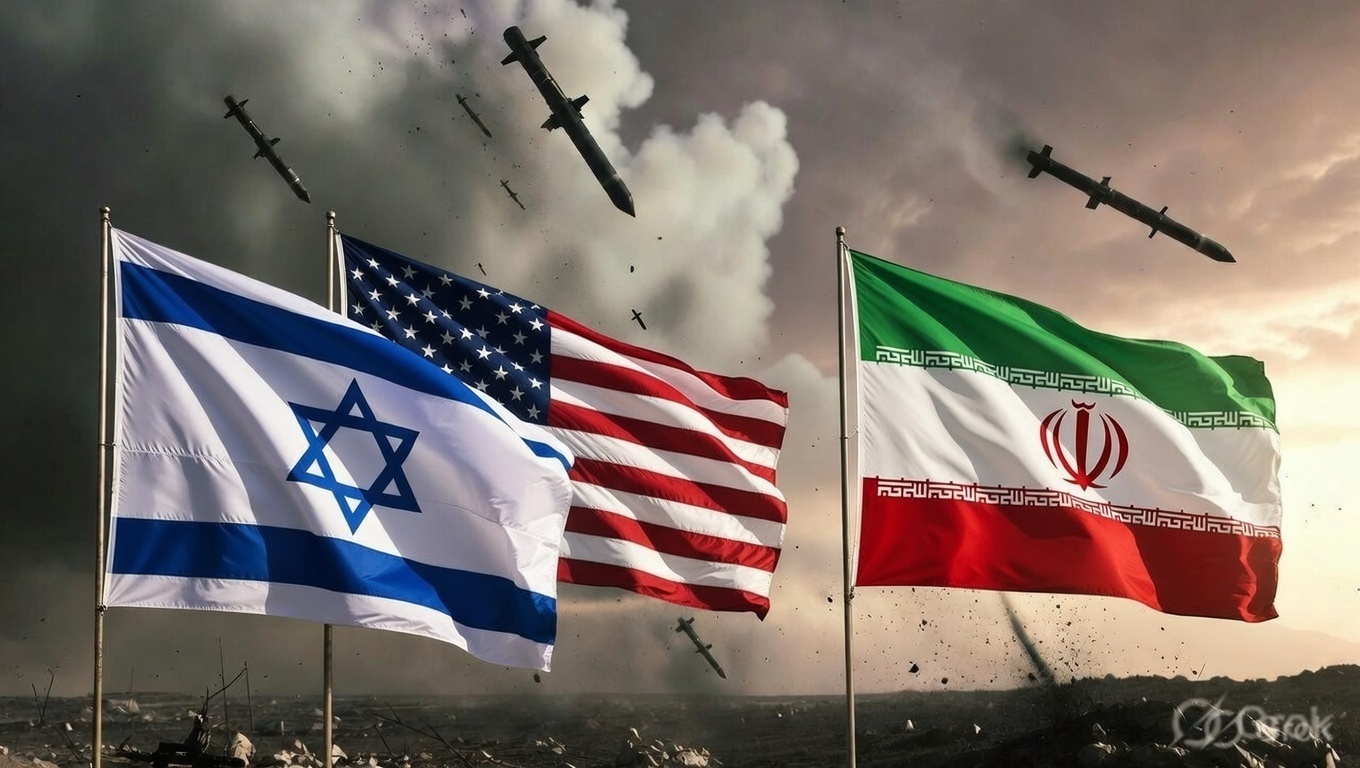
Explosions over Tehran. Airspace shut. A president declaring major combat operations. And a regime that never fixed its skies now facing the consequences.
On the morning of 28 February 2026, smoke rose over Tehran’s Pasteur district. Missiles struck near the offices of Supreme Leader Ayatollah Ali Khamenei. Explosions were reported in Qom, Kermanshah, Isfahan and Karaj. Iran’s airspace was shut down. Mobile communications in the capital went dark.
In Washington, US President Donald Trump posted a video confirming that American forces had begun what he called “major combat operations” in Iran, describing it as an effort to eliminate “imminent threats from the Iranian regime.” Israel’s defence minister Israel Katz confirmed the strikes, calling them pre-emptive and necessary to remove threats to the state of Israel. US officials said the attacks were being carried out by aircraft and from one or more aircraft carriers. They described it, pointedly, as “not a small strike.”
The world had been watching this moment build for months. Now it has arrived.
The Diplomatic Trap That Did Not Hold
The timing struck many observers as deliberately stark. Just a day before the strikes, the US and Iran had completed another round of indirect nuclear talks in Switzerland. Iranian state media noted that this was the second time their country had been attacked in the middle of negotiations, the first being the twelve-day conflict of June 2025.
An Omani mediator had reportedly signalled progress, claiming Iran had agreed not to stockpile enriched uranium, yet the military timetable had clearly been set elsewhere and far earlier, operating on assumptions and intelligence assessments that diplomacy was unlikely to meaningfully alter.
The pattern is familiar. In the months before the 2003 invasion of Iraq, Washington maintained engagement with UN inspectors while troop deployments reached operational readiness. Diplomatic channels remained open while military decisions were already locked in. History rarely repeats itself precisely, but structural echoes are hard to ignore.
Trump had warned in February that “really bad things” would happen if Tehran refused serious negotiation. Iran did not accept his terms. The military option followed. An Iranian official told Reuters that Tehran was preparing a “crushing” response. Israel declared a nationwide state of emergency, closed its airspace and moved hospitals underground.
So What Happens Now?
The immediate military exchange is only the opening phase. The larger question concerns political intent. Is this coercion designed to reset deterrence, or is it the opening move in something intended to end a regime?
The distinction matters. It determines whether the region braces for escalation or for transformation.
Iran’s Airspace and the Cost of Strategic Choices
A central question now dominates strategic discussion: how were Israeli and American aircraft and missiles able, once again, to penetrate Iranian airspace with apparent ease?
During the June 2025 conflict, Israeli military statements claimed strikes on nearly 300 missile launchers and multiple air defence nodes. Independent verification remains incomplete, but the operational effect was clear. Iran’s defensive network was significantly degraded.
By early 2026, it had not been meaningfully rebuilt. A reported reconstruction agreement with Russia in December 2025 had not delivered critical systems in time. The Su-35 fighter jets long discussed between Moscow and Tehran had yet to arrive. China provided monitoring support but no direct interception capability.
The vulnerability, however, is structural.
For decades, Iran prioritised offensive asymmetry over defensive resilience. The Islamic Revolutionary Guard Corps directed resources toward ballistic missiles, drones and regional proxy networks. These tools extended influence into Lebanon, Iraq, Syria and Yemen without requiring air superiority over Iranian territory, and the strategic doctrine assumed that the ability to escalate horizontally across the region would serve as sufficient deterrence against any sustained direct assault on the homeland.
That assumption has now been tested twice in less than a year.
Sanctions constrained modernisation, limiting access to advanced avionics, radar integration and layered air defence systems. Much of Iran’s air fleet dates back to the 1970s. The F-14 aircraft acquired under the Shah remain in service largely through improvised maintenance.
Yet sanctions alone do not explain the gap. Procurement priorities reflected internal political competition between the IRGC and the regular armed forces. Missile programmes and proxy networks carried ideological prestige. Air defence reform did not.
Iran built reach. It did not build shelter.
Russia, China, and the Limits of Strategic Alignment
Moscow and Beijing have urged de-escalation. Russia, which signed a twenty-year strategic partnership with Iran in January 2025, says it warned Washington against striking. China expressed deep concern.
But neither country maintains a mutual defence treaty with Tehran, and neither appears willing to confront US forces directly in the Gulf.
Russia remains absorbed in Ukraine. China balances energy ties with Iran against broader relationships with Gulf states. Their support has been economic rather than military. China purchases the overwhelming majority of Iran’s oil exports, sustaining Tehran financially despite sanctions. That relationship will continue. It does not translate into air cover.
After the June 2025 conflict, former Russian president Dmitry Medvedev floated the possibility of Russia or Pakistan providing nuclear warheads to Iran. The suggestion was never formal policy, but its articulation revealed how strategic frustration can be signalled indirectly and how signalling itself can alter calculations in ways that become difficult to control once escalation logic takes over.
Reza Pahlavi and the Politics of Exile
On the morning of the strikes, Reza Pahlavi described the operation as a humanitarian intervention against the Islamic Republic. He argued that the attacks targeted the regime rather than the nation and urged Iranian security personnel not to defend the leadership.
For decades, Pahlavi has positioned himself for such a moment. He has engaged Israeli leadership publicly and outlined a post-regime vision in which Iran recognises Israel and reintegrates into the regional order.
Inside Iran, political reality is more complex. Leaders of the Woman, Life, Freedom movement criticised the strikes, arguing that foreign bombs do not advance domestic reform. Former Israeli intelligence chief Amos Yadlin acknowledged that air power alone does not topple entrenched systems.
Exile politics and internal legitimacy do not automatically converge.
Iran’s Internal Fault Lines
Iran is not socially monolithic. Persians constitute a majority, but Azeris, Kurds, Arabs, Baloch and Turkmen communities form substantial regional concentrations. These demographic realities are politically sensitive and difficult to measure precisely, yet the diversity is undeniable.
For decades, the Islamic Republic managed centrifugal pressures through coercion, ideology and security presence. A severely weakened centre removes those stabilising mechanisms simultaneously.
Kurdish factions maintain cross-border ties with Iraqi Kurdish groups. Arab sentiment in oil-rich Khuzestan has never fully dissipated. Baloch insurgency in the southeast reflects long-standing grievances.
The most destabilising scenario is not orderly regime change but fragmented authority across multiple regions. A fractured Iran would carry implications far beyond its borders, particularly given its geography along the Strait of Hormuz.
The Sectarian Balance Reconfigured
The Islamic Republic has been, since 1979, the primary state sponsor and theological anchor of political Shiism across the Middle East. Without Tehran, Hezbollah loses its strategic depth and most of its financing. The Houthis lose their most significant military supplier. Shia militias in Iraq lose their patron. The Shia Crescent, that arc of influence running from Tehran through Baghdad, Damascus and Beirut to the Mediterranean, depends entirely on Iranian coherence for its structural integrity.
A seriously degraded Iran does not merely weaken one state. It redistributes power across an entire sectarian geography. The Sunni monarchies of the Gulf, particularly Riyadh, Abu Dhabi and Manama, will feel the strategic pressure ease in ways they have not experienced since before 1979. Saudi Arabia’s Vision 2030, its rapprochement with Israel and its cautious normalisation diplomacy all become considerably more viable in a Middle East where Iran is no longer the dominant disruptive force. Turkey, positioning itself as the leader of a post-Arab Spring Sunni political order, will see its regional leverage grow.
One caveat deserves stating plainly. A Middle East without Iranian counterbalance also creates space for jihadist currents that the IRGC, whatever its many crimes, did actively suppress within its sphere of influence. The fall of one destabilising force does not guarantee the rise of a stabilising one.
Israel and the Regional Hierarchy
If Iran’s theocracy is reduced to internal survival mode, Israel’s relative military dominance becomes clearer. No regional state combines nuclear deterrence, advanced air capability, intelligence reach and demonstrated operational range in the same way.
This shift will not sit comfortably across the Arab world. Strategic relief from Iranian pressure coexists with questions about how Israeli power will be exercised and how American influence will shape its limits.
Limited Strike or Regime Collapse?
The most consequential question remains unresolved. Trump has said the United States does not seek a prolonged war. Yet rhetoric urging Iranian soldiers to lay down their arms suggests ambitions that extend beyond limited strikes.
A constrained campaign weakens Iran but preserves state continuity. A collapsed Iranian regime introduces unpredictable fragmentation in a country more complex than Iraq in 2003 or Libya in 2011, where the interplay of ethnic, sectarian and regional forces produced outcomes that planners had neither fully anticipated nor adequately prepared to manage.
The argument for decisive action rests on preventing reconstruction, rearmament and renewed nuclear acceleration. The argument for restraint recognises that regime removal does not guarantee stable succession.
What is certain is this. Smoke rises over Tehran. Oil markets react sharply. The Strait of Hormuz is under intense watch.
Whether Operation Lion’s Roar proves to be a limited correction or the opening chapter of systemic transformation depends not only on the missiles already launched, but on the political calculations that follow them.
This is a developing story. All information in this report is based on sources available in the public domain at the time of publication (2 PM IST, February 28, 2026). Details may change as the situation evolves.
Subscribe Deshwale on YouTube
