



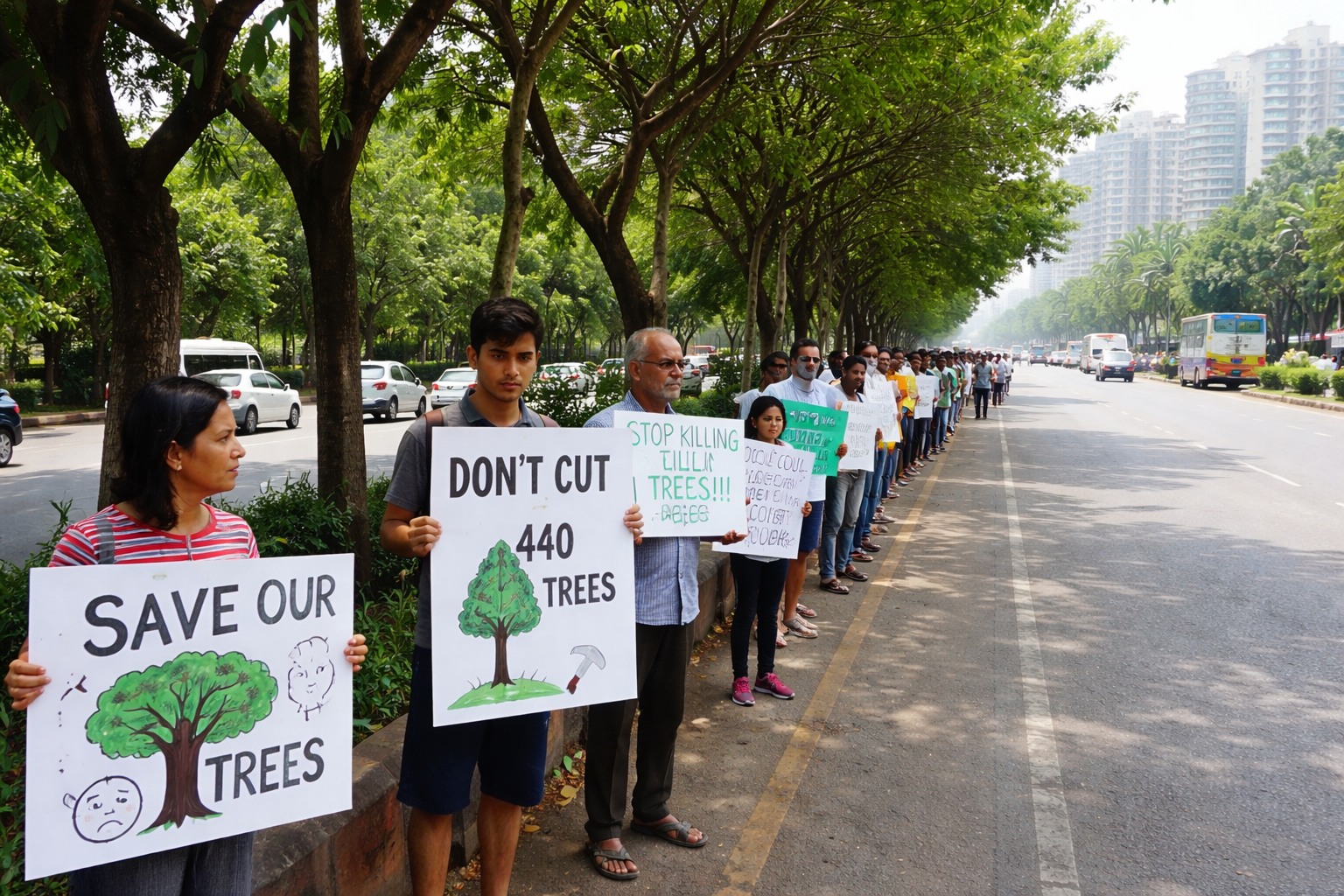
More than 200 residents recently formed a human chain along Palm Beach Road in Navi Mumbai to protest against the proposed felling of 440 trees for an underpass project at Sanpada. The gathering was peaceful and notably silent. Children, senior citizens and joggers stood shoulder to shoulder, holding placards that asked a simple question: can a city grow without cutting down its shade?
At one level, this is a local planning dispute. At another, it reflects a familiar tension in Indian cities between infrastructure expansion and ecological stability.
A Community Draws a Line
The protest was organised by local environmental groups and residents’ associations concerned about the scale of tree loss along one of Navi Mumbai’s most recognisable boulevards. Palm Beach Road is not merely a traffic corridor. It is a tree lined stretch that moderates heat, filters air and shapes the character of the neighbourhood.
According to the Forest Survey of India, urban districts in Maharashtra show widely varying canopy densities. Navi Mumbai, developed as a planned township, retains relatively higher green cover than many older metropolitan zones, with tree and forest cover estimated at roughly 40 to 45 per cent of its total area when mangroves and reserved forest patches are included. However, roadside avenues form only a small fraction of that cover. Their removal has a visible and immediate effect.
Participants argued that mature trees cannot simply be replaced by saplings elsewhere. Ecological research supports this view. A mature urban tree can sequester around 20 to 25 kilograms of carbon dioxide annually, and over decades it can store several tonnes of carbon in biomass and soil. Newly planted saplings take years to deliver comparable benefits.
The choice of a silent human chain was deliberate. It avoided confrontation. It also signalled that residents see this as a civic issue rather than a partisan one. No slogans, no shouting. Just people standing there.
Urban Ecology Is Not Cosmetic
There is a tendency in planning debates to treat roadside trees as aesthetic additions. Science suggests otherwise.
Urban tree cover reduces surface temperatures through shade and evapotranspiration. Studies conducted in Indian and international cities indicate that shaded corridors can be 2 to 5 degrees Celsius cooler than adjacent exposed asphalt during peak summer afternoons. In humid coastal regions such as Mumbai and Navi Mumbai, that difference affects pedestrian comfort and heat stress risk.
The India Meteorological Department has recorded increasing frequency of heat stress days across parts of Maharashtra in recent years. Built surfaces amplify this through the urban heat island effect. Tree lined avenues interrupt that cycle.
Trees also intercept particulate matter. While they are not a substitute for emission control, they help reduce local exposure to airborne pollutants. Losing 440 trees in one corridor will not alter the city’s climate trajectory. That would be overstated. But cumulative losses across projects can erode urban resilience over time.
The Infrastructure Argument
The Navi Mumbai Municipal Corporation has proposed the underpass to ease congestion at a busy junction along Palm Beach Road. Traffic volumes have increased as residential and commercial development expanded. Planners argue that grade separation will improve traffic flow and reduce idling emissions.
Transport bottlenecks do increase fuel consumption. However, international research on induced demand suggests that adding road capacity can attract more vehicles over time. Without parallel investment in public transport and demand management, congestion relief may be temporary.
Residents have asked whether alternative designs were fully evaluated. Could signal optimisation or partial redesign reduce tree loss? These questions deserve technical clarity. Planning decisions of this scale should rest on transparent traffic modelling and environmental impact assessments.
Municipal bodies also operate within financial constraints. Infrastructure projects involve costs running into several crores. Public authorities must weigh fiscal prudence against environmental loss. That balance is rarely simple.
Law and Oversight
Tree felling in urban Maharashtra is regulated through municipal tree authorities and state level norms. Proposals require permissions, public notice and compensatory plantation commitments. Authorities often promise to plant multiple saplings for each tree cut.
Yet compensatory plantation has limits. Survival rates of urban saplings vary widely. Soil conditions, maintenance budgets and long term monitoring determine outcomes. Announcing numbers is easy. Ensuring survival is harder.
Courts and green tribunals in India have increasingly scrutinised urban tree felling, insisting that alternatives be considered and environmental costs minimised. A protest alone does not halt a project. It can, however, compel fuller disclosure.
A Morning on Palm Beach Road
If you had walked along Palm Beach Road that morning, you would have seen families in everyday clothes holding handwritten signs. A few schoolchildren looked slightly unsure about where to stand. Traffic flowed beside them. It was calm. Almost understated.
It was an ordinary civic gesture. And yet it carried weight.
This Debate Travels
Civic resistance to urban tree felling is not unique to Navi Mumbai. In Sheffield in the United Kingdom, residents campaigned between 2015 and 2018 against a street tree replacement programme linked to highway contracts. In Germany, protests intensified in 2010 and 2011 when trees were cut in Stuttgart’s Schlossgarten park for the Stuttgart 21 rail project. In Canada and Australia, community opposition in the early to mid 2010s focused on highway expansions and rail upgrades that threatened established urban canopies.
These movements differed in scale and outcome. Some secured design changes. Others did not. What they shared was a growing recognition that mature urban trees are infrastructure in their own right.
Politics and Accountability
Environmental concerns are no longer peripheral in urban politics. Voters increasingly link quality of life to clean air and access to green space. Local representatives will need to explain the rationale, the alternatives considered and the safeguards planned.
National climate commitments emphasise sustainable urbanisation and enhancement of carbon sinks. While 440 trees may appear small in national arithmetic, repeated local decisions shape cumulative outcomes.
It may sound abstract, but local shade matters.
What Happens Next
The project now moves through administrative processes. Environmental groups may seek further engagement or legal review. The civic body may proceed with modifications. Outcomes remain uncertain.
What is clear is that urban residents are asking for development that does not treat ecology as expendable. They are not rejecting infrastructure outright. They are asking for better design and accountability.
In the end, this is about more than a single underpass. It is about how Indian cities define progress in a warming world. The answer will not come from protest alone, nor from planning offices alone. It will emerge from the friction between them.
Subscribe Deshwale on YouTube
