




How London’s and New York’s Suburban Rails Outpaced Mumbai’s, Exposing a Century of Institutional Indifference
The Statistic That No One Flinches At
Every day, roughly ten people die on Mumbai’s suburban rail network. Not in crashes. Not from mechanical failure. They fall from open doorways, are struck on unprotected tracks, crushed in stampedes, or electrocuted on infrastructure that was already ageing when India gained independence. Over twenty years, this accumulates to fifty thousand lives, a figure greater than many wars, recorded in annual reports as a line item under untoward incidents.
The word for this is not tragedy. Tragedy implies the unforeseeable. This is policy.
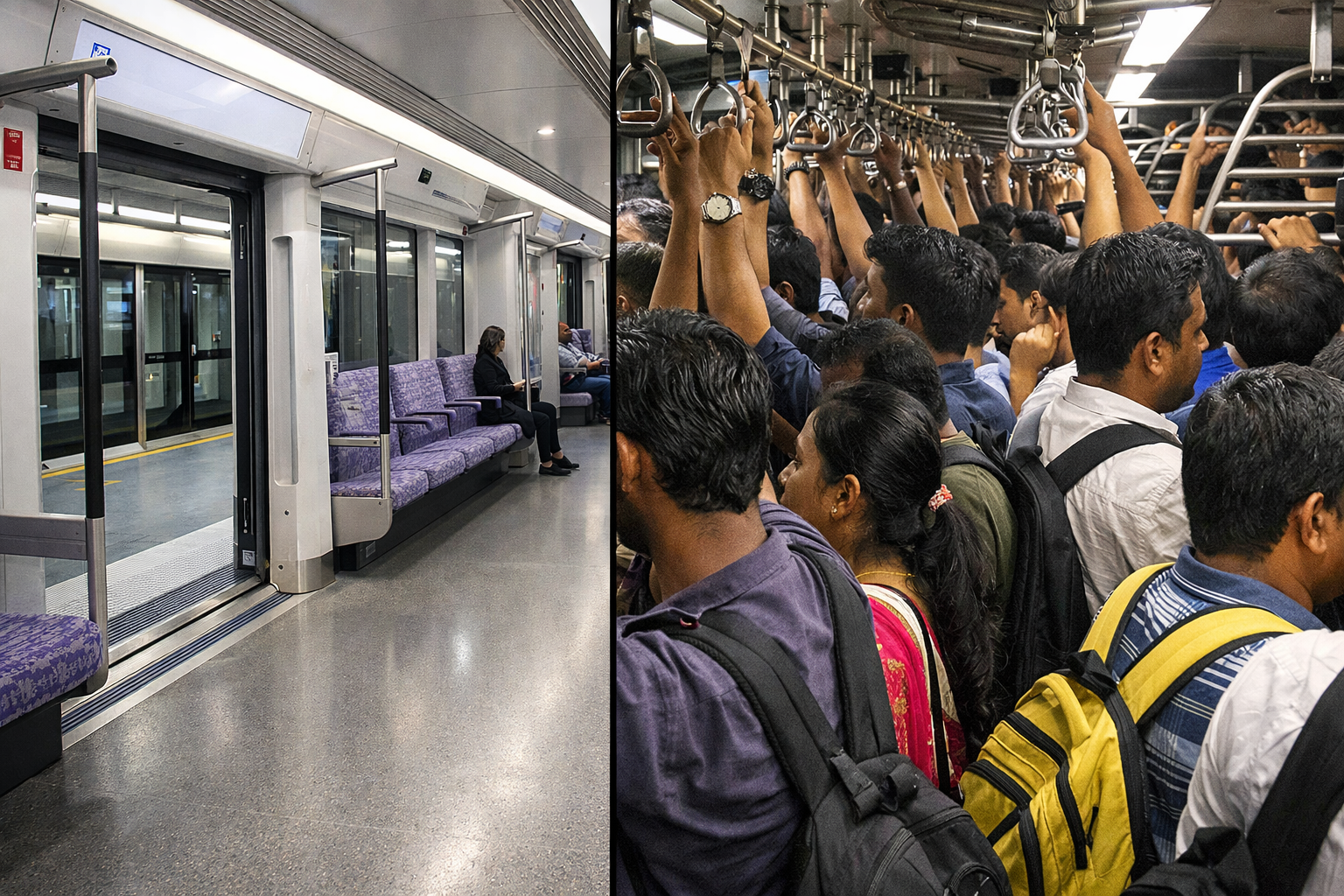
Mumbai’s suburban railway, born in 1853, moves approximately 7.5 million people daily across 390 kilometres of track. Coaches designed for 1,800 riders routinely carry 4,000 during peak hours, a crush load exceeding 500%, requiring commuters to hang from exterior handholds with practised ease. To function at all under these conditions is, in a literal sense, miraculous.
But miracles are not policy. And the inconvenient truth, buried beneath decades of romanticising the spirit of the Mumbai local, is this: two cities that built commuter railways in the same Victorian era, London from the 1830s, New York from 1834, have systematically, repeatedly, and successfully rebuilt theirs. Mumbai expanded its. There is a difference. That difference is now measured in corpses.
Three Networks, One Century – Three Very Different Choices
All three cities inherited the same Victorian-era alignment logic: radial spokes feeding dense commercial cores, built for populations a fraction of what they would become. All three were choked, at various points in the 20th century, by the collision of industrial-age infrastructure and post-war urban explosion. The question was never whether crisis would arrive. It was who would respond, and how.
London’s answer came through structural reinvention. Transport for London, established in 2000, consolidated the Underground, the overground suburban network, buses, and cycling under a single mayoral authority with ring-fenced budgets. The Oyster contactless card unified fares across all modes in 2003. Then came the Elizabeth Line, 100 kilometres of new east-west capacity, opened in 2022, shaving 30% off cross-city journey times. That it ran over budget is true. That it transformed London’s commuter geography is inarguable.
New York’s answer was stormier. The Metropolitan Transportation Authority, created in 1965, nearly died in the fiscal crisis of 1975, survived via federal bailouts, and spent the 1980s in a grinding rehabilitation of the Long Island Rail Road and Metro-North corridors. Hurricane Sandy’s 2012 devastation, with $5 billion in damage, could have broken the network. Instead, it catalysed a resilience overhaul: flood barriers, improved signalling, rolling stock replacement. East Side Access finally delivered LIRR trains to Grand Central Madison in 2023. Positive Train Control, the federally mandated collision-avoidance system, was implemented across all commuter corridors by 2018.
Neither network is flawless. But both cities made a foundational choice that Mumbai has never fully made: they treated commuter rail as an urban organism requiring its own governance, its own finances, and its own political accountability, separate from the national rail system it happened to be part of.
What Indian Railways Did Instead
Indian Railways is one of the world’s great logistical organisms, 68,000 route kilometres, 1.4 billion passengers annually, the connective tissue of a subcontinental economy. It is also, structurally, a terrible custodian of an urban commuter network. Its priorities are national by design: freight corridors, long-distance mail trains, the bullet train to Ahmedabad. Mumbai’s suburban services, generating losses of approximately ₹1,500 crore annually due to politically frozen fares, are a liability on this balance sheet. Liabilities, in any organisation, tend to be managed rather than invested in.
This has nothing to do with a shortage of money:
- India spent ₹2.65 lakh crore on railway capital expenditure in 2024
- Approximately 10% reached suburban safety and capacity upgrades
- The remainder financed the prestige economy of high-speed rail and new Vande Bharat routes
The governance mismatch is structural:
- London placed commuter rail under a city authority answerable to a mayor
- New York consolidated it under a state authority whose board includes commuter representatives
- Mumbai’s suburban rail answers to the Railway Board in New Delhi, where a Mumbai commuter’s daily mortality statistics must compete for attention alongside coal freight contracts in Jharkhand and new station development in Varanasi
When the 2023 monsoon flooded tunnels on the Central Line, a near-repeat of the 2005 deluge that killed one thousand, the response was the familiar cycle: condolence, committee, delay. New York, after Sandy, built seawalls around Penn Station. Mumbai, after 2005, rebuilt the same platforms.
The Spirit Myth – A Political Achievement of the First Order
There is a narrative about Mumbai’s suburban commuter that has served policymakers extraordinarily well for decades. It goes like this: the Mumbai commuter is uniquely stoic, uniquely adaptable, a bearer of the city’s famous spirit. They hang from doorways not because the system has failed them but because they have transcended the system. They are not victims. They are heroes.
This narrative is a political achievement of the first order. It transforms a governance catastrophe into a cultural virtue. It allows administrators, railway ministers, and newspaper columnists to speak of ten deaths per day as the cost of Mumbai’s vitality rather than the consequence of their inaction. It ensures that the commuter who falls from a moving train at Kurla is mourned briefly and forgotten quickly, while the spirit of the Mumbai local lives on as a tourism tagline.
London and New York do not romanticise overcrowding. They measure it, report it, and are held accountable for it. TfL publishes monthly performance dashboards with on-time rates, crowding indices, and safety records. The MTA faces annual state legislature scrutiny over capital plan delivery. When New York’s summer of hell in 2017 saw 75% of trains delayed, it produced a political crisis and an emergency action plan. When Mumbai’s monsoon flooding kills commuters annually, it produces a minute of silence and a renewed promise on infrastructure spending that does not arrive.
The spirit of the Mumbai local is real. The question is why so much is asked of it, and so little of the people responsible for the trains.
What Must Change Specifically
On governance:
- A Mumbai Rail Authority with genuine financial autonomy requires an act of Parliament, a clear divestment of suburban assets from Indian Railways, and a funding model combining state contribution, central grants, and non-fare revenues
- Japan’s JR East model – privatised suburban operations retaining public obligations, cross-subsidised by station retail and real estate – delivered a 60% revenue increase while preserving employment and affordability
- MTA’s Hudson Yards development generates $1 billion annually; Mumbai’s stations sit atop some of the world’s most valuable urban land and are used for tea stalls
On safety:
- Automatic door systems, platform screen doors, and perimeter fencing are capital investments with known costs
- They have not been implemented because the political calculus assigns a higher value to keeping fares artificially low, and thus avoiding the revenue required for safety capital, than to the lives of those who have no alternative
On signalling:
- Communication-Based Train Control (CBTC), which London uses to achieve two-minute headways, would increase Mumbai’s effective capacity by 20–30% without a single kilometre of new track
- It unlocks capacity from existing infrastructure rather than requiring land acquisition – Mumbai’s most intractable constraint
- This is not a technological aspiration; it is a procurement decision
On fares:
- The equity argument for low fares is genuine and must be honoured – but fares suppressed to ₹10–50 while the network haemorrhages capital is not equity; it is deferred suffering
- The alternative is a cross-subsidy model: congestion charges on private vehicles feeding rail reinvestment, targeted subsidies for low-income commuters, and fare rationalisation that raises revenues from middle-class discretionary journeys while protecting the essential commute of EBC households
- This model exists and works in London, New York, and Singapore; it requires political will that Indian Railways, as a national body, has no institutional incentive to develop
1853 Was the Birth. Now Choose the Legacy.
London’s Elizabeth Line opened in 2022, 186 years after the city’s first suburban railway. New York’s East Side Access opened in 2023, 189 years after the Long Island Rail Road’s first service. These are not stories of wealthy cities spending freely. They are stories of cities deciding, after decades of deferred investment and political embarrassment, that they owed their commuters something better than what they had inherited.
Mumbai’s suburban railway is 173 years old. It has carried generations across the same tracks, through the same monsoons, past the same encroachments. It has never once stopped being essential. It has almost never been treated as such by the authorities responsible for it.
The comparison with London and New York is uncomfortable not because it is unfair, but because it is accurate. Both cities eventually decided that a rail network is not a legacy asset to be managed but a living system to be renewed. Mumbai has not yet made that decision at the level that matters, legislatively, financially, institutionally.
Ten people die on Mumbai’s rails every day. They have been dying at approximately this rate for two decades. This is what a policy decision looks like when the decision is not made, the status quo, dressed up as resilience, accumulating its casualties in silence.
India’s financial capital deserves a financial capital’s railway. Not the one it inherited. Not the one it has. The one it could build, if those responsible for it were required to be responsible for it.
The tracks are there. The passengers are there. The money, whatever the Railway Board claims, is there. What remains is the institutional courage to stop calling suffering a spirit, and start treating a lifeline like one.
This analysis draws on comparative governance data from Transport for London, the Metropolitan Transportation Authority (New York), Indian Railways Annual Reports, and Mumbai Urban Transport Project documentation.
Subscribe Deshwale on YouTube
