




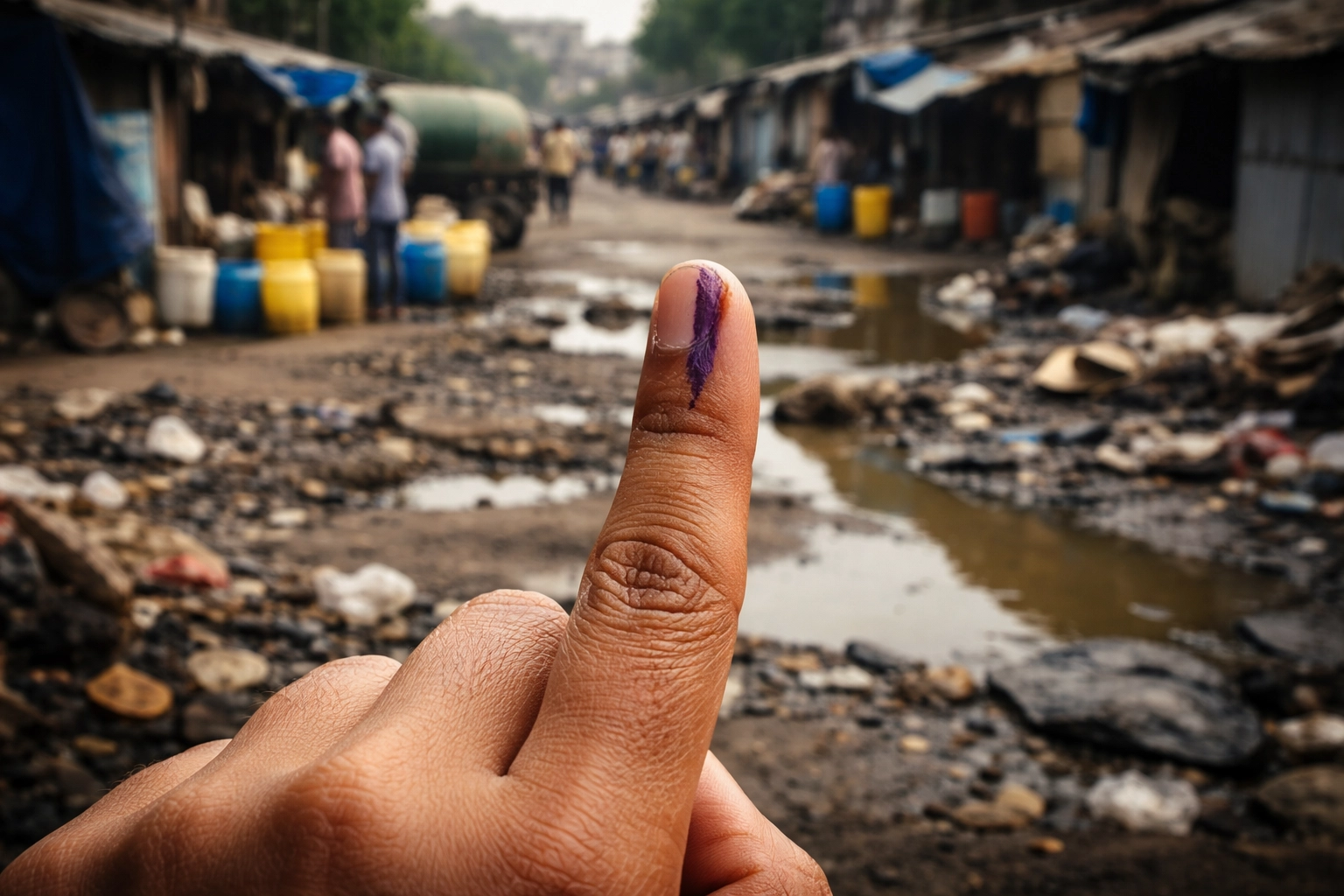
In 2010, the people of Haiti went to vote.
It had been a devastating year. A catastrophic earthquake had killed over 200,000 people. Entire neighbourhoods had turned to rubble. Families were living in tents. And yet elections were held. International observers flew in. The world applauded.
Six months later, those same tent cities were still standing.
The vote had happened. The suffering had not stopped.
The Promise and the Reality
Every democracy in the world is built on a beautiful idea:
Power belongs to the people.
But somewhere between that idea and real life, something gets lost.
In 2016, residents of Flint, Michigan, a city in the world’s most powerful democracy were drinking poisoned water. Lead had been leaking into the water supply for months. Officials knew. They said nothing. Families bathed their children in it. Babies drank it.
The people of Flint had voted in every election. They had done everything a citizen is supposed to do.
It didn’t matter.
By the time the story broke, the damage to hundreds of children brain damage, developmental delays, and a lifetime of consequences was already permanent.
No election could undo that.
A Vote Is the Beginning. It Is Not the Point.
Here is the quiet lie that most democracies tell their citizens:
“You have power. You can vote.”
What they don’t say is: “After that, you will not be consulted again for the next four to five years no matter what we do with your money, your schools, your air, or your future.”
Think about what actually happens between elections.
In India, farmers have been killing themselves at a staggering rate for decades over 300,000 deaths by suicide since 1995, many driven by debt and broken government promises. Every government since has declared it a priority. Every government since has moved on.
In Brazil, between 2019 and 2022, the Amazon rainforest lost an area larger than France to deforestation driven by government policy. The people living in those forests, many of them indigenous communities, did not vote for that. They had no mechanism to stop it. They could only wait for the next election, which may or may not change anything.
In the United Kingdom, one of the oldest democracies in the world, a government-led inquiry found in 2024 that infected blood products given to NHS patients in the 1970s and 80s had knowingly harmed tens of thousands of people. The cover-up lasted fifty years. Across dozens of elections. Across multiple governments.
Fifty years.
People voted. People suffered. The system stayed silent.
Who Actually Benefits from This Arrangement?
Here is the question the earlier version of this article was too polite to ask directly:
Why hasn’t this been fixed?
Not because it can’t be. Because it is useful to the right people for it to stay broken.
When voters only engage once every five years, politicians can afford to ignore them the rest of the time. Their real attention goes to whoever has consistent access: lobbyists, corporations, donors, party insiders. These groups don’t wait for election day. They have phone numbers. They have meetings. They have leverage every single day.
In the United States, studies have shown that congressional decisions align with the preferences of economic elites and business groups far more strongly than with the preferences of average citizens even when the majority of the public clearly wants something different.
This is not a conspiracy. It doesn’t need to be. It is simply a system where organised, consistent access wins and ordinary citizens, who show up once every four years and then go home, lose by default.
The powerful do not need to rig elections. They just need to make sure elections are the only meaningful form of participation available.
The Theatre of Accountability
We are very good at performing accountability without practising it.
Parliamentary debates happen and are ignored. Committees are formed and shelved. Inquiries are launched and produce reports that sit unread in government archives. Ministers resign and return to power eighteen months later with a different title.
In South Africa, the Zondo Commission spent years and billions of rands investigating “state capture” , the systematic looting of public institutions by Jacob Zuma’s government. Thousands of pages. Damning findings. Overwhelming evidence.
Zuma served 15 days of a 15-month sentence before being released on medical parole.
In Italy, Silvio Berlusconi was convicted of tax fraud in 2013. He used his continued political influence to avoid prison. He remained one of the most powerful figures in Italian politics until his death in 2023.
The system creates the appearance of consequences without the reality of them.
And ordinary people who cannot afford lawyers or lobbyists, who do not own newspapers, who cannot fund political campaigns are left watching a performance and calling it justice.
The People Who Have Stopped Watching
In the 2020 US presidential election celebrated globally as a historic turnout one in three eligible voters still did not vote.
In France’s 2022 legislative elections, abstention hit a record high. More people chose not to vote than voted for any single party.
In most democracies, the people who vote least are the young, the poor, and those who have been most failed by the system. This is not apathy. When you work two jobs and can’t afford to take time off on a Tuesday, that is not apathy. When every party has promised you something and none has delivered, that is not apathy.
That is experience.
And the devastating irony is that when these groups disengage, politicians respond by focusing even more on the groups who do vote: the older, the wealthier, the more connected. Which makes the system work even less for those who have already given up on it.
It is a self-sealing loop. Abandon the system, and the system abandons you more.
What We Actually Choose When We Vote
Here is something worth sitting with.
When you vote, you are not choosing what your tax money will be spent on. You are not voting on the national budget, the education curriculum, the healthcare plan, or the foreign policy. You are choosing one person or one party who will then make all of those decisions for you, mostly behind closed doors, mostly without consulting you, for the next several years.
This system representative democracy was designed in an era before electricity. When gathering public opinion meant weeks of travel. When newspapers were the fastest form of communication. When the idea of asking millions of citizens their view on a specific policy was genuinely impossible.
That world no longer exists.
Today, a single survey can capture the views of a million people in hours. Technology allows real-time consultation on policy decisions. The tools for genuine participation exist. They are simply not used because using them would shift power away from those who currently hold it.
Switzerland manages it. Swiss citizens vote on specific national policies multiple times a year not just on who governs, but on what the government actually does. Participatory budgeting where citizens directly decide how portions of public money are spent has been used in Porto Alegre in Brazil, in New York City, in Seoul. It works. It is just rare, because it requires governments to genuinely share control.
The Hardest Truth
The most uncomfortable thing about democracy is this:
It requires citizens to want more from it than it currently offers.
Not just on election day. Every day.
In 2019, millions of people took to the streets in Chile not over a single election, but over years of accumulated inequality, of a system that worked beautifully for a small elite and left everyone else behind. The protests forced a constitutional rewrite. Messy, imperfect, ultimately incomplete but it happened because citizens refused to accept that voting was enough.
The same year, Lebanon saw a spontaneous uprising triggered by a proposed tax on WhatsApp calls, but built from decades of a political class that looted the country with total impunity. Ordinary people across sectarian lines that had divided them for generations stood together in the streets and said: this is not the deal we agreed to.
They were right. It wasn’t.
What Real Democracy Looks Like
Real democracy is not one day every five years.
It is a daily reality in which citizens can remove a corrupt official mid-term, not just wait for an election to do what should have been done already. Public budgets and your money are debated openly, with public input, not decided in rooms ordinary people cannot enter. When a major policy decision is made, citizens are told in plain language: here is who benefits, here is who pays, here is what the evidence says. And when a government fails its people, there are real consequences not a Commission report and a resigned minister who reappears six months later with a book deal.
This is not fantasy. The tools, the examples, the proof of concept they already exist.
What is missing is the political will to use them. And political will does not appear on its own. It is forced into existence by people who refuse to disappear between elections.
Democracy was not built so that we could suffer politely every day and express it quietly once every five years.
It was built on the radical idea that those who govern should answer genuinely, continuously, concretely to those they govern.
The gap between that idea and the system most of us live in is not inevitable. It is a choice made by those who benefit from the gap, and permitted by those of us who have accepted that voting is the finish line rather than the starting point.
It isn’t.
The vote is the floor. Not the ceiling.
What gets built above it the protests, the journalism, the community organising, the refusal to be forgotten between elections that is where actual democracy lives.
Haiti, Flint, the Amazon, fifty years of infected blood, water that poisoned children.
This did not happen because democracy failed.
They happened in places where citizens were told their job ended at the ballot box.
It doesn’t.
It never did.
“Democracy is not a spectator sport.” Marian Wright Edelman
Subscribe Deshwale on YouTube
