




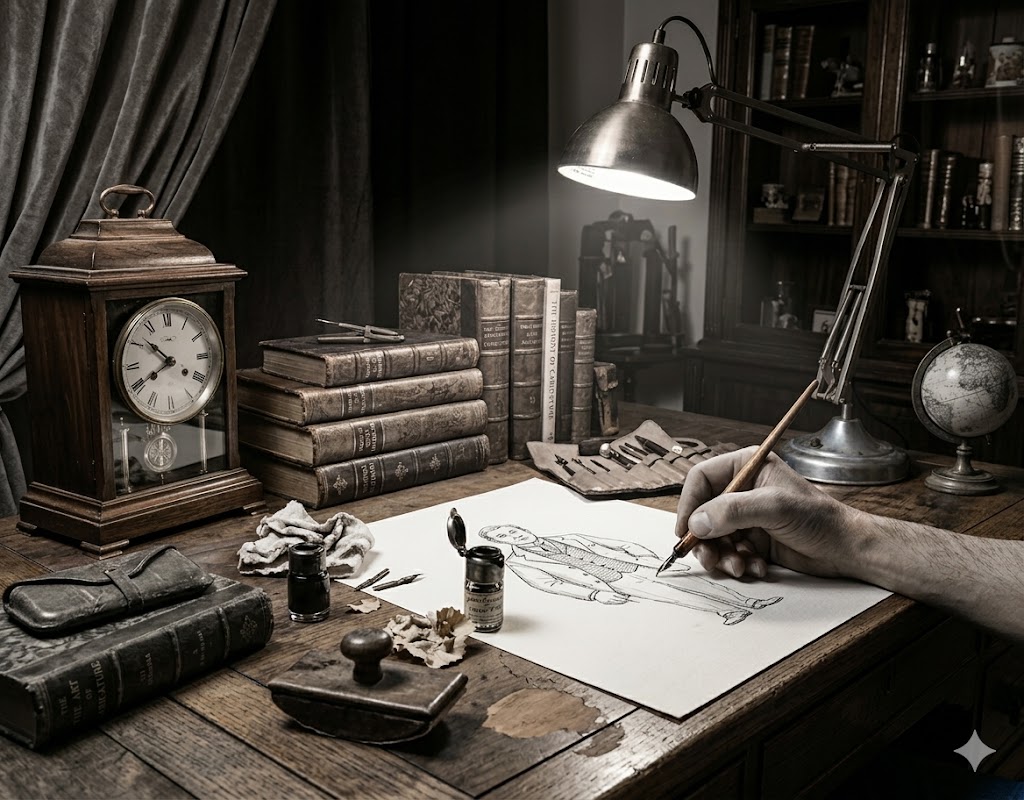
For three centuries, the editorial cartoon was the most dangerous single object a newspaper could publish. One image could bring down a government, free a people, or get its maker killed. Today, fewer than thirty staff cartoonists remain employed at American newspapers. This is the history of how the most powerful art form in journalism was laughed into extinction.
On the morning of 19 July 2023, three men received telephone calls they had not expected. Jack Ohman, the Sacramento Bee’s editorial cartoonist and the sitting president of the Association of American Editorial Cartoonists, was told his position was eliminated. He had no warning at all, he said afterwards, no meeting, no process, no conversation about his fifteen years at the paper. Joel Pett, whose cartoons from the Lexington Herald-Leader had won him a Pulitzer Prize, was let go. Kevin Siers, who had drawn for the Charlotte Observer since 1994 and who had also won a Pulitzer, was fired by the same chain, McClatchy, on the same morning. Three Pulitzer-Prize-winning cartoonists. One morning. Thirty newspapers in the McClatchy chain would publish no more editorial cartoons. The decision, the company explained, was based on changing reader habits and a relentless focus on providing the community with important local journalism. McClatchy did not appear to notice the contradiction in that sentence.
Ohman, speaking from the wreckage of a career he had built over decades, was not bitter in the register one might expect. He was precise. “I had no warning at all,” he told the Associated Press. And then, with the economy of a man who has spent his professional life saying complex things in the smallest possible space: “At the end of the day, I think people like cartoons. But it’s hard for a cartoon to be ecumenical.” The word ecumenical is worth dwelling on. It means broadly acceptable, universally welcoming, safe for all audiences. It is, in the context of editorial cartooning, an exact description of what the form has never been, cannot be, and must not become if it is to remain what it has always been: the sharpest instrument in the democratic press, the one piece of content that cannot be bothered into blandness because a line drawing either cuts or does not, and a drawing that does not cut is merely decoration.
The firing of Ohman, Pett, and Siers on 19 July 2023 was not an event. It was a punctuation mark, the latest period in a sentence that has been running for sixty years, the sentence that describes the slow and systematic elimination of editorial cartooning from the newspapers that created it, sustained it, deployed it against kings and bosses and war and fraud, and are now completing its destruction with the same efficient disregard that they once brought to cutting foreign bureaus and investigative desks and book review sections. The art form that brought down Boss Tweed, rallied Britain against Hitler, and gave independent India a mirror in which it could see itself clearly for the first time is now staffed, in the United States, by fewer than thirty full-time practitioners. There were two thousand at the start of the twentieth century. Two hundred and seventy-five in 1957, the year the professional association was formed. Fewer than thirty now.
The descent is not a trend. It is an elimination.
This essay is an attempt to understand that elimination, not simply as a media economics story, which it also is, but as a cultural and political history of the most consequential art form that the newspaper ever housed. To understand what has been lost, you must first understand what it was. And to understand what it was, you must begin not with a newspaper office but with a prison cell in Paris in 1832, where a lithographer named Honoré Daumier was serving six months for the crime of drawing a king who looked like a pear.
I. The Dangerous Picture: From Broadsheets to Battlefields (1500 to 1870)
The editorial cartoon did not begin with newspapers. It began with power and the desire to diminish it, with the Protestant Reformation’s satirical woodcuts mocking the Pope’s corpulence and the Cardinal’s greed, distributed as broadsheets to audiences who could not read Latin but could understand an exaggerated face. In the sixteenth century, when Martin Luther’s supporters employed the printing press to circulate engravings of Rome’s corruption, they were doing something that would be repeated in every subsequent century by every subsequent radical movement that understood the simple, devastating truth: a picture can travel further than a word, and can be understood by people who have never been given the chance to learn words.
William Hogarth formalised this truth in early eighteenth-century England with his sequential engravings, A Rake’s Progress, Beer Street and Gin Lane, Marriage A-la-Mode, multi-panel satires of social hypocrisy and class corruption that were sold as prints affordable to the middling sort, not just the wealthy collector. Hogarth understood that the cartoon’s power lay precisely in its accessibility: it could not be made difficult. A complex argument, put in prose, could be misread or ignored by someone without the education to follow it. Put in a picture, exaggerated, labelled, its meaning visible in the drawing’s own geometry, it arrived in the mind before the defences went up. It was the first truly mass medium, faster than a pamphlet, more immediate than a sermon, more specific than a rumour, and infinitely reproducible at a cost that the new printing presses of Europe were reducing year by year.
In France, the tradition found its martyr in Honoré Daumier, who was arrested in 1832 for his lithograph Gargantua, published in the satirical weekly La Caricature, which depicted King Louis-Philippe as an enormous figure seated on a commode-throne, being fed the taxes extracted from the poor and excreting them as government favours to his courtiers. The image was not subtle. It was not intended to be subtle. Daumier was tried, convicted of inciting contempt of the king, and sentenced to six months in prison and a five-hundred-franc fine. The French government, having imprisoned the artist, then banned political cartoons altogether. The sequence, drawing, arrest, censorship, prohibition, would be repeated in one form or another by every government in every century that followed, in every country that had both a free press and something to hide. The cartoon was banned because it worked. Power does not censor things that do not matter.
When Daumier emerged from prison, he moved to the newspaper Le Charivari, whose very name, meaning a loud and discordant cacophony used to mock the socially transgressive, was a statement of purpose, and spent the next four decades producing over four thousand caricatures of bourgeois life, political corruption, and the justice system’s contempt for the poor. His Rue Transnonain, published in 1834, depicted the bodies of a working-class family massacred by government troops in the aftermath of a labour uprising, a man in his nightshirt dead on the floor over the crushed body of his infant child, his neighbours dead around him. It was not a political cartoon in the conventional sense. There was no exaggeration, no symbolism, no label on a barrel. It was a documentary image rendered in the visual language of caricature, and it was so devastating in its specificity that the government attempted to seize every printed copy from the shops. They failed, as governments always fail to contain an image that has already been seen.
Across the Atlantic, the tradition was developing on its own trajectory, rooted in the specific anxieties of a new democracy that had built its founding documents on Enlightenment principles and its economic foundations on slavery. Benjamin Franklin’s 1754 woodcut Join, or Die, a snake divided into eight segments, each labelled with a colony, was the first American newspaper cartoon, published in the Pennsylvania Gazette to argue for colonial unity against the French. It was a map, an argument, and a threat, compressed into a single image that could be reproduced on any press in any colony and understood by anyone who could look. The image was revived during the Revolutionary War and again during ratification debates. It is one of the most reproduced images in American political history. Franklin drew it in under an hour. It has been arguing his case for two and a half centuries.
II. The Golden Age and Its Heroes (1870 to 1945)
If any single figure marks the transition from the cartoon as radical pamphlet to the cartoon as journalistic institution, it is Thomas Nast, who arrived in the United States from Germany as a child in 1846 and grew up to become, in Abraham Lincoln’s assessment, the Union Army’s best recruiting sergeant. Nast joined Harper’s Weekly during the Civil War and spent the following three decades producing images so influential, so widely reproduced, and so politically specific that they changed the outcomes of elections and ended the careers of men who thought themselves untouchable.
The most famous chapter of his career was his campaign against William Marcy Tweed, the Tammany Hall boss who controlled New York City’s finances with such comprehensive corruption that he was, by some estimates, extracting between ten and two hundred million dollars from the city’s treasury through a network of bribes, inflated contracts, and electoral fraud. Tweed was not a subtle man and he was not a discreet one; he operated in full view of the press, secure in the knowledge that the people who might expose him either worked for him or owed him something. What he had not anticipated was Nast, who drew him repeatedly, bloated, corrupt, arrogant, visibly contemptuous of the city he was plundering, in images that circulated to every literate household in New York and to many that were not literate at all. Tweed reportedly understood the threat perfectly. “Stop them damn pictures. I don’t care so much what the papers write about me. My constituents can’t read. But, damn it, they can see pictures.” He tried to bribe Nast with one hundred thousand dollars to go to Europe to study art. Nast declined. Tweed died in prison in 1878.
The Nast era established the institutional conditions under which the editorial cartoon would flourish for the next century: a mass-circulation newspaper, a politically engaged readership, a publisher willing to take the risk that came with publishing something that might offend a powerful person, and a cartoonist with the skill, the nerve, and the institutional support to draw something that could not be ignored. Nast also invented two of the most durable symbols in American political culture, the Democratic Party’s donkey and the Republican Party’s elephant, both of which emerged from his pen in the 1870s and have not changed significantly since. He gave independent India’s children a lasting image of Father Christmas, refining the figure from the diverse regional traditions of Saint Nicholas into the red-coated, white-bearded form that the Coca-Cola Company would eventually borrow and render globally standardised. A cartoonist shaped the imagery of the American political system and the iconography of Christmas. The profession’s cultural reach, at its peak, was total.
In Britain, the tradition found its institutional home in Punch, founded in 1841 as an explicitly satirical magazine modelled on La Caricature and Le Charivari. Punch’s cartoonists, among them John Tenniel, who drew the most famous image in Victorian political cartooning with Dropping the Pilot in 1890, showing Bismarck descending the steps of the ship of state as the young Kaiser Wilhelm II watched from the deck, were among the most culturally powerful figures in British public life. Tenniel is better remembered now as the illustrator of Alice in Wonderland, which he also was, but his political cartoons were more important in his own time. The image of Bismarck stepping down appeared on the front page of Punch and was reproduced across the European press within days, shaping the public’s understanding of a major geopolitical event before any political analysis had been written. The cartoon arrived first. The explanation came later.
The figure who stands most significantly at the convergence of British cartooning’s golden age and the Indian tradition it produced, not through intention but through the specific power of the images he made, is David Low. Born in New Zealand in 1891, working in Australia before settling in London, Low spent the interwar years at the Evening Standard producing cartoons of Hitler, Mussolini, Stalin, and Churchill that were, in some cases, the most diplomatically significant images in the English-speaking world. His 1939 cartoon Rendezvous, showing Hitler and Stalin bowing to each other over the corpse of Poland with identical unctuous grimaces, captured the moral obscenity of the Molotov-Ribbentrop Pact with an economy that no editorial could match. Hitler banned Low’s cartoons from Germany and occupied Europe. Mussolini had him investigated. Von Ribbentrop reportedly made a formal complaint to the British government about the cartoons, which the British government politely ignored. Winston Churchill was drawn by Low more than any other subject and hated it and kept the originals. The relationship between a powerful man and the cartoonist who draws him honestly has always had this quality: the powerful man knows the drawing is telling the truth about him, which is why he cannot bear it and cannot look away.
III. The Indian Inheritance: From Vernacular Punch to the Common Man (1870 to 2015)
In British-ruled Bengal, political cartoons appeared in newspapers as early as the 1870s, published in the vernacular Punch-style journals that sprang up across colonial India in imitation of the London original. The Anglo-Gujarati Parsi Punch in Ahmedabad, the Urdu Oudh Punch in Lucknow, the Hindi Hindu Punch in Calcutta, these comic papers, as they were called, were weekly publications that brought political commentary and caricature to literate audiences across the subcontinent, in multiple languages, framing the questions of colonial rule and nationalist aspiration in images that crossed the barriers of formal political discourse. In March 1922, Anandabazar Patrika in Kolkata published its first cartoon, calling for the resignation of Lord Montagu, then Secretary of State for India. The cartoon was an institutional gesture of the new nationalist press: claiming the weapon of political satire as an Indian weapon, deploying it against the British administration, in the language of visual argument that the British press itself had pioneered.
The figure who most completely defined Indian political cartooning in the independence era was Kesava Shankara Pillai, known as Shankar, born in 1902 in Kayamkulam in Kerala, who became the cartoonist for the Hindustan Times in Delhi and then launched Shankar’s Weekly in 1948, deliberately modelled on Punch as an Indian institutional equivalent. Jawaharlal Nehru, who was among the most sophisticated consumers of political satire among world leaders of his era, gave Shankar the instruction that became the defining motto of Indian cartooning’s early democratic spirit: “Don’t spare me, Shankar.” It was not merely a personal tolerance of mockery. It was a philosophical position, that a democracy required the cartoon as a constitutional function, that the cartoonist who did not spare the Prime Minister was performing a civic duty, that satire was not an option in democratic journalism but a necessity. Nehru had Shankar’s cartoons of him framed and hung in his office. He requested enlarged copies with the artist’s autograph. He understood that being drawn honestly was part of what it meant to hold power honestly.
The tradition Shankar established was continued and deepened by Rasipuram Krishnaswami Iyer Laxman, known as R.K. Laxman, who joined the Times of India in 1951 and published his daily cartoon strip You Said It on its front page for more than half a century. The strip’s central figure, the Common Man, a bespectacled, dhoti-clad, bewildered everyman in a checked coat who stood and watched the spectacle of Indian democracy with perpetual and dignified incomprehension, was not a political actor. He was a political witness. He did not speak, did not act, did not organise or resist or demand. He stood at the edge of every cartoon and observed: the corruption, the bureaucratic indifference, the gap between the politician’s promise and the citizen’s experience, the distance between independent India’s aspirations and its daily realities. In doing so, he became the most precise representation of the Indian political subject that any art form in any medium has produced. Salman Rushdie mentioned him in two novels. A bronze statue of him stands at Symbiosis International University in Pune. He was given a face by one man, who saw every Indian in it, and then was recognised by every Indian as themselves.
Laxman worked in the shadow of David Low, whose signature he had misread as “cow” for years in his Mysore childhood, squinting at the cartoons that appeared in The Hindu, and eventually emerged from that shadow entirely. His linework was precise where Low’s was bold; his humour was gently deflating where Low’s was incendiary; his politics were forensic where Low’s were declaratory. He gave Indira Gandhi a long nose and a strong chin. His cartoon on her assassination in 1984, showing the broken figure of the Common Man and the silence of the witnesses, captured the national trauma in a way that every editorial combined could not. When Jawaharlal Nehru saw a Laxman cartoon targeting him in 1962, he called the cartoonist and requested an enlarged copy with Laxman’s autograph, so that he could frame it, because he had enjoyed it enormously. The anecdote measures the distance between the Nehru era and every era that followed it.
During the Emergency of 1975 to 1976, Laxman’s cartoons were not published. The Times of India complied with the censorship regime without significant resistance, as most of the Indian press did. The absence of the daily cartoon from the front page was, for those who had read it every morning for twenty-four years, a specific kind of silence, the silence of a check that had been disabled, a corrective voice that had been switched off. The Emergency ended. Laxman came back, as he said himself, all guns blazing. But the episode revealed something that the democratic theory of the cartoon had always assumed away: the institutional will to publish it was as essential as the artist’s will to draw it, and the two did not always align.
IV. The Contraction Begins: Television, Syndication, and the First Dying (1950 to 2000)
The decline of the editorial cartoonist as an institutional figure in the newspaper did not begin with the internet. It began with television, which arrived in American living rooms in the late 1940s and 1950s and fundamentally altered the relationship between the newspaper and its public. Before television, the newspaper was the primary medium of political spectacle, the place where national events were visualised and interpreted for a mass audience. The editorial cartoon was the most powerful instrument of that visualisation: it made the face of the President, the shape of the crisis, the nature of the corruption, legible to anyone who could look. When television gave audiences the actual face of the President, in moving image, with sound, in their own living room, the newspaper lost something irreplaceable, the monopoly on the visual imagination of political life.
The numbers tell the story with the clarity of a well-drawn line. At the start of the twentieth century, an estimated two thousand editorial cartoonists were employed by American newspapers, one for virtually every paper of any size in every city of any significance. By the time the Association of American Editorial Cartoonists was formed in 1957, that number had fallen to two hundred and seventy-five. The decline from two thousand to two hundred and seventy-five happened mostly between 1930 and 1957, driven by the consolidation of the newspaper industry, the rise of syndication, which allowed a single cartoon to serve dozens of papers simultaneously at a fraction of a staff cartoonist’s salary, and the migration of the visual attention of the public to radio and then television. The individual staff cartoonist, employed by a specific paper, drawing cartoons about the specific corruption of specific local officials and specific regional politicians, was being replaced by the syndicated cartoon, national in scope, broadly acceptable in politics, designed to offend no one because it had to serve a hundred markets simultaneously.
This shift had a specific consequence for the form’s most important function. The local editorial cartoon, the cartoon that drew the city councillor who was taking bribes from the construction contractor, the state legislator who had gerrymandered his district, the police chief who had covered up the beating, was the cartoon that had the most direct political effect. It was the cartoon that Boss Tweed had feared, because it named him specifically to the people he was defrauding. The syndicated cartoon, national in scope and therefore unable to name anyone specific, replaced this with something safer and duller: commentary on Washington politics, visual opinion on national events, the cartoon as ideological decoration rather than investigative instrument. Matt Groening, the creator of The Simpsons who had himself come up through the alt-weekly cartooning tradition, identified the consequence precisely: cartoonists in this paradigm were “at the bottom of the food chain,” existing to fill a space on the opinion page rather than to perform a specific institutional function.
The syndication model also changed the relationship between cartoonist and editor in ways that were structurally damaging to the form. The staff cartoonist, employed by a single paper, working in its newsroom, attending its editorial meetings, knowing its advertisers and its community and its local power structure, had accountability in both directions: he was accountable to the paper for the quality of his work, and the paper was accountable to the community for what the cartoonist said. The syndicated cartoonist, serving hundreds of markets through a distributor, was accountable to no specific community and could be accountable to no specific editor. The cartoon became free-floating, removed from the institutional and democratic context that had given it its function, deployed as an inoffensive filler in spaces where a more specific and more dangerous image once appeared.
V. The Digital Catastrophe and the McClatchy Massacre (2000 to the Present)
The internet did not invent the decline of the editorial cartoon. It accelerated it to terminal velocity. When newspaper advertising revenues collapsed, precipitously from 2006 onwards, catastrophically from 2008, and continuously through every year since, the editorial cartoon was among the first casualties of every cost-cutting exercise, for reasons that reveal something important about how newspapers had come to understand their own function.
The editorial page, the section of the newspaper that housed the cartoon, the op-ed column, the signed editorial, the letters from readers, was a production without commercial logic. It carried no advertising. It was expensive to staff and generate. It was, in the economic framework that the new newspaper management imposed after the collapse of print advertising, a liability without an offsetting asset. The editorial cartoon was the most expensive item on that page for the size of the space it occupied: a staff cartoonist earned a full salary, required a private office and time and the institutional infrastructure of a newsroom, and produced one image per day that ran at approximately three columns wide. In the financial calculus that determined newsroom staffing after 2008, a cartoonist’s salary could be replaced by a syndication contract at a fraction of the cost, or the space could be eliminated entirely. Most editors chose one or the other.
The figures from the Herb Block Foundation, named after the Washington Post’s Pulitzer-winning cartoonist who had spent fifty years drawing with the vigour of a man who understood his institution’s obligation, are the most precise account of the descent. Two thousand staff cartoonists at the start of the twentieth century. Two hundred and seventy-five in 1957. By 2020, when Pulitzer winners Signe Wilkinson and Tom Toles retired from the Philadelphia Daily News and the Washington Post respectively, neither position was filled. By the time of the McClatchy firings in July 2023, fewer than thirty full-time editorial cartoonists were employed at American newspapers. Matt Bors, one of the few practitioners of the younger generation who had built a career in cartooning before transitioning to digital platforms, described the arc with the precision of an insider: “I wasn’t the future of editorial cartoons; I was one of the last people making a go at it.”
The McClatchy firing of July 2023 was not the end of this story. It was representative of a pattern that had been repeating itself, with less fanfare, for fifteen years. The Seattle Times had fired its cartoonist of six years. The Kansas City Star had fired its cartoonist of twenty-seven years. The Ventura County Star had fired its cartoonist. In 2008 alone, by one count, at least sixteen newspaper staff cartoonist positions were eliminated. The trade blog The Daily Cartoonist tracked them as they fell, one by one, sometimes in clusters, the human beings who had constituted the institutional memory of local political satire being shown the door with the institutional courtesy appropriate to the permanent cancellation of a function nobody in management had ever quite understood.
What was being eliminated was not merely a job category. It was a specific kind of knowledge, the knowledge of how to compress a complex political moment into a single image, how to make the complexity of the news legible without making it simple, how to be funny and fierce simultaneously, how to draw the face of power in a way that everyone recognises and power cannot deny. This knowledge takes decades to acquire. It is acquired through the specific discipline of the daily cartoon, one image per day, every working day, no days off for inspiration, no excuses accepted for a blank page. The cartoonists who survived the successive waves of layoffs, Pulitzer winners, artists of genuine distinction, people who had spent thirty years refining an instrument, were eliminated with the same efficiency as any other budget line. Their expertise died with their employment. No one is being trained to replace them.
VI. What the Cartoon Was: A Theory of the Form
The editorial cartoon operated at the intersection of three distinct forms of knowledge: political analysis, artistic skill, and moral courage. The political analysis told the cartoonist what to draw, which event, which figure, which decision, which lie was ripe for visual treatment on this specific morning. The artistic skill determined how to draw it, what symbol to use, what angle to take, how to exaggerate without lying, how to simplify without distorting. The moral courage was what made the drawing publishable, which is to say: what made the cartoonist willing to draw the thing that needed to be drawn even when the thing that needed to be drawn was a specific representation of a powerful person who had the resources and the motivation to make the cartoonist’s life significantly worse.
The cartoon that did not require courage was not an editorial cartoon. It was a cartoon, an illustration, a decoration, an inoffensive arrangement of lines that occupied space on a page without consequence. The history of the form is a history of courage: Daumier going to prison for the pear. Nast declining the hundred-thousand-dollar bribe. Low drawing Hitler when Hitler controlled Europe. Laxman drawing Indira Gandhi with a long nose and a stronger chin, every morning, through three governments and a national emergency. The cartoonists who were fired by McClatchy in 2023 had won Pulitzer Prizes, which means that in the judgment of the profession’s most authoritative award body, they had produced work of genuine consequence, work that the democratic press was obligated to publish and to protect.
The form’s power derived, at its deepest level, from a specific property of the drawn image that the written word does not share: it cannot be fully argued with. A written analysis can be rebutted with another written analysis. An editorial can be contested by a letter to the editor. But a drawing of a corrupt politician in a corrupt politician’s posture, rendered with the accuracy of an artist who has spent decades studying the human face and body, sits on the page as a visual fact. The politician can deny the characterisation. The reader cannot unsee the image. Thomas Nast understood this when he declined the bribe: not because he was immune to money, but because he understood that the image, once published, existed independently of any argument about whether it was fair. It was there. Every voter who saw it carried it. It could not be un-published by a counter-editorial. It could only be countered by another image, and the other image would have to be as good, which Tweed’s image-makers could not manage, because Nast was better than they were.
Boss Tweed also understood it. “My constituents can’t read. But, damn it, they can see pictures.” This is the cartoon’s democratic function stated with the clarity of someone who suffered from it. In a society of unequal literacy, in a democracy where the franchise extends to people whose access to complex written argument is limited by education and time, the image is the most inclusive form of political communication. It reaches where the editorial does not. It stays where the article fades. The cartoon was the democratic press’s most democratic instrument.
VII. The Meme, the Algorithm, and the Question of Succession
The most common argument offered in defence of the editorial cartoon’s decline is that it has been superseded, that the internet has democratised visual political commentary, that anyone with a smartphone and a social media account can now produce and distribute images mocking power, that the meme has replaced the cartoon as the primary vehicle of visual political satire, and that the loss of the staff cartoonist is therefore not a loss but a transformation. This argument is wrong, and wrong in a specific way that matters.
The meme is not a cartoon. It is a quotation repurposed for mockery, an existing image, usually a still from a film or a television programme, overlaid with text that recontextualises it for satirical effect. It requires no original artistic skill. It requires no political analysis beyond the recognition of a parallel. It can be produced in seconds and distributed in minutes. It is also, by definition, derivative, its humour depending on the audience’s recognition of the source material, and its satirical force limited by the distance between the source image and the target situation. A meme is a joke. An editorial cartoon is an argument.
More importantly, the meme is anonymous or pseudonymous, produced by individuals who bear no institutional accountability for their content, distributed by platforms whose algorithms reward engagement regardless of accuracy or fairness, and consumed in a context, the social media feed, that dissolves the distinction between satire and propaganda, between the image that is exaggerated for comic effect and the image that is falsified to deceive. The editorial cartoonist working for a newspaper operated within an institutional framework of accountability: the paper could be sued, could be held to account by its community, was required to correct factual errors, and was subject to the professional standards of journalism. The meme-maker on social media is subject to none of these constraints, which is partly why memes can be so funny and wholly why they cannot do what the cartoon did.
What the meme environment has produced is not the democratisation of visual political satire. It is the atomisation of it, the dispersal of the form’s energy into millions of individual moments of mockery that have no cumulative political force because they are attached to no institution with the editorial authority to direct them toward a sustained argument. Nast’s campaign against Tweed worked because it ran in the same publication, week after week, building a sustained case through a series of images that each added to a cumulative record. A million individual memes, each funny in isolation, each forgotten in the feed within hours of publication, produce no equivalent cumulative force. They are fireworks. The editorial cartoon at its best was a siege engine.
There is, in the digital era, one institutional form that has partially preserved the function of the editorial cartoon: the independent newsletter and the Substack publication, which has allowed a handful of cartoonists, among them Eli Valley, Tom Tomorrow, and Matt Bors, to build direct-subscription audiences and to work without the editorial constraints and commercial pressures of a newspaper employer. The form survives in these spaces, recognisably itself, doing something close to what it did in the newspaper. But these are boutique operations, serving self-selected audiences of already-convinced readers, without the mass-circulation reach that gave the newspaper cartoon its democratic function. A cartoon published in Harper’s Weekly in the 1880s was seen by the audience that needed to see it. A Substack cartoon in 2026 is seen by the audience that has already agreed with it.
VIII. The Cartoonist as the Last Honest Person in the Room
There is a sentence that Nehru said to Shankar Pillai that has stayed in the history of Indian democracy as a kind of constitutional aspiration, a statement of what the relationship between political power and satirical art should be in a functioning democracy: “Don’t spare me, Shankar.” Three words. The most important political instruction ever given to a cartoonist, anywhere.
What Nehru understood, and what the newspaper editors who have spent the last thirty years firing cartoonists clearly do not understand, or understand and have decided is too expensive to honour, is that the editorial cartoon was never merely a feature of the newspaper. It was a structural guarantee. It was the thing that made the newspaper’s claim to democratic accountability most visible, most immediate, and most personal. When a newspaper employs a cartoonist with the skill and the courage to draw the powerful honestly, it is making a specific institutional commitment: that power will be held to account not merely by the words on the editorial page but by the image on the front page, in the language that everyone can understand, with the force that only the best-drawn image can deliver.
When McClatchy fired three Pulitzer-Prize-winning cartoonists on the same morning, it was not making a decision about staffing. It was making a decision about its relationship to power. It was deciding that the guarantee was too expensive. That changing reader habits made it optional. That the thirty newspapers in its chain would be better served by local journalism, whatever that means without the one form of local journalism that is most local, most immediate, and most irreplaceable: the image of the local politician, drawn by someone who has watched him for fifteen years, in the newspaper that the politician’s constituents hold in their hands.
The cartoonist who drew that image was, in every newsroom that ever employed one, the last honest person in the room. Not because reporters are dishonest, they are not, but because the cartoonist’s medium enforced a specific kind of honesty that prose journalism could always defer. A reporter could write that the politician’s proposal was problematic and hedge it into ambiguity. The cartoonist had to draw the proposal as a specific image, make a specific claim, put a specific face on a specific lie, and stand behind the drawing with the institutional authority of the publication that chose to print it. The drawing either said something or it did not. There was no middle ground between a cartoon that landed and one that sat there politely. The form required a verdict.
We have entered the era without the verdict. The politician’s face is not being drawn by the person who has watched him longest and knows him best, with the institutional backing of the publication whose responsibility it is to hold him to account. The politician’s face appears instead on social media, in memes produced by people who may love him or despise him, in images that are equally likely to be satire or propaganda, without the institutional context that would tell the reader which one they are looking at. The democratic imagination is not poorer for this, exactly. It is differently poor, overwhelmed with images, drowning in visual content, and without the specific instrument that was designed, over three centuries, to cut through the visual noise and make one thing clear.
That instrument is a pencil in the hand of a person who is angry, who is good at drawing, and who has the institutional support to publish what they produce. There are fewer than thirty of them left in American newspapers. The presses that once employed two thousand are running without them. The democratic press has decided, in its wisdom, that this is acceptable. It is not. It is the quietest and most consequential act of self-diminishment that journalism has committed in its long and complicated history. And it is being committed one firing at a time, one severance cheque at a time, in the name of changing reader habits and a relentless focus on local journalism, by people who have clearly never understood what the cartoon was, or what it cost to produce, or what it costs, and continues to cost, not to.
Subscribe Deshwale on YouTube
