



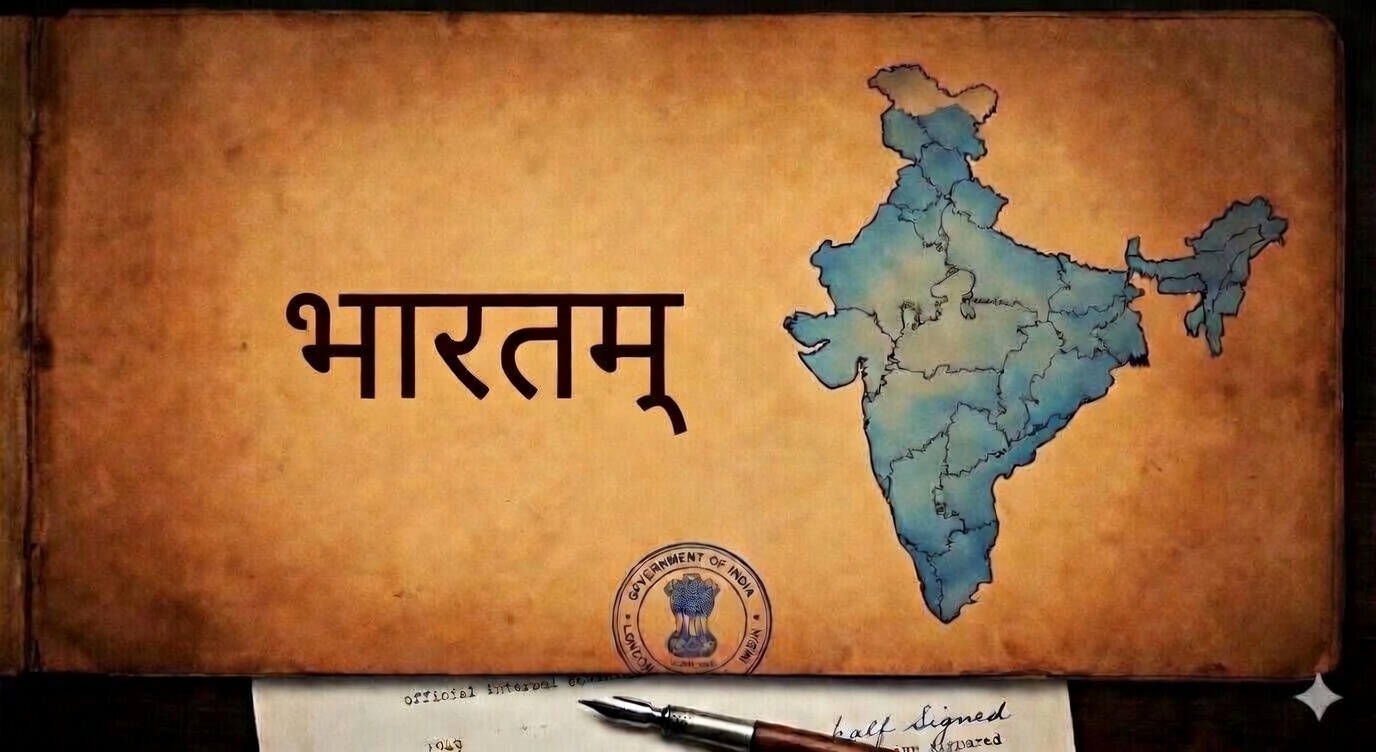
PART II: The Paninian Mind: How Sanskrit Schooling Wired India for the Age of Algorithms
This is the second part of our three-part series on Historical Dystopianism, a forensic examination of an Alternate India that diverged from our own in the winter of 1949. Part I established how the Sanskrit Mandate survived its political birth. Part II enters the classroom.
The Child in Classroom One
In 1962, a seven-year-old girl named Kamakshi sat in a government primary school in Thanjavur and learned her first Sanskrit declension. She was not from a General Category (GC) family. Her father repaired bicycles. Her mother sold jasmine at the temple gate. But under the new national curriculum mandated by New Delhi’s Education Reforms Act of 1955, Kamakshi’s school, like every government school in the republic, had begun instruction in Sanskrit from Class One. Not as a sacred language. Not as a liturgical exercise. As a structured cognitive system.
Her teacher, a young man trained in the first cohort of the National Sanskrit Pedagogy Programme, did not ask Kamakshi to memorise prayers. He asked her to learn rules. Specifically, he asked her to understand that every Sanskrit word was generated, not merely learned. That beneath the surface of the language was an engine, a set of approximately four thousand grammatical rules codified by the grammarian Panini in the fourth century BCE, and that if you understood the engine, you could produce any word, any form, any construction the language required.
Kamakshi, who was good with numbers and bored with rote repetition, found this interesting.
She was not alone.
What Panini Actually Built
To understand why the Sanskrit Mandate produced the educational outcomes it did in this alternate India, you need to understand what Panini’s Ashtadhyayi actually is. It is not a dictionary. It is not a style guide. It is, by the consensus of modern computational linguists, the world’s first formal generative grammar, a rule-based system for producing all grammatical utterances of a language from a finite set of base elements.
Noam Chomsky’s transformational grammar, which revolutionised linguistics in the 1950s, shares deep structural DNA with the Paninian system, a resemblance that Western linguists spent several decades being slightly embarrassed about. The recursive structures at the heart of both systems, the idea that a finite set of rules can generate an infinite set of valid expressions, is also the foundational logic of computer programming, of Boolean algebra, of the kind of nested conditional thinking that underlies every line of functional code.
In the standard timeline, India discovered this parallel in pockets, in elite university seminars, in occasional academic papers. In this alternate timeline, every child in the national school system encountered it at age seven. Not theoretically. Practically. Through daily grammatical drills that were, in effect, daily exercises in recursive logic.
The implications took roughly a generation to become visible.
The Longitudinal Evidence
In 1974, the newly established Indian Institute of Cognitive and Educational Sciences in Mysore launched what would become the most cited study in this alternate India’s educational history: the Mysore Longitudinal Cohort Study. It tracked 1,200 students across twelve states from their first year of Sanskrit instruction in 1962 through to their professional outcomes by 1987.
The study’s lead researcher, a psychologist named Dr. Indira Venkataramaiah, had a specific hypothesis. She believed that sustained exposure to Paninian grammar during the critical window of early cognitive development, ages six to twelve, was producing measurable changes in how her cohort approached abstract problem-solving. Not just in language tasks. In mathematics, in logical sequencing, in what she called “rule-system intuition,” the ability to infer the governing logic of an unfamiliar system from a limited number of examples.
Her 1981 interim report, submitted to the Ministry of Education, was quietly explosive. Students from the Mandate cohort outperformed their pre-Mandate counterparts in every metric of abstract reasoning. The gap was widest in tasks requiring the kind of hierarchical, rule-governed thinking that Paninian grammar demands daily. It was smallest in tasks requiring creative divergence from established rules, a finding that the report flagged honestly and that critics would later seize upon.
The full 1987 findings were, by then, almost redundant. The data was already visible in the admission registers of the Indian Institutes of Technology.
The IIT Numbers Tell the Story
This is where the macro picture comes into focus, and it is not subtle.
In the standard timeline, IIT admissions in the 1980s drew overwhelmingly from a narrow socioeconomic band: urban, English-medium-schooled, upper-caste households with the resources to fund years of expensive coaching. The system was technically meritocratic and practically hereditary.
In this alternate timeline, the Sanskrit Mandate had done something the coaching industry could not replicate. It had distributed a specific cognitive toolkit universally. Kamakshi’s daughter, Meenakshi, trained in the same Paninian grammar drills her mother had learned, sat the IIT entrance examination in 1983 and cleared it. Her father drove a three-wheeler. She became a computer scientist.
By 1985, the socioeconomic profile of IIT admissions in this alternate India looked nothing like ours. The proportion of students from rural households had risen from roughly 8 per cent in 1965 to 31 per cent by 1983. The proportion from non-English-medium schooling backgrounds was 67 per cent. These were not affirmative action numbers. They were open merit numbers, and they reflected a genuine democratisation of abstract reasoning capacity that the Sanskrit classroom, improbably and without anyone quite intending it, had delivered.
How India Became the Architect of AI
The economic story that flows from this educational story is, frankly, staggering to reconstruct.
In our standard timeline, India’s technology sector found its footing in IT services, the outsourcing model that made Bengaluru and Hyderabad bywords for cost-effective software maintenance. It was a respectable model. It was also, fundamentally, an execution model rather than an architecture model. India got good at building what others designed.
In this alternate timeline, the cognitive profile of India’s engineering graduates was different. A generation raised on recursive grammar, on rule-system thinking, on the Paninian instinct for generating novel constructions from first principles, was less suited to execution-mode work and considerably more suited to the kind of foundational, architectural thinking that builds new systems from scratch.
The Indian contribution to early artificial intelligence research in this timeline is not a footnote. It is central. The formal grammar traditions that underlie much of early AI’s approach to natural language processing, the very challenge of teaching a machine to parse and generate human language, were second nature to researchers who had spent their childhoods inside the world’s oldest formal generative grammar. Indian researchers were not adapting to this intellectual terrain. They had grown up in it.
By 1993, three of the seven foundational papers in what this alternate timeline calls the First AI Architecture Wave had Indian lead authors. By 1998, the proportion was closer to half.
The Cost Nobody Likes to Mention
None of this came free.
Dr. Venkataramaiah’s 1981 interim report flagged the creativity gap, and it deserves honest treatment here. The Mandate cohort’s strength in rule-governed abstract reasoning came with a measurable relative weakness in open-ended divergent thinking, in the kind of lateral, rule-breaking creativity that produces surrealist art, jazz improvisation, or a Bollywood film that nobody expected to work and somehow does.
India’s cultural output in this alternate timeline is, by most assessments, more technically refined and somewhat less wild than our own. The cinema is more formally sophisticated. The music is more structurally complex. It is also, occasionally, a little less surprising. Whether that is a price worth paying is a question this report does not presume to answer. Different readers will weigh it differently.
There is also the equity question that the aggregate numbers tend to obscure. The Sanskrit Mandate was a universal curriculum, but universal curricula are never universally delivered. A government school in rural Bihar in 1965 did not have the same quality of Sanskrit pedagogy as a central school in Delhi. The cognitive dividend was real, but it was distributed unevenly, and the communities that received the thinner version of the Mandate, the rote-memorisation variant taught by undertrained teachers with no understanding of the Paninian logic underneath, did not share proportionally in the IIT numbers or the AI dividend.
Kamakshi got lucky. She got a good teacher. Not everyone did.
What This Means for the Standard Timeline
The reader in our actual 2026 will notice, perhaps with some discomfort, that the alternate India’s educational miracle was not built on a new technology or a lavish budget. It was built on a decision about what to put inside a seven-year-old’s head, and specifically, on putting inside that head a system that rewarded understanding over memorisation, rules over rote, and generation over recall.
Our own National Education Policy 2020 speaks, in fitful and sometimes vague terms, about exactly these cognitive goals. It uses different language. It does not invoke Panini. But the underlying anxiety is the same: that a system built on reproduction of known answers will not produce the minds needed for a world that keeps asking new questions.
Kamakshi’s daughter became an AI architect. Kamakshi herself repaired bicycles for a few years before opening a small school. She taught Sanskrit grammar, the Paninian kind, in a two-room building in Thanjavur. She charged Rs. 20 a month. She had forty students.
That is probably where the real story lives.
