



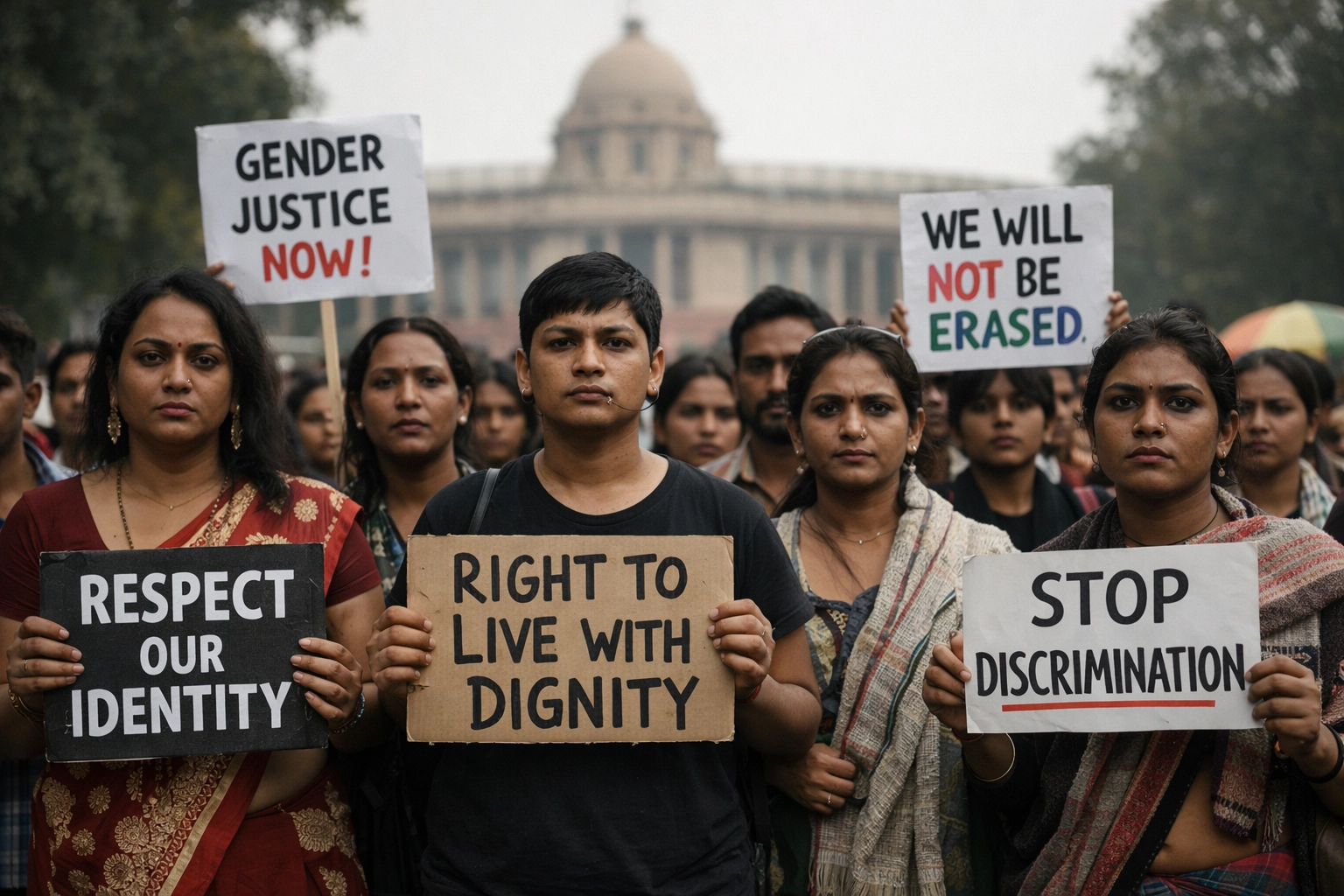
Arjun, a transgender activist from Kerala, said it plainly last week, as protesters gathered outside Parliament: “Coming out is already difficult, with a lack of family support and social stigma. This new law will only increase fear and isolation.”
He was reacting to the Transgender Persons (Protection of Rights) Amendment Bill, 2026 signed into law by President Droupadi Murmu on March 30. On paper, it was presented as a step forward. In practice, for millions of transgender Indians, it feels like a door quietly closing.
What the amendment actually changes
This is not a routine update. The 2026 amendment strips away the right to self-perceived gender identity, a right the Supreme Court had guaranteed in the landmark 2014 NALSA judgment. Under the new law, a person’s transgender identity must be verified by a medical board and then approved by a District Magistrate before an identity certificate is issued.
The amendment also removes the categories of trans-man, trans-woman, non-binary, and genderqueer that were recognised under the 2019 Act replacing them with a narrow list that largely covers socio-cultural identities like hijra, kinner, and aravani.
Most alarmingly, it introduces a criminal provision that penalises “compelling” or “alluring” a person to outwardly present a transgender identity with penalties extending up to life imprisonment. Amnesty International called the law “a fundamental shift in how the state views transgender people. Identity is no longer treated as something inherent, but as something to be checked, certified, and controlled.”
Over 140 lawyers, feminists, and civil society groups had urged the President to withhold assent, citing constitutional violations. She signed it anyway.
A community already on the margins
To understand why this amendment lands so hard, consider where India’s transgender community already stands not in theory, but in numbers.
India’s 2011 Census counted approximately 4.88 lakh transgender persons, of whom over 66% lived in rural areas. Their literacy rate was 56%, compared to a national average of 74%. The unemployment rate sat at 48%, more than double the national figure. A 2018 NHRC report found that 92% of transgender individuals were excluded from economic activity entirely, with roughly 23% pushed into sex work as a survival mechanism.
In education, 52% of transgender students reported harassment by classmates, and 15% by teachers. Many never made it past primary school.
On housing, despite being listed as a priority group under the Pradhan Mantri Awaas Yojana, data from multiple states reveals near-zero uptake a gap between policy intent and on-ground implementation that has persisted for years.
Healthcare tells the same story. A NALSA study found that 27% of transgender individuals were denied medical care based solely on their gender identity. Gender-affirming procedures cost between ₹2–5 lakh and remain largely uncovered by insurance, even under Ayushman Bharat.
Behind every statistic is a decision someone was forced to make between being who they are and being safe, fed, or housed.
The gap between law and life
India has not been indifferent. The NALSA judgment, the 2019 Act, the SMILE welfare programme, Ayushman Bharat’s TG Plus card these were genuine, if imperfect, steps. The intent has repeatedly been stated. The enforcement has repeatedly fallen short.
The 2026 amendment, however, does not merely fail to close this gap. It widens it. By replacing self-identification with a state-controlled certification process, it adds bureaucratic layers to an already difficult journey precisely for those least equipped to navigate them: the rural, the poor, the undocumented.
As Aakar Patel, Chair of Amnesty International India, stated: “Instead of simplifying processes, this amendment adds more bureaucratic and medical layers, approvals, and verifications which pave the way for prejudice.”
What real progress looks like
Laws matter. But laws without enforcement, without social education, and without genuine community consultation are monuments to good intentions not instruments of change.
The real measure of progress is not the number of amendments passed, but whether Arjun can walk into a hospital without fear. Whether a transgender student in rural Uttar Pradesh stays in school. Whether a young person in Kerala, choosing to live openly, does not have to choose between identity and safety.
India’s transgender community has waited long enough. They do not need the state to certify who they are.
They need the state to finally listen to what they have been saying all along.
