



By: Hiren Gandhi
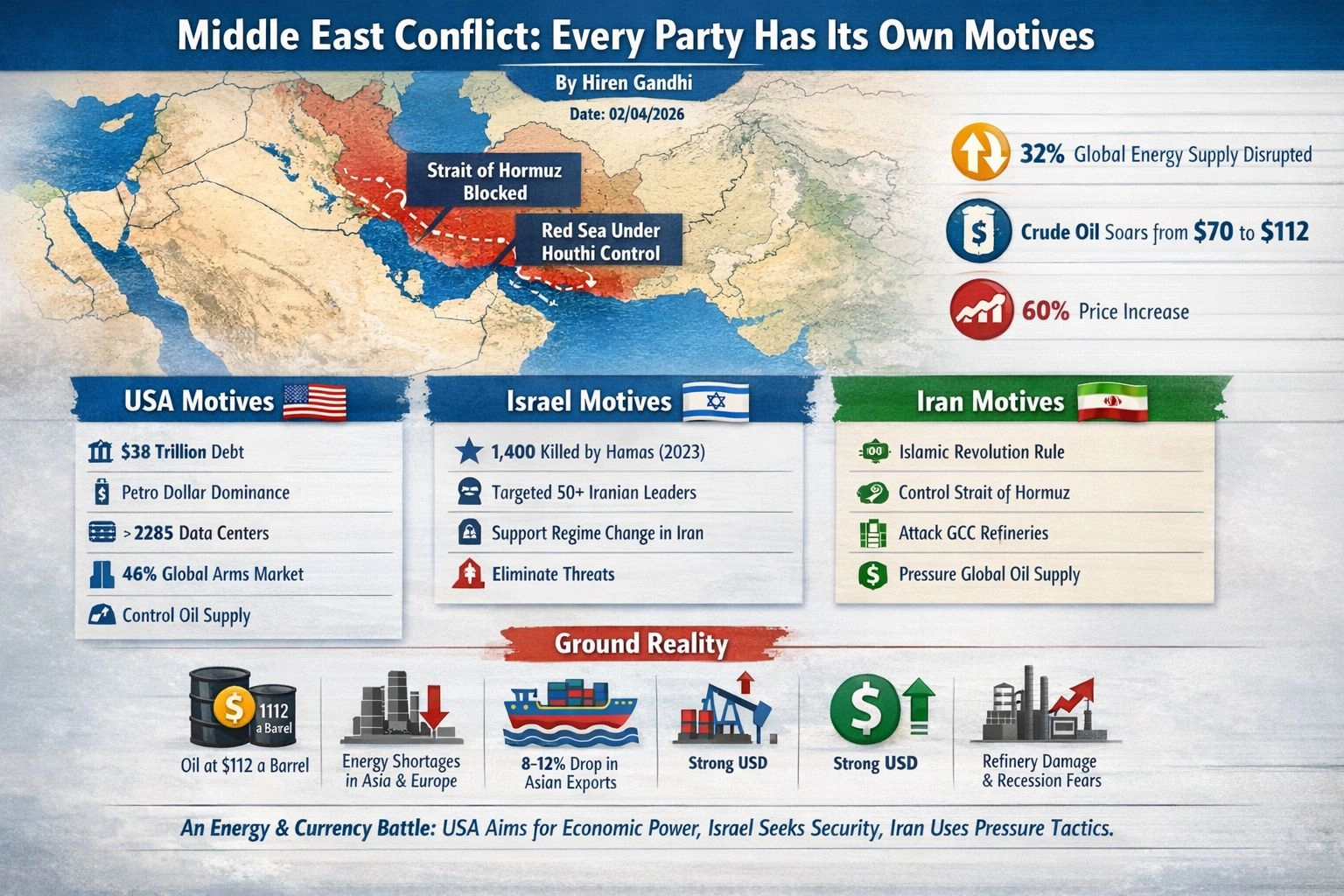
The ongoing escalation in the Middle East, which began after 28 February 2026, has moved far beyond a conventional military conflict. It is increasingly being viewed as a complex geopolitical contest involving energy security, currency dominance, and global power equations.
The crisis intensified after the United States, along with Israel, launched coordinated strikes on Iran. Tehran responded swiftly, targeting Israel and key installations in Gulf Cooperation Council (GCC) nations. The ripple effects of this escalation are now being felt across global markets, particularly in energy supply chains.
Energy Shock Disrupts Global Markets
One of the most immediate consequences of the conflict has been the disruption of critical oil transit routes, especially the Strait of Hormuz and Red Sea corridors. These routes collectively handle a significant share of global energy shipments, with the Strait of Hormuz alone accounting for nearly 20 percent of global oil flow.
Recent developments suggest that disruptions in these routes have sharply pushed oil prices higher, with crude crossing the $100 mark amid supply concerns. This surge is not merely a market fluctuation but a warning signal for the global economy, as higher energy costs feed directly into inflation and trade disruptions.
Reports indicate that Iran continues to maintain pressure on the Strait of Hormuz, using it as a strategic lever against the West. The resulting spike in energy costs has already begun impacting food prices, trade flows, and inflation globally.
United States: Economic Strategy at Play
From a strategic standpoint, the United States appears to be engaged in a broader economic contest. With mounting debt pressures and the need to reinforce the dollar’s global dominance, control over energy flows becomes critical.
Oil remains central to currency power. By influencing global oil supply chains, the US can strengthen the petro-dollar system. Additionally, the country’s expanding digital infrastructure, including thousands of data centres, requires stable and affordable energy, further reinforcing its strategic interest in oil and gas control.
The defence sector also plays a role. As the world’s largest arms exporter, prolonged conflict tends to sustain demand for military equipment, indirectly supporting economic activity.
Israel: Security and Survival
For Israel, the conflict is both strategic and existential. Following the 2023 Hamas attacks, national security has become paramount. Iran’s backing of groups such as Hamas, Hezbollah, and the Houthis has positioned Tehran as a direct threat.
Israel’s military actions, including targeted strikes on key Iranian leadership and infrastructure, signal a clear objective: dismantle the threat at its roots. The approach leaves little room for partial measures.
Iran: Leveraging Supply Chains
Iran, while not in a position to win a direct military confrontation with the United States, holds significant leverage through geography. Its control over the Strait of Hormuz allows it to influence global oil flows and create economic pressure worldwide.
By disrupting supply chains and targeting energy infrastructure in GCC countries, Iran aims to increase the cost of conflict for its adversaries. Analysts suggest this strategy is less about outright victory and more about forcing negotiations on favourable terms.
Global Impact Intensifies
The effects of the conflict are already visible across multiple sectors. Energy shortages are emerging in parts of Asia and Europe, while inflationary pressures are rising again. Supply chain disruptions are affecting trade, and fears of a global economic slowdown are resurfacing.
Countries heavily dependent on energy imports are particularly vulnerable, as rising fuel costs strain national economies and increase fiscal pressures.
India’s Balanced Approach
For India, which imports nearly 80 percent of its crude oil, the situation is especially sensitive. However, the country is responding with a calibrated strategy. Increased imports from Russia, continued engagement with GCC nations, and balanced diplomatic ties with Iran reflect a pragmatic approach.
While the conflict appears military on the surface, its core lies in control over energy and currency systems. The United States is pursuing long-term economic leverage, Israel is focused on eliminating security threats, and Iran is using disruption as a negotiating tool.
The trajectory of this conflict remains uncertain. However, its impact on global energy markets, inflation, and economic stability is likely to persist for the foreseeable future.

Secretary — InGlobal Business Foundation (IBF)
Director — ReNis Agro International LLP, Ahmedabad, India
Subscribe Deshwale on YouTube
