



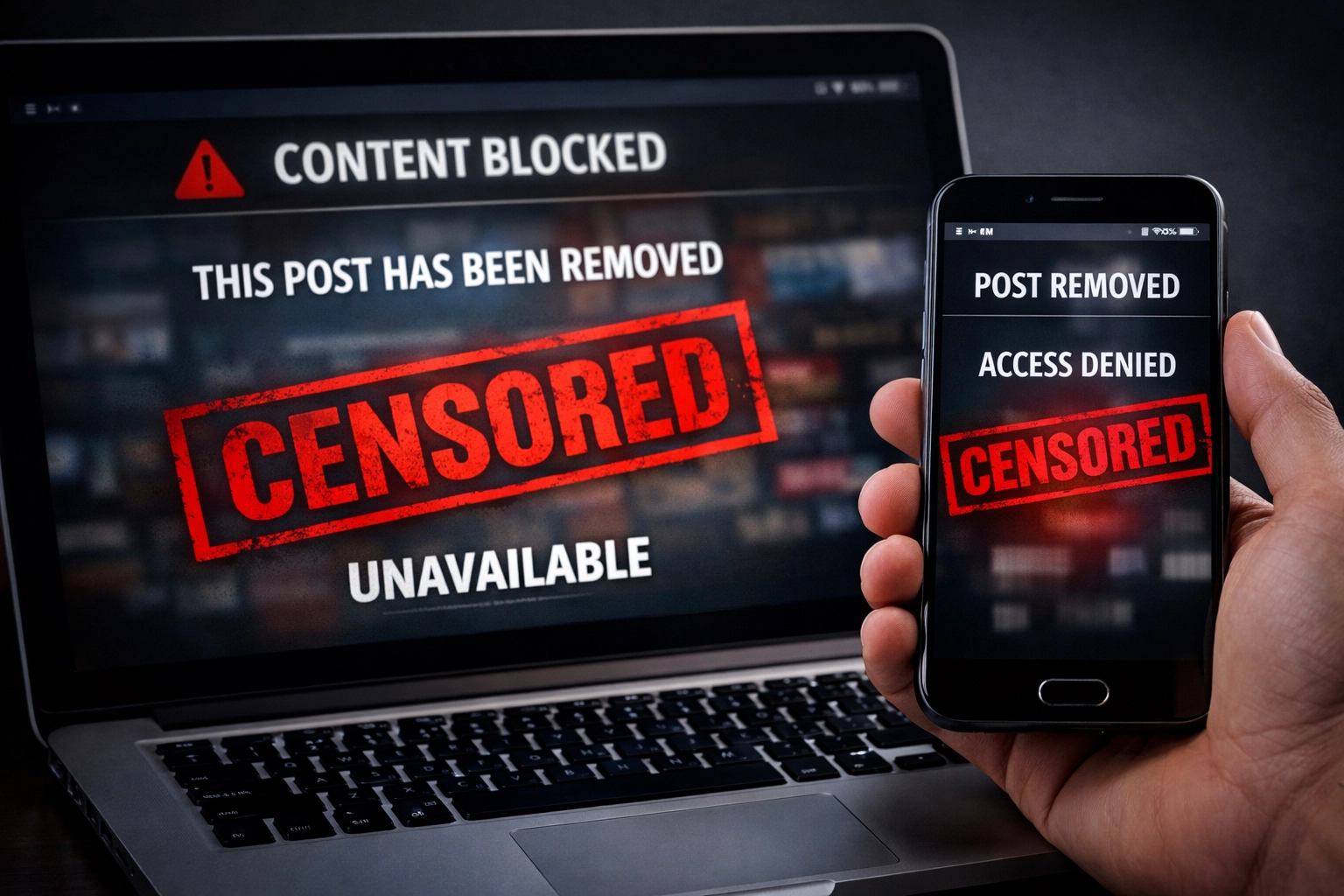
When the world’s largest democracy quietly becomes a teacher of internet control, the lesson travels fast
There is a particular kind of danger that doesn’t announce itself. It doesn’t come with tanks in the street or a sudden blackout. It comes dressed in the language of bureaucracy in words like “intermediary guidelines,” “grievance redressal mechanisms,” and “due diligence frameworks.” It comes in the form of a government notification, published on a Friday evening, that most people won’t read.
India has been doing this for four years now. And the rest of the world has been taking notes.
The quiet export
Let’s start with a fact that doesn’t get nearly enough attention: India is not just a country with an internet freedom problem. India is, increasingly, a country that other governments study when they want to build their own internet freedom problem.
This is not a conspiracy. It doesn’t require a secret meeting or a signed memorandum. It works far more simply than that. When a country of India’s size, democratic history, and global standing passes a law that allows the government to take down online content with minimal judicial oversight and then survives the international criticism, keeps its seat at global forums, and faces no real consequence it sends a message to every government watching.
The message is: you can do this too.
Bangladesh, Sri Lanka, Nigeria, Kenya governments across Asia and Africa have been quietly crafting their own versions of “intermediary guidelines” and “digital media ethics codes.” The specific language changes. The architecture doesn’t. Executive authority over online speech, compliance officers who can be personally pressured, shrinking windows for public consultation these are not coincidences. They are a template, and India wrote the first draft.
How India built the blueprint
To understand what is being exported, you first have to understand what was built.
In February 2021, the Indian government passed the Information Technology (Intermediary Guidelines and Digital Media Ethics Code) Rules without a single public consultation, without a parliamentary debate worthy of the name, and in the middle of a pandemic when civic attention was stretched thin. Critics called it rushed. The government called it necessary.
What the rules actually did was elegant, in a troubling way. They did not ban platforms. They did not shut down the internet. Instead, they created a structure of conditional permission platforms that could operate freely, as long as they appointed a Chief Compliance Officer, responded to government takedown requests within tight deadlines, and agreed to trace the “first originator” of messages on encrypted platforms when asked. Fail to comply, and you lose the legal protection that keeps you from being sued for every piece of content your users post. Fail to comply, and your compliance officer, a real person, living in India, with a family and a career faces criminal liability.
It was a masterclass in governing without governing. The government never had to pick up the phone and tell Facebook what to delete. It just had to make sure Facebook understood what would happen if it didn’t.
The respectability problem
Here is the part that makes India’s case uniquely dangerous in a global context: India is not Belarus. It is not Iran. It is not a country the world already expects to suppress free speech.
India is the world’s largest democracy. It has a Supreme Court that has, on occasion, pushed back against executive overreach. It has a free press battered and diminished, but not entirely gone. It has elections. It has opposition parties. When India does something, it cannot simply be dismissed as the behaviour of an authoritarian state. It has to be engaged with, argued against, negotiated over.
This respectability is precisely what makes the export so potent.
When a government in, say, Nairobi or Colombo wants to pass a law that gives it power over online content, it faces immediate comparison to China or Russia. Human rights groups sound the alarm. Western governments issue statements. The diplomatic cost is real. But if that same government can point to India as a functioning democracy, a country that sits on the UN Human Rights Council, a country that hosts G20 summits and say we are simply following the Indian model, the conversation changes entirely. The alarm sounds a little less loud. The statements are a little more carefully worded.
Democratic cover, borrowed from the world’s largest democracy, is extraordinarily valuable. And India has been handing it out for free.
The American warning nobody acted on
Earlier this year, the United States government did something unusual. In its annual trade report, a dry document that usually concerns itself with tariffs and market access, the Office of the US Trade Representative called out India’s online takedown rules explicitly, flagging them as appearing politically motivated and noting a pattern of requests targeting content with political dimensions.
Read that again. The United States government, in an official publication, said that the Indian government’s censorship practices appear to be about politics, not law.
This is a remarkable thing to put in writing. And yet it was met, in India, with the standard response of denial, deflection, and the suggestion that foreign governments should mind their own business when it comes to India’s sovereign digital policy.
That response will also be exported. When other governments are called out for their own takedown practices, they will reach for exactly that framing: sovereignty, cultural context, the hypocrisy of Western critics. India has already stress-tested the defence. It works well enough.
What the comedian knows that the lawyer doesn’t
There is a 26-year-old stand-up comic named Pulkit Mani. Last month, a short video he posted on Instagram was blocked under Section 79(3)(b) of the IT Act. He received a terse notice from the platform. The government has not told him what law he broke. He has not been given a hearing. He does not know when or whether his content will be restored.
His story is, on the surface, a story about one young man and one blocked video. But it is also a story about the end point of the blueprint of what the architecture looks like once it is fully assembled and running.
This is not a bug. This is the feature. A system in which a creator doesn’t know why their content was removed, cannot appeal to any transparent process, and has no meaningful recourse is a system that creates precisely the behaviour it is designed to create. People begin to ask themselves, before they post anything: is this the kind of thing that gets blocked? And then they don’t post it.
In Dhaka, in Lagos, in Colombo, there are comedians and journalists and activists watching what is happening to Pulkit Mani. They are watching not because India is far away and interesting, but because their own governments are building the same machine, and they are trying to understand what it will feel like when it is turned on.
The speed of institutional decay
What makes the export particularly urgent right now is the pace at which the original model is accelerating.
On March 30 this year, India’s Ministry of Electronics and IT released a new set of proposed amendments to the IT Rules changes that would allow the government to issue “clarifications, advisories, directions, SOPs, codes of practice” that platforms must follow as a condition of their legal protection. It gave the public fifteen days to respond. Fifteen days, for changes that legal experts described as the most significant expansion of executive power over online speech in the country’s history.
When a government gives you fifteen days to object to something that took four years to build, it is not really asking for your opinion. It is a consultation. And that performance, the appearance of democratic process wrapped around a foregone conclusion, is perhaps the most sophisticated thing being exported.
Other governments will learn to do this too. They will publish their proposals on a Friday. They will give two weeks for comment. They will hold one stakeholder meeting. They will point to the process when critics arrive. We consulted, they will say. We followed the procedure.
They will have learned it from watching India.
The larger stakes
It is fashionable, in conversations about global internet freedom, to focus on China and Russia, the obvious, unapologetic architects of closed digital spaces. China’s Great Firewall is an engineering marvel of suppression. Russia’s internet sovereignty laws are blunt instruments wielded without embarrassment.
But the more dangerous model, in the long run, may be the one that doesn’t look like suppression at all. The one that maintains the vocabulary of democracy due process, grievance redressal, public consultation while systematically dismantling the substance of free expression. The one that allows a government to silence a comedian without ever issuing a public order, arrest an editor without ever charging him with censorship, and take down eight thousand social media accounts while insisting it is only enforcing the law.
That model needs a country respectable enough to make it credible and large enough to make it look normal.
India, it turns out, is exactly the right size.
The IT Rules, 2021 and their subsequent amendments continue to be challenged in courts across India. The latest draft amendments, published on March 30, 2026, are open for public comment until April 14.
Subscribe Deshwale on YouTube
