



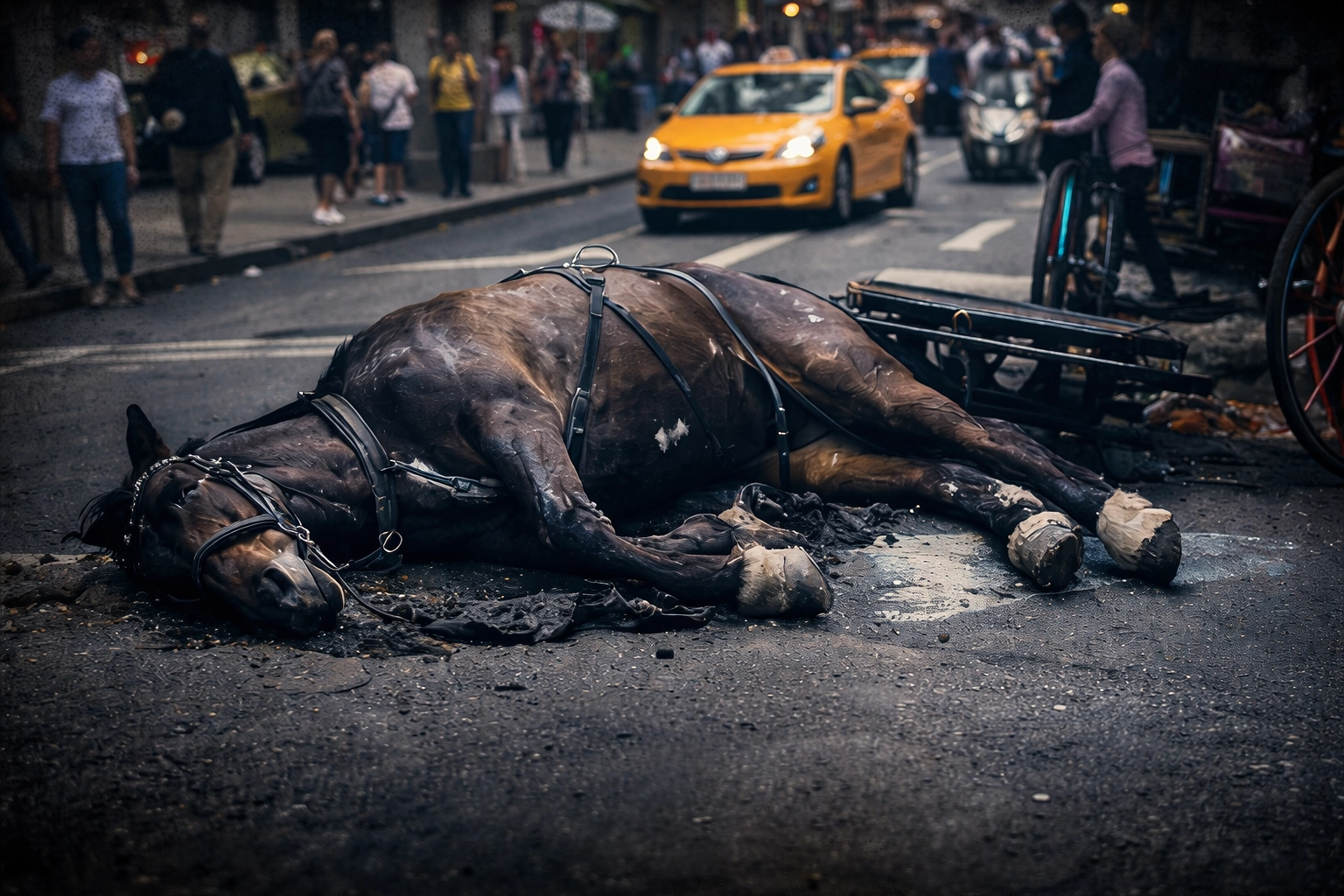
We have built an entire global industry on the silent suffering of animals. It is not tradition. It is not a culture. It is commerce wearing a costume and the animal always pays the price.
I. The Weight That Cannot Speak
His name was Ryder. He was a carriage horse in New York City, a grey, broad-shouldered animal who spent his days hauling tourists through the streets of Hell’s Kitchen in the August heat of 2022. On one of those days, in full view of passersby and their cameras, Ryder collapsed on the tarmac. He lay there in his harness, in the middle of a Manhattan street, while traffic moved around him and onlookers photographed his body. He died where he fell. His owners mourned him. His union defended the industry. His city, the self-appointed capital of the civilised world, did nothing. His death became a viral moment for four days, then disappeared. And the carriages kept rolling.
Ryder was not an anomaly. He was a consequence of the visible end of a system that had been grinding animals into the asphalt of tourism for generations, under the protection of heritage, the cover of culture, and the silence of governments that found the revenue more compelling than the suffering. His story is one thread in a global tapestry of institutional cruelty that stretches from the stone steps of Santorini to the pilgrimage routes of the Himalayas, from the pyramids of Giza to the cobblestones of Jerusalem, from the desert of Morocco to the carriage lanes of Central Park. Everywhere that tourists go looking for charm and experience and a photograph to carry home, animals are being broken to provide it.
This is not an essay about sentimentality. Animals are not people, and no serious argument pretends otherwise. This is an essay about something far more precise: the deliberate, profitable, state-sanctioned use of living creatures as machines, in conditions that science has documented as torturous, under laws that exist on paper and nowhere else. It is about the fact that we know with veterinary certainty, with legal specificity, with photographic and documentary proof accumulated over decades and we continue anyway. The question is no longer whether this is wrong. The question is why we have chosen to let it continue, and who profits from that choice.
II. What the Science Has Already Settled
Researchers at Ohio State University’s Agricultural Technical Institute determined that a horse should carry no more than 20 per cent of its own body weight. A standard study from the University of Edinburgh established that a 160-kilogram donkey can safely carry up to 50 kilograms on its back. A camel, in reasonable conditions, can manage 90 kilograms across 32 kilometres per day but only with adequate rest, water, and recovery time. These are not contested findings. They are not emerging science. They have been established and published and cited and largely ignored by every tourism economy that profits from animal labour.
The consequences of ignoring them are equally well-documented. Overloading causes spinal compression, joint degradation, and chronic pain in horses and donkeys. In the short term, it causes open wounds from ill-fitting saddles that, because the animals are returned to work before healing, develop into permanent lesions. PETA Asia’s investigations at the Giza Pyramids found horses collapsing mid-ride, workers beating them back to their feet, animals denied water in temperatures exceeding 40 degrees Celsius. The Morocco investigation found camels tied on two-foot ropes, exposed to sandstorms, sold to slaughter the moment they stopped being profitable. The Santorini investigation found donkeys forced to carry tourists *and* bags of rubbish up more than 500 steps through the night, with no rest period at all.
Cruelty is not an accident of oversight. It is the intended operating model of an industry that has calculated that the cost of animal welfare is greater than the cost of animal suffering.
India’s laws are a monument to this calculation. The Prevention of Cruelty to Animals Act of 1960 and the Draught and Pack Animals Rules of 1965 prescribe weight limits with admirable precision: 50 kilograms for donkeys, 70 for ponies, 250 for camels. Updated guidelines issued in August 2025 for working equines during religious pilgrimages went further, recommending just 25 kilograms for donkeys and prohibiting the use of sick, pregnant, and injured animals. These laws are written with the seriousness of conviction. They are enforced with the seriousness of theatre. In Shimla, in Mussoorie, in Rajasthan, at every tourist destination where a horse or camel stands waiting for its next rider, weight limits are not posted, not monitored, and not questioned. The law exists. The harm continues. The gap between them is the space where accountability goes to die.
III. The Pilgrimage and the Pyre
Kedarnath. The name itself carries the weight of millennia of devotion to a temple dedicated to Lord Pashupatinath, the Hindu god of all animals, set at 3,583 metres in the Uttarakhand Himalayas, reached only by an 18-kilometre mountain trek from Gaurikund. Tens of millions of pilgrims make this journey every year. Many of them, unwilling or unable to walk, ride horses and mules to reach the house of God.
In the first three days of the Char Dham Yatra of May 2025, fourteen horses and mules died on the Kedarnath trek. Eight on the third of May, six on the fourth. The Uttarakhand government suspended mule services for twenty-four hours and called in an expert team from the ICAR National Research Centre on Equines. A panel was convened. Statements were issued. Within days, the animals were back on the routes. The pilgrimage, which generates approximately forty crore rupees from horse and mule services in its first month alone, could not be paused for the inconvenience of animal deaths.
This is not a new crisis. In 2022, animal advocate Gauri Maulekhi testified before the Uttarakhand High Court that over 600 of the approximately 8,000 registered horses and mules had died in a single Char Dham season. She alleged that over 20,000 animals, most of them unlicensed, were in use, the majority sick or overworked. The High Court issued orders for adequate food and water. The National Green Tribunal issued similar directives. As of the 2025 season, there remained one medical shelter for equines on the entire Kedarnath route — a structure built in 2023 only because a court forced the district administration’s hand. Eight thousand registered animals. One shelter. Seven veterinary officers. This is not neglect. It is a policy decision dressed as resource constraint.
The most devastating detail from The Print’s ground reporting: the mandatory insurance policy that the Uttarakhand government introduced for mules actually incentivises their deaths. If a badly injured mule dies, its owner collects the government insurance payout. If it lives, the owner bears the cost of veterinary care. The economics of compassion, in this system, point towards mortality.
There is a phrase in Hindi that captures the moral architecture of this situation precisely: chalta hai roughly translated as “it goes on,” or “it’s fine as it is.” It is the most dangerous phrase in the Indian public vocabulary. It is the phrase behind which governments shelter while animals die on mountainsides in the name of the divine.
IV. The Word Nobody Was Saying
Across every investigation, every court order, every welfare report, every tourism industry defence, one word is almost entirely absent from the official record. Not cruelty that word appears often enough, usually to be denied. Not suffering that appears in advocacy material, then is disputed. The word that nobody in power will say, the word that changes the entire shape of this conversation, is complicity.
Complicity is not the same as indifference. Indifference implies an absence of awareness. Complicity requires knowledge. And every government with jurisdiction over a tourist site where animals carry human beings for money has knowledge. They have the veterinary research. They have the welfare organisation reports. Many of them have laws. What they do not have is the willingness to enforce those laws against an industry that produces revenue, employs constituents, and operates under the protective colouring of cultural tradition.
New York City’s Central Park carriage horses have been dying in the streets, bolting through traffic, collapsing from heat exhaustion, and being sold to slaughter at Pennsylvania livestock auctions for years. The Central Park Conservancy, the body that manages the park formally called for a ban in August 2025, stating that the practice was “no longer compatible with the realities of a modern, heavily used and shared public space.” Mayor Eric Adams signed an executive order supporting legislation to end the industry. Seventy-one per cent of New Yorkers polled supported a ban. In November 2025, the City Council’s Committee on Health voted it down, in deference to the Transport Workers Union. The most powerful city in the world cannot ban carriage rides because the union that represents the carriage drivers is the same union that represents bus and subway workers, and electoral arithmetic matters more than a horse dying in the street. This is not American exceptionalism. This is American normalcy.
And then there is Israel. In the West Bank, the donkey is not a tourist attraction it is a survival tool, particularly in communities stripped of mechanised transport by decades of economic blockade and movement restriction. There is a sanctuary near Netanya, called Safe Haven for Donkeys in the Holy Land, that has operated since 2000, rescuing and rehabilitating donkeys that have been beaten, starved, worked to collapse and then abandoned. Over a thousand donkeys at a time, cared for by a small British-founded charity, because the state that controls the territory has made no systematic provision for the welfare of working animals in the communities it controls. Israel has signed international conventions on animal welfare. It has its own animal protection legislation. And yet, in areas under its administrative authority, working animals essential to Palestinian livelihood receive no structured welfare protection. The politics of the occupation make every basic question of animal care a subordinate concern. The donkey is at the very bottom of a very long list of things that nobody wants to address. It would be convenient, if it were not so entirely predictable.
The world does not lack laws to protect animals from tourism. It lacks the courage to enforce them against the people who profit from breaking them.
V. The Argument from Culture, and Why It Fails
There is always, at this point in the argument, the intervention of culture. The donkey rides of Santorini are a tradition. The camel safaris of Rajasthan are heritage. The carriage horses of Central Park are history. The mule operators of Kedarnath are livelihoods. These arguments are not entirely without merit, and they deserve the respect of being answered seriously rather than dismissed.
The livelihoods argument is real. In Rajasthan, thousands of families depend on camel operators for their income. In Uttarakhand, the mule economy supports over 4,300 registered operators. In New York, the carriage drivers are, as their union points out, working-class immigrants who have built lives around their animals. The destruction of these livelihoods without alternative provision would be its own form of cruelty to people, this time. Any serious position on animal welfare in tourism must include serious support for economic transition. Jordan replaced donkey and horse rides in Petra with electric vehicles, supported by the Princess Alia Foundation and Four Paws International. Petra’s operators were not abandoned; they were offered an alternative. Egypt, following years of sustained PETA Asia investigations and international pressure, launched electric bus services at the Giza Pyramids in April 2025. The transition is possible. The will to fund it is what is absent.
The culture argument is weaker, and it grows weaker with each passing year. Culture is not static, and the invocation of tradition to protect cruelty is one of the oldest rhetorical manoeuvres in the history of exploitation. Bullfighting was a culture. Bear-baiting was culture. Child labour was the culture of the factory floor for a very long time. The word *culture* has no immunity to the demand for justification. Every practice that harms a being that cannot consent and cannot resist requires a stronger argument than longevity.
Santorini understood this. Since 2018, the island has enforced weight limits, mandated rest periods, and required fitness certificates for working donkeys. Spain’s Mijas Pueblo restricts its donkey taxis to 80-kilogram loads and enforced breaks. These are not abolitions; they are regulations. They are the minimum acknowledgement that an animal carrying a tourist is not a piece of equipment subject only to the economics of use. They are imperfect. They are inadequate. But they are a beginning that most of the world has not even managed to make.
VI. Ryder, Revisited
Ryder died on a New York street in August 2022. In November 2025, the City Council’s health committee voted against considering the bill that would have replaced carriage horses with electric vehicles. The horses are still there. They will be there tomorrow. They will be there next summer, in the heat, on the asphalt, carrying tourists who will not know their names and will not wonder what they weigh.
At Kedarnath, the Yatra will begin again, as it does every spring. Eight thousand animals or more will line up at Gaurikund for the climb. Some of them will not come back down. The insurance policy will pay out. The government will issue a statement. An investigation team will arrive from Delhi. And next year, the same thing will happen again, because forty crore rupees in a single month is a number that makes every other number smaller.
In Giza, the electric buses are running. In Petra, the electric vehicles have largely replaced the animals. In Santorini, a weighing scale stands at the top of the steps. These are small, imperfect, contested victories won not by governments acting on conscience, but by organisations spending decades forcing governments to act at all. They prove that the thing is possible. They also prove that without sustained, unrelenting pressure, the default position of every state is to protect the revenue stream and leave the animals to carry it.
We call ourselves a civilisation that has progressed beyond the casual cruelty of earlier centuries. We have largely ended the use of animals to carry our goods across continents. We have restricted blood sports in most of the world. We have built the moral and legal architecture, however imperfect, of animal welfare. And then we go on holiday, and we climb onto the back of a creature that has not chosen to carry us, in heat it has not chosen to endure, on terrain that is destroying its joints, and we take a photograph, and we call it an experience.
The animal beneath you has a spine. It has nerves. It has a threshold of pain that science has documented and governments have chosen to ignore. It cannot file a complaint, engage a lawyer, or testify before a court. Its only available protest is to collapse and even then, as a worker in Giza once demonstrated to PETA Asia investigators, the response can be to beat it back to its feet.
This is the verdict: the global tourism industry has, for generations, protected its most profitable cruelties behind the language of culture, the inertia of enforcement, and the silence of the animals themselves. The laws exist. The science is settled. The alternatives have been demonstrated. What remains is a choice by governments, by tour operators, by travellers, and by everyone who has ever booked a camel safari and told themselves it was harmless.
It was not harmless. It has never been harmless. And the animal you rode carried that truth home long before you did.
Subscribe Deshwale on YouTube
