



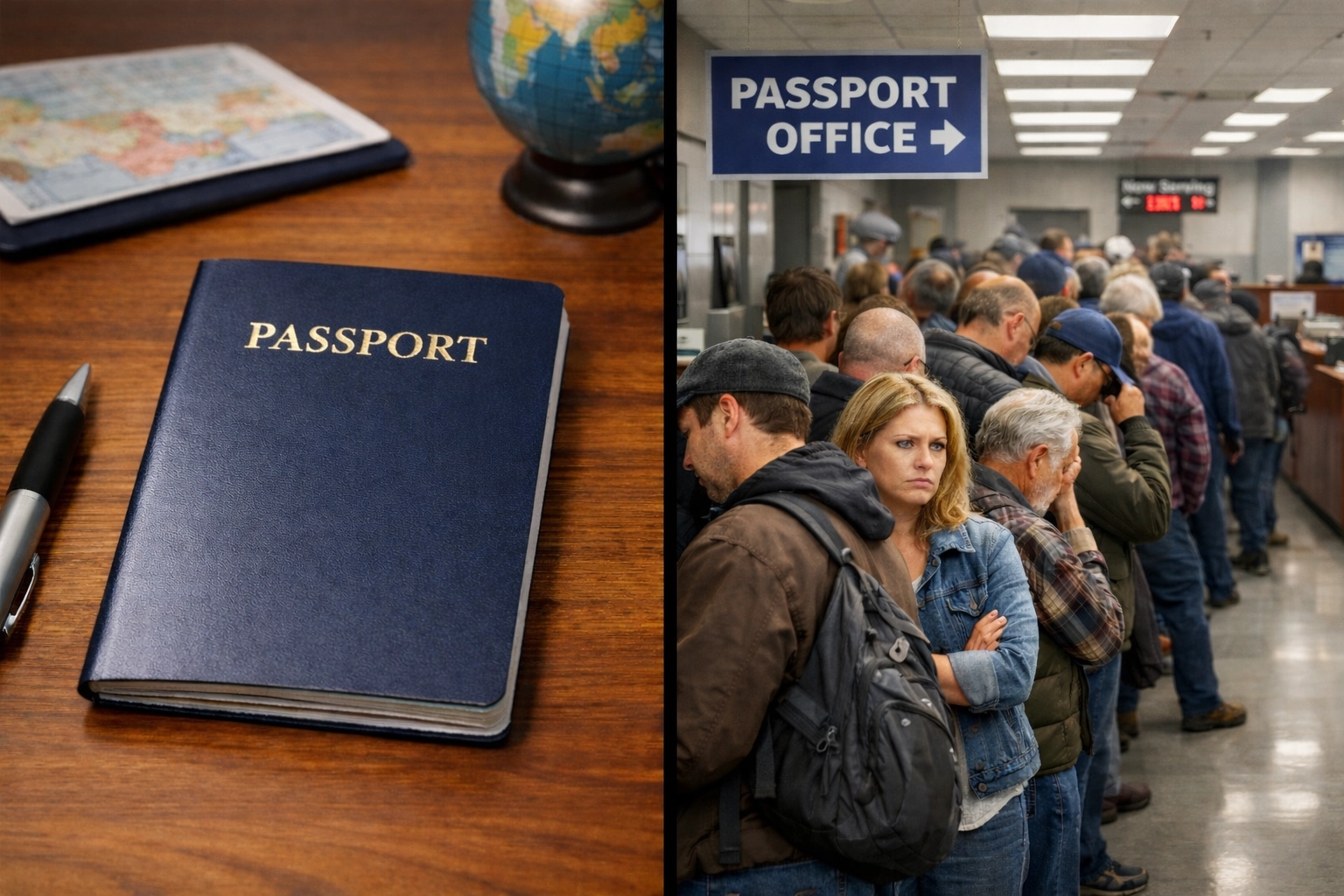
A searing look at which countries treat passport issuance as a citizen’s right and which treat it as a bureaucratic obstacle course.
The passport is not merely a travel document. It is the physical proof that a government acknowledges you exist, that it vouches for you before the world, that it will stand behind you at borders, that it considers you worth the effort of a laminated booklet. Strip away the officialese, and what you hold in your hand when you hold a passport is a government saying: *this person belongs somewhere*. That sentence ought to be easy to issue. In most of the world, it is not.
The question of how fast a country issues its citizens a passport is not an administrative footnote. It is a moral statement. Speed in this context is not mere efficiency — it is respect. When a government makes you wait six weeks, or ten weeks, or twelve weeks, or charges you an emergency premium to receive what is already legally yours, it is not simply slow. It is telling you something about how it views you. Bureaucratic delay, when it is chronic and systematic, is not neutral. It is a policy. And like all policies, it serves someone — usually not you.
The Countries That Get It Right
Let us start where the argument is honest: a handful of nations treat passport issuance as the simple civic transaction it has always been. Germany, Finland, Sweden the Nordic-Germanic bloc that dominates global passport power rankings process citizen passports in timelines that would embarrass their anglophone counterparts into silence. Finnish police stations handle applications that can move through the system in days for urgent cases, with standard processing that does not stretch into months of purgatory. Sweden’s domestic passport infrastructure, integrated directly with its civil registration system, reflects a country that already knows who you are before you walk through the door. The application is, in many ways, a formality. The document follows.
These are not accidents of governance. They are deliberate constructions states that decided, at some foundational level, that their citizens are entitled to frictionless interaction with the instruments of their own citizenship. The passport is a right in these countries, in the deepest sense of that word: something you have not because you earned it through inconvenience, but because you are a citizen and that is sufficient.
Singapore sits apart from this European bloc but belongs philosophically with it. Its passport is among the most powerful on earth consistently ranked first globally for visa-free access, alongside France, Germany, Italy, Japan, and Spain and its issuance reflects a city-state that treats administrative efficiency as national identity. The Singapore government’s integration of digital services with biometric infrastructure means that renewing a passport there is not an ordeal but a transaction, brief and dignified.
Ireland deserves specific acknowledgement. Its citizenship-by-descent programme is one of the most generous on the planet, and the passport operation supporting it is extraordinary in scale: its streamlined citizenship-by-descent programme has helped almost 15 million people gain Irish passports despite the island’s population only being around six million. This is a country that actively wants its diaspora to hold its passport. That posture — welcoming rather than grudging — shapes everything from policy to processing speed.
Canada’s Grudging Progress
Canada announced in April 2026 something that should have existed two decades ago. The federal government will refund passport fees to applicants if processing times exceed 30 business days, under a new service guarantee that Immigration Minister Lena Metlege Diab framed as “strengthening accountability.” Thirty business days. That is six calendar weeks a ceiling that most northern European nations would consider a scandal, not a promise.
To be fair to Canada, current processing standards already sit well below the 30-day threshold for most applicants, typically between 10 and 20 business days, depending on whether you applied through a Service Canada Centre, an embassy or consulate, or by mail. The guarantee is, as they concede, essentially a backstop, a promise that the exceptional breakdown will not go financially unpunished. That is not nothing. But it is not the systemic transformation it was presented as, either.
What Canada is doing, in its cautious Canadian way, is acknowledging that the pandemic-era collapse of passport services scarred the public trust in ways that political speechwriting cannot fully repair. Since 2021, passport issuance has surged by 315%, with 5.4 million passports expected to be issued in 2025. The surge exposed a system that had no elastic capacity, one that worked adequately in quiet times and buckled catastrophically under any significant load. The “30 days or free” guarantee is Canada promising it has fixed the plumbing. Its citizens, who in 2023 sat on waiting lists for months while flights departed without them, will believe it when they live it.
The refund mechanism is a fine idea. But the deeper question: why does obtaining a document that proves what you already are require six weeks as a baseline? Canada does not ask. That silence is instructive.
America’s Bureaucratic Theatre
The United States issued 27.3 million passports in FY2025, which marks a new annual record and it managed to do this while maintaining a routine processing time of four to six weeks, down from the post-pandemic nadir of twelve to eighteen weeks. The State Department announced this reduction as a triumph, the language of the press release thick with self-congratulation.
Four to six weeks. A country that can put a rover on Mars and a satellite in geosynchronous orbit takes four to six weeks to print a booklet and mail it to someone who has already proven their citizenship. The mathematics of this do not add up to competence. They add up to a bureaucratic apparatus that has never been asked, seriously, to treat its citizens as customers rather than supplicants.
The deeper obscenity is the two-tier system. Do you want your passport faster? Pay more. Expedited passports, which cost an extra $60, will continue to take two to three weeks. Emergency appointments at passport agencies are available if your travel is within fourteen days provided you already have it booked, you can prove it, and you can secure an appointment, which during peak season is its own Kafkaesque ordeal. From May through July 2023 the height of the backlog processing of routine applications averaged 10.5 weeks and processing of expedited applications averaged 6.1 weeks. During that period, Americans with non-refundable flights to funerals, weddings, medical emergencies abroad, were turned away or told to pay more for still-inadequate speed.
This is a moral category, not an administrative one. When a government charges a premium for timely service on a civic right, it is not offering a service tier. It is monetising desperation. And the Americans who paid that premium in 2023 were not richer Americans, on the whole they were ordinary people with ordinary emergencies who had no recourse but to hand over sixty extra dollars for a guarantee that still wasn’t really a guarantee.
The share of Americans holding a passport has increased from 5% in 1990 to 48% in 2024. That explosion in demand is not a surprise it is the predictable consequence of globalisation, cheap air travel, and a workforce with international obligations. A competent government would have tracked that curve and built capacity ahead of it. The US did not. It hired staff in emergencies, mandated overtime, requiring passport staff to work up to 24 hours of overtime per month in fiscal year 2023 more than 250,000 hours in total and called the resulting reduction in delays a victory. It is not a victory. It is a system lurching back toward baseline after a predictable failure that was nobody’s surprise.
Permission
Here is the word nobody in this conversation uses: permission. A passport, in its plainest function, is your government’s permission for you to leave. To re-enter. To exist internationally. The speed at which it grants this permission tells you everything about the government’s underlying theory of its relationship to you.
The Nordic model says: you are a citizen; here is your document; go. The Anglo-American model says: you are a petitioner; demonstrate your need; wait; perhaps pay more; we will get to you when we get to you. These are not merely administrative differences. They are philosophical ones, dressed in the neutral language of processing times and application queues. When Germany issues a passport in days and the United States takes six weeks, something is being communicated that has nothing to do with the complexity of printing biometric booklets.
The countries that issue passports fastest are, not coincidentally, countries with high levels of civic trust where governments trust citizens and citizens trust governments. Finland and Sweden are not fast because they have better printers. They are fast because they built systems premised on the assumption that the citizen standing in front of them is who they say they are and deserves the document they have come to collect. The United States built its system on a different premise: everyone is a potential problem until proven otherwise, and proving it takes weeks.
This is the Kafkaesque truth at the heart of slow passport issuance: it is not a failure of logistics. It is a success of suspicion.
Israel’s Particular Irony
Israel presents a case study in bitter irony. A state founded on the principle of gathering on the idea that Jews anywhere in the world should have immediate, unconditional right of return runs a passport system that takes 4 to 6 weeks for standard delivery, and longer for biometric documents during peak travel season. A country whose founding legislation, the Law of Return, is perhaps the most philosophically generous citizenship instrument in the world, processes the travel documents of its gathered citizens with the same bureaucratic torpor as any other mid-tier state.
The deep contradiction here is not administrative. It is ideological. Israel says, come home, we will always take you in and then makes you wait six to eight weeks for the paperwork that actualises that homecoming. The Misrad HaPnim, the Interior Ministry, is notorious among new immigrants for its queues, its opacity, and its particular genius for making people feel like problems to be processed rather than citizens to be welcomed. The naye olim the new immigrants who arrived from across the world on the strength of that founding promise discover quickly that the idealism lives in the legislation and not the offices.
This is not unique to Israel. Most countries write beautiful things about citizenship and then make citizenship documents slow and difficult to obtain. But Israel’s case is pointed out because the philosophical distance between the promise and the practice is so wide. You cannot claim the Law of Return as a cornerstone of national identity while running a passport office that feels designed to discourage return.
What the Fastest Systems Tell Us
The countries that issue passports fastest are doing something specific: they have built their systems around the person applying, not around the bureaucracy processing. They assume good faith. They use digital infrastructure aggressively. They do not treat in-person visits as the default. They do not require you to prove, document by document, what is already in their databases.
From 762,000 passports issued in the EU in 2014 to 1.2 million in 2024, according to Eurostat, the bloc has seen a stark 54% increase in 10 years. The European Union, for all its procedural reputation, has managed to absorb that surge because its member states invested in digital civil registration infrastructure that makes verification quick. When your government already knows your biometrics, your address, your family status, and your citizenship status when it has maintained that data carefully and kept it current a passport application is not an investigation. It is a confirmation.
The countries that are slow are countries that have allowed their civil registration systems to remain fragmented, siloed, and paper-dependent. They compensate for bad infrastructure with long processing times and call it security. It is not security. A criminal who wants a fraudulent passport does not apply through the normal queue. The six-week wait time does not catch them. It catches the nursing student who needs to travel to a clinical placement in another country, and the journalist with an assignment starting in three weeks, and the father who received the call that his elderly mother in another country has fallen ill. The haani log the ordinary people are the ones who wait.
The Verdict
Here is what the evidence insists on, if we have the honesty to let it: the speed of passport issuance is a political choice disguised as an administrative constraint. Finland makes it quick because Finland decided to make it quick. The United States makes it slow because the United States has never been forced to decide otherwise.
Canada’s “30 days or free” guarantee is progress, and it should be acknowledged as such. It is also, when held next to Finland’s same-day urgent service or Germany’s efficient biometric processing, a reminder of how modest our expectations of government have become. We have been so thoroughly trained to accept bureaucratic delay as natural as the cost of citizenship that a six-week ceiling feels like a gift.
It is not a gift. It is a floor that should have been the ceiling long ago.
The passport is not a privilege the government grants you. It is a right the government owes you. And any country that makes you wait six weeks, or charges you extra for timely delivery, or loses your application in a system outage, or sends you a letter asking for more documents while your flight date approaches that country is not serving you. It is making you serve it.
The best countries in this world have understood something that the mediocre ones have not: that citizens who can move freely, who can present themselves at international borders with a document that arrived promptly and in good faith, are citizens who trust their governments. And governments that are trusted govern better.
Chalta haithis won’t do any more. The world moves fast. So should the documents that let us move with it.
Subscribe Deshwale on YouTube
