



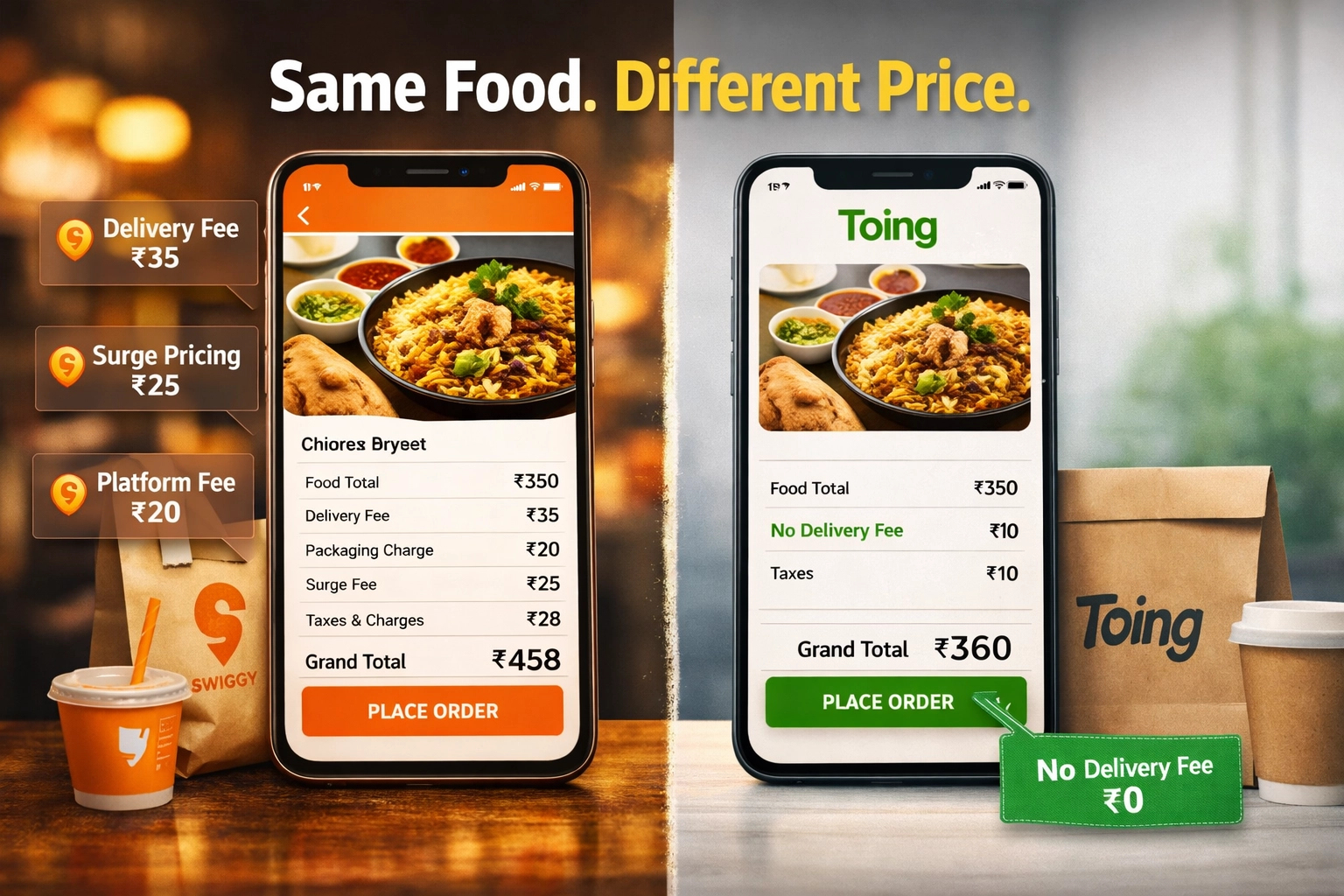
Swiggy’s new standalone app isn’t just about affordable biryani. It’s a quiet confession that food delivery got too expensive and a calculated bet on the next hundred million users.
There is a particular kind of moment in the life of any large company when it quietly admits, through a product launch rather than a press release, that something went wrong. Swiggy had that moment in September 2025, when it released a new app into the world called Toing.
Toing is, in the most technically accurate description possible, a budget food delivery app. It promises meals starting at ₹49, no platform fee, no delivery fee, no surge fee. It is built by Swiggy. It runs on Swiggy’s infrastructure. You log in with your Swiggy credentials, your saved addresses transfer over automatically, your payment details are already there. And yet, Toing is not Swiggy. It is a separate app. A different experience. A different promise.
What Swiggy is really saying with Toing if you read between the lines of the green-and-pink branding is this: the main app got too expensive for a very large number of people we would very much like to keep ordering from us. So here is a door they can actually afford to walk through.
What Toing Actually Is
Start with the basics, because the name is doing nobody any favors in communicating them.
Toing launched on August 30, 2025, first in select pockets of Pune. Pune was not a random choice; it is an education and IT hub with a high density of college students and young professionals, exactly the demographic that looks at a ₹238 Swiggy order for something they could cook for ₹60 and decides, rationally, to cook. Swiggy wanted them back. Toing is how it is tried.
From Pune, the app expanded steadily: Nashik, Nagpur, Vadodara, Delhi NCR, Agra, Guwahati, and then Mumbai. As of early April 2026, it now operates across 18 cities and counting. The expansion pattern is deliberate Tier 2 cities and education hubs first, the metros as confirmation that the experiment worked.
The app’s interface is clean and unhurried, presenting the user with a menu of meals anchored around an honest premise: what you see is what you pay, give or take government taxes. No packaging fee suddenly appeared at checkout. No rain surcharge on a cloudy Tuesday. No platform fee that nobody asked for but everyone is charged. On Toing, the platform fee sits at ₹12 per order, compared to ₹14.99 and higher on the main Swiggy app — a small number that adds up quietly across the thousands of orders a regular user places in a year.
The food categories lean practical: poha, khichdi, dosa, paratha, idli, biryani, burgers, bowls. The kind of food that a 22-year-old living alone in a one-bedroom in Kothrud actually eats on a Wednesday evening, not the kind of food that photographs well for Instagram.
The Numbers That Make It Real
Abstract promises about affordability mean very little until someone puts actual receipts on the table. So here is what the data looks like.
MediaNama’s review tested the same order of Chicken Biryani Bowl and Falafel Nuggets from The Good Bowl on both Toing and the main Swiggy app simultaneously. On Toing, the bill came to ₹346. On Swiggy, the same items from the same restaurant cost ₹486. The gap of ₹140 came entirely from the surcharges that Swiggy layers on but Toing strips away: a ₹25 packaging charge, a ₹25 rain fee, higher GST, and a heavier platform fee.
Another comparison, a simpler sub-₹99 order, told a starker story. On Toing: ₹124. On Swiggy: ₹193. The food is identical. The restaurant is the same. The difference is the architecture of fees that surrounds the food on one platform and doesn’t on the other.
Business Standard’s price comparison found something similar: for a ₹189 meal, Toing’s final bill was ₹210. Swiggy’s was ₹238. Across a month of regular ordering, these differences are not trivial. They are the difference between food delivery being a daily habit and being an occasional treat.
It is worth being honest about one thing, though: Toing is not cheap food. It is cheaper to order. The restaurants are sometimes the same ones you find on Swiggy McDonald’s, Theobroma, Subway appear on both platforms with identical menus. The saving is in the removal of Swiggy’s fee architecture, not in any reduction in what the restaurant charges. Occasionally, restaurants do offer Toing-specific pricing The Great Indian Peninsular Kitchen listed its Bohri Chicken Biryani at ₹225 on Toing versus ₹360 on Swiggy but this is the exception, not the rule.
The honest version of Toing’s pitch is: we stopped charging you for things you never agreed to pay for.
Why a Whole New App, Though?
This is the question that nags. Swiggy already has an ‘Offer Zone’. It already has a ‘₹99 Store’. It already sends push notifications about Delightful Deals. It already runs credit card promotions and discount coupons. If affordability was the goal, why not just make the main app more affordable?
The answer, most likely, involves the word that consumer companies rarely say out loud: positioning.
Swiggy’s main app has spent a decade building an identity as a certain kind of experience, reliable, full-featured, aspirational in the way that urban Indian consumer tech aspires to be. When Swiggy shows up in conversations, it sits alongside Zomato in the category of platforms that people complain about being too expensive while continuing to use. That brand carries associations. Some of them are good. Some of them, for the price-sensitive student in Nagpur, are the precise reason she doesn’t open the app.
By launching Toing as a completely separate entity, Swiggy can speak to that student without disrupting what it has built for everyone else. Toing can be loud about affordability, unapologetic about its no-frills positioning, and deliberately youthful in its branding — all without touching the identity of the main app. It is, as one way of reading it, a game of divide and conquer: Swiggy for people who have arrived, Toing for people who are getting there.
There is also a market logic underneath the brand logic. India’s food delivery penetration remains surprisingly shallow outside the top 8–10 cities. The next wave of growth will not come from convincing Bengaluru’s existing heavy users to order one more time per week. It will come from converting the enormous population of price-sensitive, digitally fluent 20-somethings who tried food delivery once, found the final bill alarming, and went back to making Maggi. Toing is Swiggy’s attempt to reach that population before someone else does.
That someone else, as it happens, already has a head start.
Enter Ownly: The Reason Toing Exists in Its Current Form
In August 2025, roughly a fortnight before Toing launched in Pune, Rapido the bike-taxi company with two million riders and thirty million monthly transacting users quietly released a food delivery app called Ownly into select Bengaluru neighbourhoods.
Ownly’s proposition is more radical than Toing’s. Where Toing removes fees for users, Ownly removes commissions for restaurants. Entirely. Swiggy and Zomato charge restaurant partners between 16% and 30% in commission on every order a percentage that, over time, causes restaurants to raise their online menu prices by 10–20% to protect their margins, which is exactly why that biryani costs ₹360 on Swiggy and ₹225 at the dhaba down the road. Ownly’s pitch to restaurants is the one the National Restaurant Association of India had been demanding for years: pay nothing. Customers pay a flat ₹30 delivery fee. That is the model.
By March 2026, Ownly had expanded city-wide across Bengaluru, onboarded approximately 20,000 restaurant partners, and was making expansionist noises about Delhi NCR, Mumbai, Hyderabad, Pune and Chennai. Its head of new initiatives told restaurant partners at an NRAI town hall: “In the beginning, we’re not going to be earning money.” Which is either refreshingly honest or a warning, depending on your disposition.
The two apps Toing and Ownly attack the same problem from different sides. Ownly makes the food cheaper by removing the restaurant’s cost burden. Toing makes the experience cheaper by removing the user’s fee burden. The two approaches are not identical. They are not even directly comparable. But they are both responses to the same underlying truth that has been visible in India’s food delivery market for the last three years: the pricing got out of hand, and someone was eventually going to say so.
Toing is Swiggy saying it first, about itself, before a competitor did it louder.
The Super Brand That Swiggy Is Becoming
Toing is Swiggy’s seventh standalone app. Let that number sit for a moment.
There is Swiggy (food delivery), Instamart (10-minute groceries), Dineout (restaurant reservations), Snacc (10-minute canteen-style food), Genie (same-day delivery), Pyng (professional services marketplace), Crew (travel and lifestyle concierge), and now Toing. Each app targets a different user, a different moment, a different kind of spending decision.
This is a deliberate departure from what Swiggy was building until recently: a super app, a single destination that folded everything under one roof. The logic of the super app is intuitive one login, one interface, everything in one place. But it brings a complication. When you are trying to be everything to everyone within one app, you end up being nothing in particular to anyone. The student who wants a ₹99 meal and the professional booking a ₹4,000 Dineout reservation are not the same user, and designing one experience for both of them is a compromise that satisfies neither.
The super brand model has multiple focused apps, each optimised for one user type, all built on shared Swiggy infrastructure lets the company have both conversations simultaneously without either one contaminating the other. Swiggy’s credentials work across all of them. The delivery network is shared. The restaurant database is shared. The investment is amortised across a portfolio. Only the experience of the first screen, the tone, and the price promise differs.
Whether this is wisdom or sprawl remains to be seen. Running seven apps is expensive. Maintaining seven distinct brand identities is a marketing challenge that few companies handle elegantly. And there is always the risk of confusion a user who has Swiggy, Snacc, *and* Toing on their phone and is unsure, when hunger strikes at 8 PM, which one to open.
Does It Actually Work?
Yes, with asterisks.
The savings are real when you compare apples to apples same restaurant, same dish, same evening. The fee architecture that Toing removes is genuinely the most irritating part of ordering on the main platform, and its absence is felt immediately. First-time users tend to experience something close to relief: the number on the screen when you select a dish is roughly the number you pay.
The limitations are also real. Toing’s restaurant selection, while growing, remains thinner than the main app. The delivery time promise is 30 minutes, which is honest about not competing on speed the way Snacc or Bolt do. The ₹49 starting price is technically accurate and practically rare. The staples at that price point exist, but the main categories skew more toward ₹100–₹250. And government taxes are not included in any of the fee-waiver promises, which is nobody’s fault but worth knowing upfront.
For the user it is built for the student, the young professional, the person who calculates whether that last delivery fee puts the month’s food budget over the line Toing does what it says it does. It makes ordering feel less like a small act of financial recklessness and more like a reasonable decision.
That may sound like a low bar to clear. But in a market where the dominant emotion associated with food delivery has, for several years now, been a mild guilt every time you press ‘Place Order’, clearing that bar is not nothing. It is, in fact, exactly what the next hundred million users were waiting for someone to do.
Swiggy just did it. To itself. Which is either clever or desperate, and the answer probably depends on whether Ownly is still around in two years.
Subscribe Deshwale on YouTube
