




After 20 years of Nitish Kumar, a new face takes charge. Here’s what you actually need to know.
For two decades, if you lived in Bihar, you pretty much knew who was running the show. Nitish Kumar. The man who fixed roads, launched welfare schemes, and became so dominant in state politics that even when he quit and came back multiple times, Bihar just shrugged and moved on. He was the constant. The one name that felt permanent in a state where political alliances changed faster than the seasons.
But today, April 15, 2026, that era is officially over.
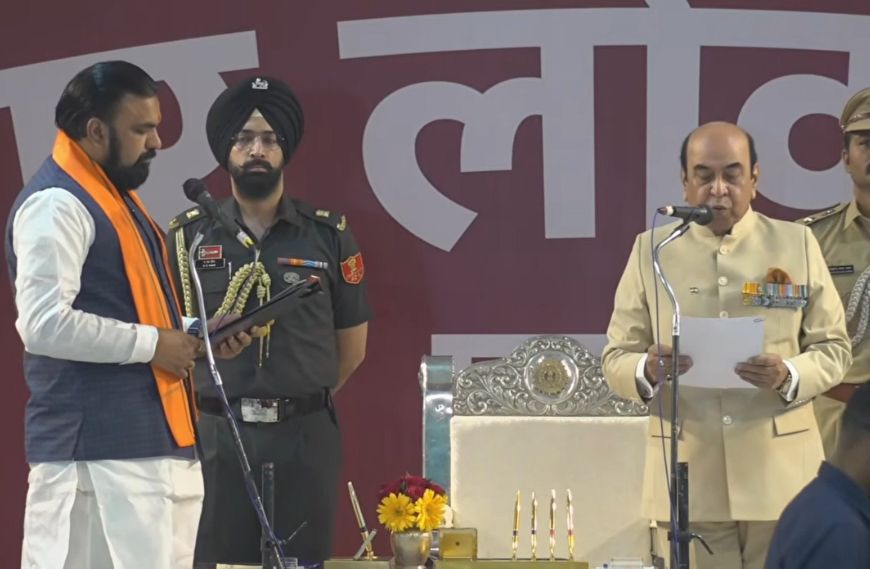
Samrat Choudhary a 57-year-old politician from the Tarapur constituency took the oath as Bihar’s Chief Minister at Raj Bhavan in Patna. Two Deputy Chief Ministers, Vijay Kumar Choudhary and Brijendra Prasad Yadav both from the JD(U) were sworn in alongside him. Senior NDA leaders, including Union Ministers JP Nadda and Chirag Paswan, attended the ceremony to mark the occasion.
And with that single oath, Bihar achieved something it has never seen before in its political history: its first-ever BJP Chief Minister.
So who is Samrat Choudhary, really?
If you haven’t been closely following Bihar politics, you’d be forgiven for asking, “Who is this man?”
His story is actually quite fascinating. Born Rakesh Kumar, Choudhary is the son of Shakuni Choudhary, a well-known political figure in the state. He entered politics in 1990 and spent years moving between parties RJD under Lalu Prasad Yadav, then JD(U) under Nitish Kumar, and finally the BJP. Critics labelled him an opportunist who followed power. Supporters called him a practical survivor who knew when to adapt.
He officially joined the BJP in 2017 and rose quickly within the party, becoming a trusted face among the OBC community. By 2024, he was serving as Deputy Chief Minister and Finance Minister. By today, he holds Bihar’s highest office. For a man who spent decades in the political wilderness, switching sides and rebuilding his career each time, this is nothing short of a remarkable journey.
Why did Nitish Kumar leave?
Here’s what surprises many people: Nitish Kumar didn’t lose an election. He actually won and won big.
In November 2025, the NDA alliance swept Bihar’s assembly elections, winning 202 out of 243 seats. Nitish was sworn in as Chief Minister for a record 10th time, a feat unmatched by any other leader in the state’s history. So why did he leave?
The answer lies in national ambitions. In March 2026, Nitish announced his intention to contest the Rajya Sabha elections India’s upper house of Parliament. He won that seat and was sworn in as a Member of Parliament on April 10. With that, he stepped away from state governance, handing the reins of Bihar over to the BJP for the very first time.
In simple terms: Nitish didn’t fall from power. He walked away from it, moving from Patna to Delhi, leaving behind a state he shaped for more than two decades.
What does this mean for ordinary people in Bihar?
This is where the story truly matters not for politicians, but for the 13 crore people who wake up every day in Bihar hoping for better schools, safer streets, more jobs, and improved hospitals.
Samrat Choudhary has made big promises. As Finance Minister in 2024, he presented Bihar’s largest-ever budget of ₹2.79 lakh crore and announced the creation of over 30,000 government jobs. He has spoken passionately about continuing Nitish Kumar’s development work and taking it even further under the vision of “Viksit Bihar 2047.”
He has also taken a firm stance on law and order. As Home Minister, he gave police a free hand against criminal gangs in districts like Begusarai, drawing comparisons to the strict law enforcement model seen under UP’s Chief Minister Yogi Adityanath. For many Biharis who have seen crime disrupt daily life and livelihoods, this sends a strong signal.
But not everyone is convinced. Opposition leader and Jan Suraj founder Prashant Kishor wasted no time raising doubts. He claimed Bihar would now effectively be “run from Gujarat,” suggesting that Union Home Minister Amit Shah would control things from behind the scenes. It is an allegation the BJP firmly denies, but it is one that will follow Choudhary throughout his tenure.
The big picture
Bihar is one of India’s most populous, youngest, and most aspirational states. Its people have long deserved better infrastructure, quality education, reliable healthcare, and meaningful employment opportunities. Nitish Kumar delivered some of that over 20 years. The roads got better. Crimes against women were addressed more seriously. Some development happened.
Whether Samrat Choudhary can build on that legacy or do even better is the real story Bihar is waiting to read.
The oath-taking ceremony lasted just over an hour. The real test, however, will last five long years. And for Bihar’s crores of farmers, students, daily wage workers, and young job seekers, the question is not who took the oath today.The question is: what happens tomorrow?
Subscribe Deshwale on YouTube
