




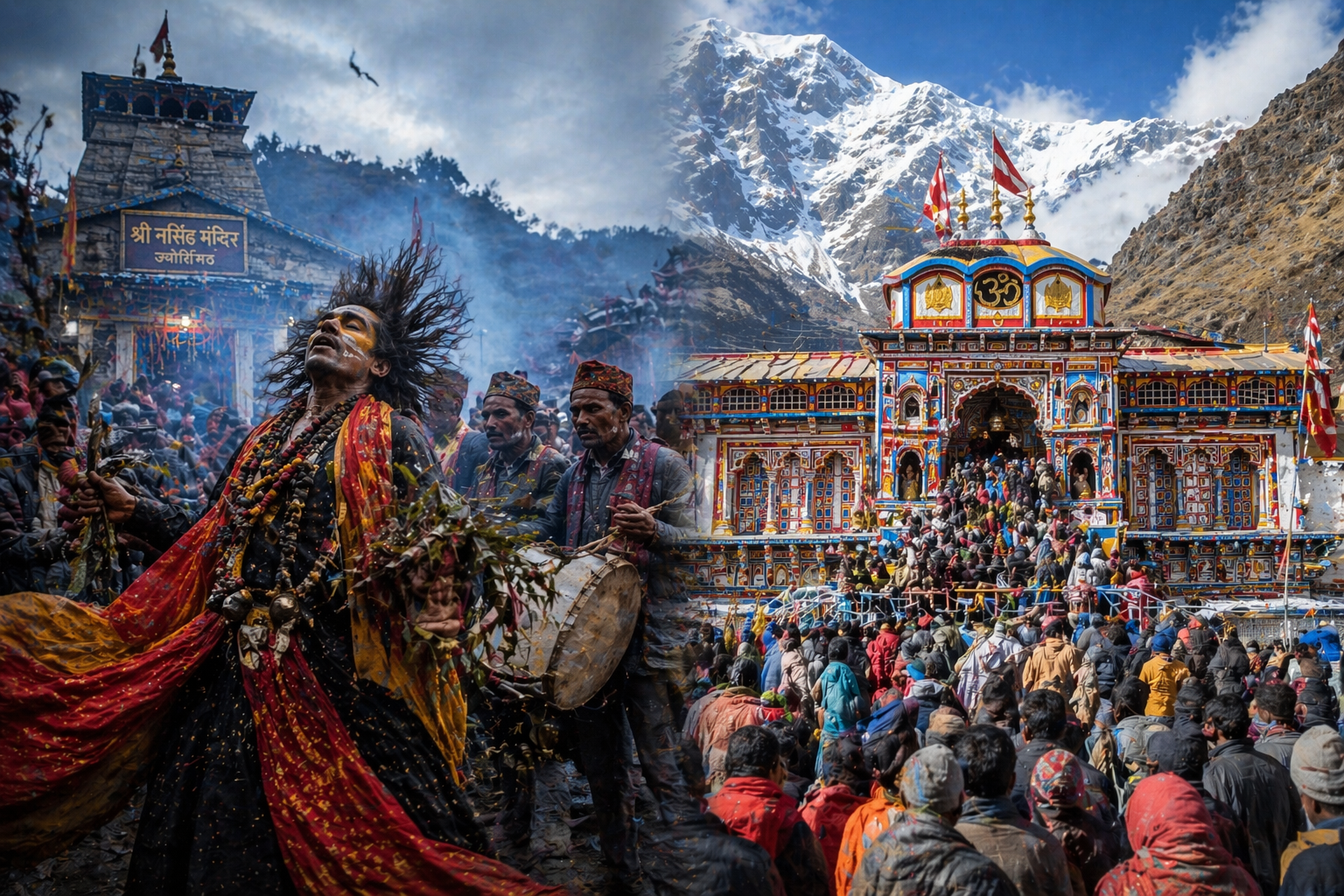
Every year, before the gods of Badrinath wake up, a local folk spirit must first give his blessing. In Joshimath, no one skips this step.
Every January, in the quiet hill town of Narendra Nagar in Uttarakhand, a ceremony takes place that sets the entire spiritual and economic clock of the state ticking. At the Tehri Royal Palace, astrologers open the Hindu Panchang, the ancient almanac of auspicious dates and after careful calculation, an announcement is made. This is the date on which the gates of Badrinath Temple will open.
The room holds some of the most powerful figures in Indian religious administration: the Maharaja of Tehri, traditional caretaker of Badrinath; the Rawal, the temple’s Chief Priest, who by tradition is a Nambudiri Brahmin from Kerala; and the Badrinath-Kedarnath Temple Committee (BKTC), the government body that officially manages the shrine. Together, they decide the opening date or kapaat udhghatan — that will set the entire Char Dham Yatra season into motion.
In 2026, that date was April 23.
What no official press release mentions, however, is what happens just before those gates open in Joshimath, forty-three kilometres below Badrinath at a small but deeply sacred temple where a three-headed spirit from local folklore must first be satisfied.
The temple that holds Badrinath’s god through winter
To understand why Joshimath matters so much, you need to understand one fact: for six months every year, Badrinath Temple is shut. The Himalayas at 3,133 metres become inaccessible under snow. So every November, in a moving ceremony, the idol of Lord Badri Vishal is carried down from Badrinath in a decorated palanquin and taken to the Narsingh Temple in Joshimath a shrine established in the 8th century by Adi Shankaracharya and considered one of the 108 sacred Divya Desams of Lord Vishnu.
For those six winter months, Joshimath is, effectively, where Badrinath lives.
Every spring, the same palanquin sets out from Narsingh Temple, carrying Lord Badri back to his mountain home. Priests from the BKTC perform elaborate rituals at Narsingh Temple before the journey begins. Around 15,000 to 20,000 devotees gather on the opening day alone to witness the procession.
But before any of this official machinery moves, there is the Timundia Mela.
The spirit who was here first
The Timundia Mela, held annually at the same Narsingh Temple just before Badrinath opens, is dedicated to a figure who belongs to a completely different layer of religion not the formal Vaishnavite tradition that Badrinath represents, but the older, wilder folk faith of the Garhwal Himalayas.
Timundiya is a three-headed guardian spirit, rooted in local legend. According to oral tradition, he was once a fierce and untameable being who was eventually subdued and transformed into a protector of the region. His role today, in the belief of the people of Joshimath, is to guard the land, ensure the safety of those who pass through it, and bless the season that is about to begin.
During the mela, a chosen individual known as a human medium is believed to be possessed by the spirit of Timundiya. In a trance state, to the sound of drums and rhythmic chanting, he performs acts considered sacred by devotees: consuming offerings of grain, jaggery, and other items that signify divine acceptance. For locals, this is not a spectacle. It is confirmation that the guardian of the land has been consulted and has given his blessing.
Only after this blessing can the pilgrimage season truly begin.
Two religions, one temple, one season
What is remarkable about Joshimath is the coexistence it quietly holds together. On one hand, you have the full weight of institutional religion: a temple committee, a chief priest from Kerala appointed through tradition, a royal family, astrological calculations, and a pilgrimage circuit that generates an estimated ₹7,500 crore for Uttarakhand’s economy annually. Last year, over 51 lakh pilgrims registered for the Char Dham Yatra, contributing daily economic activity estimated at over ₹200 crore during peak season. Pilgrimage tourism accounts for nearly 40 percent of Uttarakhand’s total revenue.
On the other hand, in the same courtyard, at the same temple, a man in a trance communes with a three-headed local spirit whose name does not appear in any Vedic scripture.
Both must play their role. Neither replaces the other.
This is how folk religion and mainstream Hinduism have always coexisted in India not by merging, but by layering. The Rawal of Badrinath, trained in South Indian Nambudiri traditions, does not manage the Timundia Mela. The veer of Joshimath does not sit at the Tehri palace on Basant Panchami. Each holds authority in his own realm. And the pilgrimage season, somehow, requires them both.
Who really holds the key?
The formal answer to who controls the Char Dham calendar is clear: the BKTC, the Rawal, and the Tehri royal family, guided by the Hindu Panchang.
But the folk answer, the one that has lived in Joshimath for centuries before any committee existed, is different. The Timundia Mela says, in effect, that no amount of government clearance or astrological calculation is enough on its own. The land itself must agree. The local guardian must be appeased. The region’s own ancient protector must be told: the season is beginning. We are passing through. Keep us safe.
In a country where millions of pilgrims climb into the Himalayas every year trusting that someone, somewhere, has taken care of all the arrangements it is worth knowing that one of those arrangements involves a possession ritual at a small temple in Joshimath, performed for a three-headed spirit that official religion does not fully acknowledge, but that the people of this region have never stopped believing in.
The gates of Badrinath open with great ceremony. But the key, it turns out, was always in Joshimath.
Subscribe Deshwale on YouTube
