



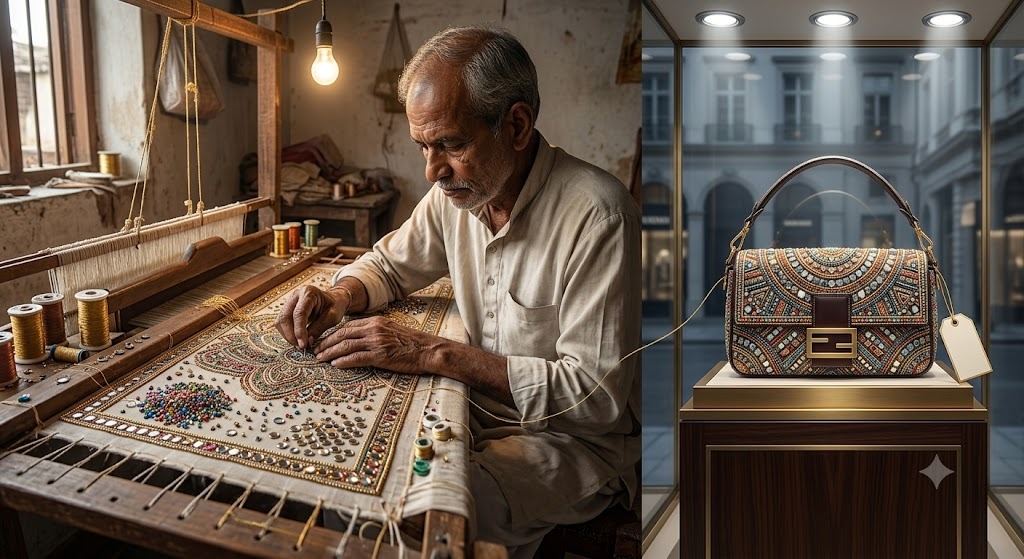
A luxury handbag can carry thousands of beads, hundreds of mirrors and more than a hundred hours of handwork. It can sit behind glass in a luxury boutique and carry a price tag of several lakh rupees.
But there is one thing a customer may not see: the person who spent those hours putting every tiny piece in place.
That is the part of the luxury story worth looking at.
Fendi’s Baguette 26424, part of its Fall/Winter 2026-27 collection, is entirely hand-embroidered with 39,500 beads and 475 mirrors and requires more than 138 hours of craftsmanship. Fendi initially listed the product as Made in Italy, while its multicolour version now identifies it as made in Italy and India by Chanakya artisans. The Mumbai-based Chanakya International has worked with major global fashion houses for decades.
The bag’s mirror work quickly reminded many Indians of familiar festive craft. Social media gave it the nickname “Navratri bag”, and the conversation moved towards cultural appropriation and whether Indian craftsmanship was receiving enough recognition.
Those questions are legitimate.
But I think there is another question that deserves even more attention:
What happens to the Indian craftsperson after the luxury brand has received the beauty, the publicity and the premium price?
India’s role in global luxury embroidery is far larger than most customers realise. The Financial Times reported in July that Indian ateliers produce up to 90 per cent of embroidery used in global luxury fashion. It also noted that Indian artisans can work on garments eventually sold for tens or even hundreds of thousands of euros, while the embroidery itself may cost a fraction of the final retail price.
This does not mean every rupee between a karigar and a luxury price tag is profit. A finished product carries the cost of materials, design, transport, taxes, finishing, marketing, stores and many other expenses.
But the gap still makes us stop and think.
We often talk about Indian craftsmanship as priceless. Yet the people practising it can remain surprisingly easy to replace in the business chain.
That is the contradiction.
Aari, zardozi, mirror work and other forms of embroidery require patience and years of practice. A karigar’s fingers learn things that cannot simply be downloaded from a computer. Yet many young people from artisan families are choosing other professions because traditional craft can mean long hours, uncertain earnings and limited social security.
From my point of view, this is where the conversation needs to change.
We should certainly ask international brands to acknowledge Indian craft when they use it. But credit should be the beginning, not the destination.
Writing “Indian craftsmanship” on a website is valuable. Paying fairly is more valuable.
Giving an artisan a name is important. Giving that artisan a sustainable career is even more important.
India already has a large ecosystem of artisans. The Ministry of Textiles’ handicrafts portal lists millions of artisans enrolled in its systems, while government initiatives are increasingly trying to connect craftspeople with markets, training, branding and digital commerce.
There is also movement around Geographical Indications. India’s GI e-filing portal was officially launched on 15 September 2026, alongside draft guidelines aimed at simplifying the registration process. GI protection can help establish the identity and geographical association of traditional crafts, although a GI by itself cannot guarantee higher wages for individual artisans.
That distinction matters.
A craft can be protected on paper and still leave the craftsperson struggling in real life.
The real opportunity is to move Indian artisans higher up the value chain.
Instead of being seen only as people who execute embroidery according to somebody else’s design, Indian ateliers can become partners in design, technique, development, finishing and creative direction. That gives them greater bargaining power and makes their knowledge harder to treat as inexpensive labour.
There is another reason this matters.
The future of Indian embroidery may not be decided by luxury brands at all. It may be decided by the children of today’s karigars.
If a young person grows up watching a parent spend ten hours a day doing highly skilled work but sees little financial security in it, why would they choose the same profession?
That is perhaps the biggest warning sign.
A craft does not disappear only when the last artisan stops working. It begins disappearing when the next generation decides that the craft has no future.
India has already given the world extraordinary craftsmanship. The challenge now is not simply to make the world notice it.
The challenge is to make sure the people carrying that knowledge can live well enough for the craft to survive.
Luxury knows how to put a price on 138 hours of handwork.
Perhaps it is time we asked a different question:
What should 138 hours of an Indian craftsperson’s life be worth?
Subscribe Deshwale on YouTube
