 Deshwale
Chaturmas and Its Spiritual Significance: A Complete Guide
In brief · AI summary Chaturmas is a four-month holy period in Hinduism, beginning with Devshayani Ekadashi and ending with Devuthani Ekadashi, during which Lord Vishnu is believed to enter yogic sleep and Lord Shiva looks after the universe. Devotees observe fasts, avoid certain foods each month, and postpone weddings and engagements until the season ends. The period also holds meaning in Jainism, where monks stay in one place and the festival Paryushan falls within it.
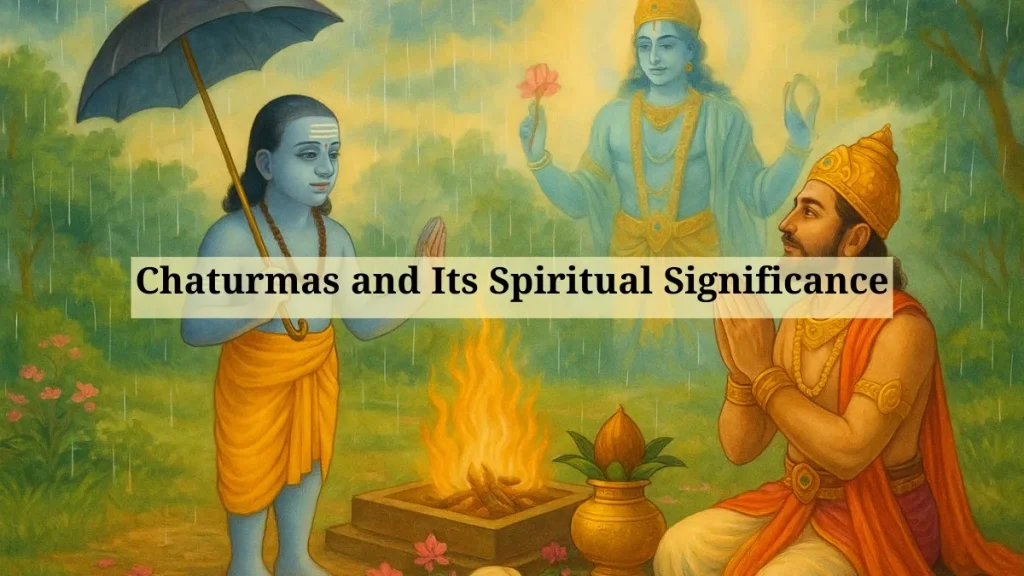
Here comes the sacred season of Chaturmas once again. In Hinduism, Chaturmas is considered a deeply holy period that spans four months. It begins with Devshayani Ekadashi, the eleventh day of the bright fortnight in the month of Ashadha, and ends with Devuthani Ekadashi, the eleventh day of the bright fortnight in Kartik.
It is believed that during these four months, Lord Vishnu enters yogic sleep. In His absence, the universe is looked after by Lord Shiva. Chaturmas is seen as an ideal time for fasting, charity, prayer, and spiritual growth. Let us explore the ancient stories and religious meaning behind it.
The origins of Chaturmas are closely linked to Lord Vishnu’s fifth avatar, Vaman, (See box matter) which appeared during the Treta Yuga. At that time, a powerful demon king named Bali had gained control over heaven, earth, and the underworld. Though King Bali was known for his generosity, his rising power became a threat to the balance of the universe.
To restore that balance, Lord Vishnu didn’t choose violence. Instead, He took the form of a humble young Brahmin boy, Vaman. Vaman arrived at King Bali’s grand sacrificial ceremony, holding a simple umbrella.
King Bali, famous for never refusing a Brahmin, welcomed the young boy warmly. When Vaman asked for just three steps of land, Bali laughed, “Only three steps?” and readily agreed.
The moment Bali gave his word, Vaman began to grow. With his first step, he covered the entire earth. With his second, he spanned the skies. There was nowhere left for the third step. Realising this was no ordinary boy, Bali bowed and offered his own head for the final step.
Impressed by Bali’s humility and devotion, Lord Vishnu placed his foot on Bali’s head, sent him to the underworld (Patal Lok), and granted him a boon that for four months every year, He Himself would stay with Bali in Patal Lok. And so began the sacred period of Chaturmas.
Chaturmas is marked by specific rules and traditions, especially around food and lifestyle. Devotees observe various fasts and give up certain food items each month:
- In Shravan (July–August): No leafy greens like spinach or fenugreek.
- In Bhadrapad (August–September): Curd/yoghurt is avoided.
- In Ashwin (September–October): Milk is avoided.
- In Kartik (October–November): Lentils are avoided.
Alongside these dietary rules, devotees offer special prayers to Lord Vishnu and Lord Shiva, chant mantras, and take ritual baths in holy rivers. Saints and monks remain in one place during this time, engaging in meditation, teachings, and self-discipline.
Weddings and engagements are not performed during Chaturmas, such auspicious events are postponed until after this sacred season ends.
Chaturmas isn’t limited to Hindu beliefs alone. It holds deep meaning in Jainism as well. Since Jain monks strictly follow non-violence, they stay in one place during the rainy season, which overlaps with Chaturmas, to avoid harming tiny life forms that emerge with rain.
They use this time for fasting, reflection, meditation, and offering spiritual guidance. The important Jain festival Paryushan also falls within Chaturmas. It is a time for self-purification and seeking forgiveness.
Scientific and Health Benefits of Chaturmas
Modern science also sees logic in Chaturmas traditions. During the monsoon season, our digestion weakens and the risk of infections increases. Hence, avoiding heavy, oily, or risky food items, as guided by Chaturmas rules, helps protect against illness.
Doctors too suggest eating light, seasonal, and fresh food during the rains, just as spiritual practices recommend. The health benefits of Chaturmas are not just spiritual but also practical.
Even in today’s world, observing Chaturmas brings mental peace and inner strength. It encourages self-control, spiritual practice, and mindfulness. Fasts and meditation during this period have been known to improve both mental clarity and physical health.
As one well-known spiritual teacher said, “Chaturmas is the time for the soul’s cleansing and its journey towards the Divine. Devotion and discipline during these four months can bring deep inner transformation.”
In all, Chaturmas is a sacred four-month journey of inner growth, devotion, and self-discipline. With fasting, prayer, and acts of kindness, we not only honour tradition but also take a step closer to spiritual fulfilment.
The Tale of Vishnu’s Vaman Avatar and King Bali
Long ago, there lived a great demon king named Bali. He was mighty, generous and beloved by his people. But over time, his power grew so vast that he took control over heaven, earth and the underworld. The gods were alarmed and sought help from Lord Vishnu.
Instead of using force, Vishnu chose a clever way. He took his fifth avatar, that of a small Brahmin boy called Vaman. Calm and soft-spoken, Vaman arrived at King Bali’s grand ceremony with a small umbrella in hand.
Bali was known for his generosity, especially towards Brahmins. Seeing Vaman, he promised to give him whatever he asked. Vaman simply requested three steps of land. Bali smiled, thinking, “Is that all?” and gladly agreed.
As soon as he did, Vaman began to grow, larger and larger. With one step, he covered the earth; with the second, he spanned the sky. There was no space left for the third. Bali now realised this was no ordinary boy, it was Lord Vishnu himself. Humbly, he bowed and offered his head for the final step.
Pleased with Bali’s devotion, Vishnu did not punish him. Instead, He made Bali the king of the underworld and promised to stay with him for four months every year as his gatekeeper.
The lesson? When power and pride grow too strong, it is humility and true devotion that lead to victory. Just like King Bali, if your heart is honest, even the Divine will stand by your side.
Quick Facts Box: What is Chaturmas?
- Chaturmas is a four-month holy period in Hinduism.
- It starts on Devshayani Ekadashi (Ashadha Shukla Ekadashi) and ends on Devuthani Ekadashi (Kartik Shukla Ekadashi).
- Lord Vishnu is believed to enter yogic sleep during this time, with Lord Shiva taking charge of the cosmos.
- It’s a time of fasting, prayer, charity, and spiritual focus.
- Jain monks also observe Chaturmas by staying in one place, meditating, and teaching.
- Scientifically, its dietary rules help with digestion and health during the rainy season.
- Chaturmas inspires inner calm, self-discipline, and connection with the Divine.