



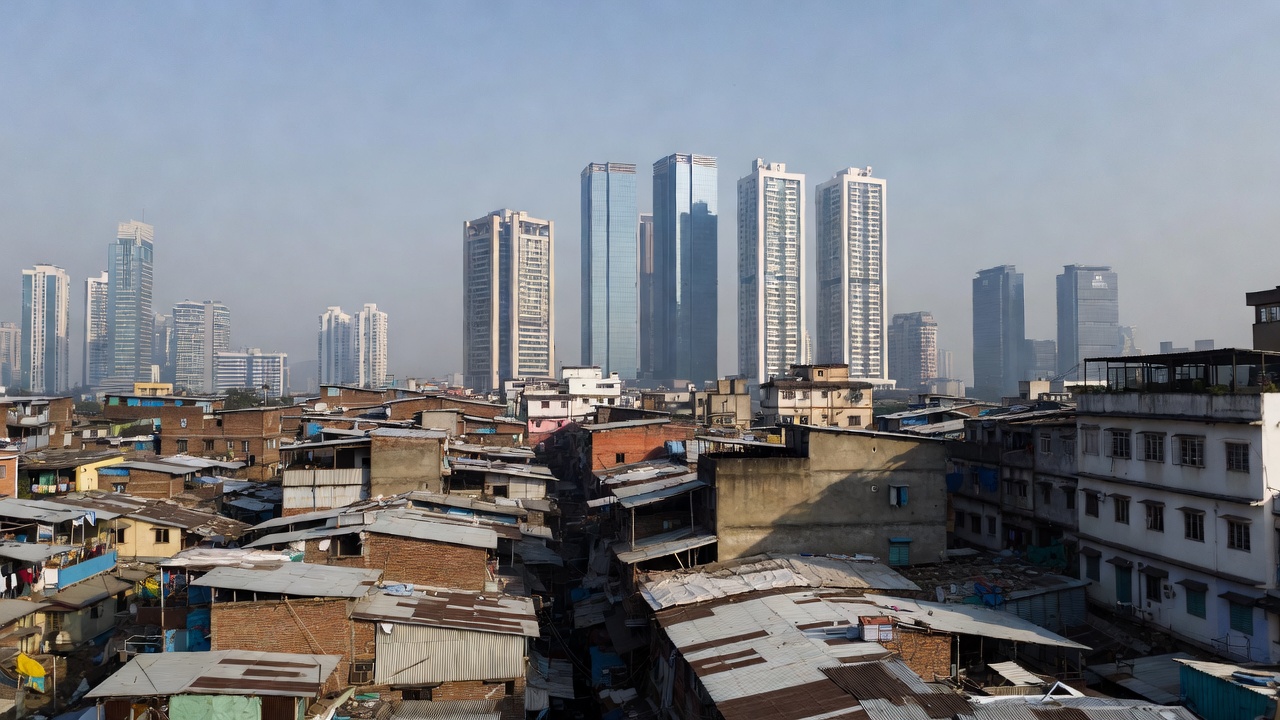
Land in Mumbai does not simply change hands. It shifts power, redraws futures, and decides, often for generations, who the city is actually built for. When the Maharashtra government formally handed over 118 acres at Mukteshwar in Malad-Malvani to the Dharavi Redevelopment Project on February 19, 2026, it did all three. The parcel, valued at roughly Rs 540 crore, now sits with Navbharat Mega Developers Private Limited, the 80:20 joint venture between the Adani Group and the Maharashtra government. Of the 140 acres earmarked at Mukteshwar, 22 remain in litigation. The rest are in hand.
This is the third major land parcel to come under the project’s control, after the Mother Dairy land at Kurla and the Jamas saltpan land at Mulund. Across the Mumbai Metropolitan Region, the state has assembled roughly 540 acres of government land for rehabilitation housing, including salt pan parcels at Kanjur, Bhandup and Mulund, and portions of the Deonar dumping ground. On paper, this is serious public land mobilisation for a project that has spent two decades cycling through failed tenders and political reversals.
The news demands to be read from several directions at once.
The Land Assembly Story: A Bureaucratic Logjam, Slowly Breaking
For anyone who has tracked the DRP over the years, the recurring obstacle was never just money or politics. It was land. Building homes for residents who do not qualify for in-situ rehabilitation within Dharavi requires government-owned land elsewhere in the MMR. That land sat with departments that had their own plans and little incentive to move quickly.
The Malad handover signals that the state machinery is finally moving in sequence. Three parcels are secured. Construction permissions were issued in January 2025. The master plan has been approved. Rs 135 crore of the Rs 540 crore land premium has already been paid by NMDPL. Ownership of the parcel remains with the DRP and the Slum Rehabilitation Authority, while NMDPL holds the development rights. This structure ensures the land cannot be quietly diverted from its stated purpose, which in past SRA projects in Mumbai has not always been a given.
The Eligibility Architecture: Where the Policy Knife Cuts
The Malad site is not for all of Dharavi’s residents. It will primarily absorb two categories: those living on upper floors, who have always been excluded from Maharashtra’s slum rehabilitation schemes because upper floors are treated as illegal structures, and those who settled in Dharavi between January 1, 2011, and November 15, 2022.
The eligibility framework runs in three tiers. Residents settled before January 1, 2000, qualify for free 350 sq ft homes within a redeveloped Dharavi. Those who arrived between 2000 and 2011 may receive 300 sq ft units outside Dharavi at subsidised rates. Those in the 2011 to 2022 window are offered rental housing with a hire-purchase arrangement, where ownership becomes possible only after twelve years. This is the cohort Malad is meant to serve.
The cutoff date carries a long and uncomfortable history. The threshold has shifted multiple times across the DRP’s two-decade lifespan, from 1995, to 2000, and now to 2011. In a settlement where migration has been continuous and documentation inconsistent, these dates are not administrative details. A family that arrived in 2009 and a family that arrived in 2012 may live three doors apart and lead nearly identical lives. One gets a subsidised home nearby. The other gets a hire-purchase arrangement in Malad for twelve years before ownership. The policy needs lines. But this particular line will generate grievances that no adjudication mechanism has yet fully prepared for.
The Railway Problem Nobody Is Talking About
The Harbour Line of the Mumbai suburban railway runs directly through Dharavi, cutting the settlement into sectors and creating a boundary that complicates both survey logistics and rehabilitation sequencing. Structures adjacent to the railway fall under the Railway Land Development Authority, not the SRA, placing a subset of tenements in a regulatory grey area. Residents in these pockets have received inconsistent answers about which authority governs their eligibility.
This is not a minor detail. It means that even as land is being assembled in Malad and other peripheral locations, a segment of Dharavi’s population remains uncertain about which agency is responsible for rehousing them. The DRP’s published documentation has not addressed this gap with the specificity it requires.
The Economy Inside the Walls: What Surveys Cannot Fully Capture
Dharavi is estimated to generate between Rs 10,000 crore and Rs 15,000 crore annually from its informal economy. Garments, leather goods, pottery, plastic recycling, farsan-making, aluminium moulding: these are industries where most operators live and work in the same premises. Displacing the home also displaces the workshop.
Kumbharwada, the century-old potter’s colony, illustrates exactly where the state’s accommodation policy breaks down in practice. Its production process depends on wood-fired kilns, river clay, and open courtyards for drying. None of that can be replicated in a vertical building’s commercial podium. By mid-2025, residents had begun voluntarily numbering their tenements, suggesting cautious acceptance of the survey process. But their specific demand — that the redevelopment preserve a horizontal, ground-level production zone within or adjacent to the redeveloped area — appears nowhere in binding policy documentation. A verbal assurance and a notified scheme are very different things, and the potters know it.
Dharavi Koliwada adds another layer. The Koli fishing families there hold documents, some dating to the colonial era, establishing prior rights over the foreshore land their community has occupied. Their position is that they are not a slum community requiring rehabilitation. They are landholders requiring recognition. That is a legally distinct claim, and the DRP framework as currently constituted has no mechanism for processing it.
The Political Economy: Asking the Question That Doesn’t Go Away
No reading of this project is complete without acknowledging what the developer stands to gain. Dharavi’s 646 acres sit next to the BKC, one of Mumbai’s most valuable commercial districts. The FSI available under the project means the commercial development enabled by rehabilitation cross-subsidisation will generate returns among the largest in Indian real estate history.
The award of the project to Adani Group in December 2022 was accompanied by credible questions about tendering fairness, including a competing bid disqualified on technical grounds that critics have called selective. What makes this more than political noise is a structural concern: rehabilitation delivery and commercial revenue are bound together in the same SPV. If commercial real estate markets soften, or construction costs escalate, the cross-subsidy model comes under pressure. The residents bearing that risk have no equity stake in the commercial outcome and no contractual protection if the financial model weakens. Comparable redevelopments in Seoul and Singapore, frequently cited as models for Dharavi, built ring-fenced financial guarantees for rehabilitation that were legally independent of commercial performance. India has not required it here. That omission deserves sustained scrutiny.
What Comes Next: The Test Is in Bricks, Not Announcements
The DRP now has land, surveys, permissions, and a seven-year deadline. But the 1.25 to 1.5 lakh new units targeted for roughly ten lakh residents still exist only in projections.
Malad-Malvani is not neutral territory. It carries its own complex demographic history, including a large migrant population and the deep social fractures of the 1990s. The township arriving there will need to be designed with that inheritance in mind, not dropped onto it as though the land were blank.
And here is the insight that the project’s supporters and its sharpest critics both tend to miss. Dharavi’s residents are not passive recipients waiting to be rehoused. They are economic agents who have built one of the most productive informal economies on the planet inside what the city officially called a slum. Their continued cooperation with this project is contingent on it delivering not just square footage but spatial logic. A 350 sq ft flat in a rehabilitated tower inside Dharavi is worth something specific because of where it is. A 300 sq ft flat in Malad is worth something different, not just financially but economically and socially. The project’s success will be measured not by how many homes are constructed, but by how many of the people who receive those homes can still earn a living from them five years later.
The land is moving. Whether the livelihoods move with it is the question that will define this project’s place in Indian urban history.
