




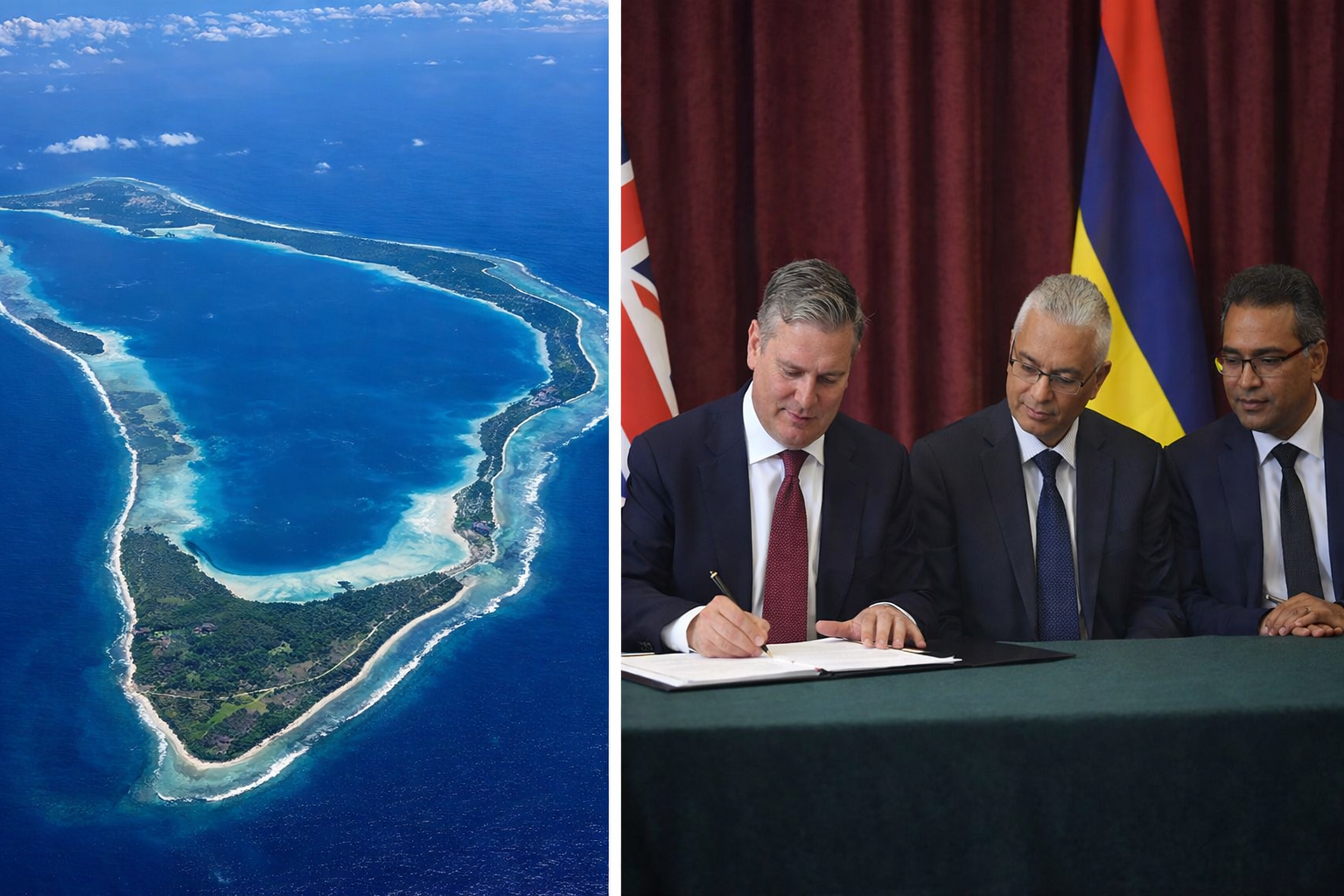
The strategic case for the treaty is sound. The moral case is overdue. Britain needs to act on both.
There is a coral atoll in the middle of the Indian Ocean, barely seventeen miles long, that has spent half a century at the intersection of imperial guilt and strategic necessity. Diego Garcia, ringed by clear water, occupied by one of the world’s most significant military bases, and emptied of its indigenous population by deliberate British policy, is back at the centre of a debate that Westminster has been trying to avoid for decades.
In May 2025, Prime Minister Keir Starmer signed a treaty handing sovereignty of the Chagos Archipelago to Mauritius while leasing back Diego Garcia for 99 years. The agreement has since been mired in parliamentary obstruction, transatlantic noise, and the predictable accusations of capitulation from a Conservative opposition that had fourteen years in power to resolve exactly this problem and chose not to.
Britain should ratify this treaty. The arguments against it do not survive serious scrutiny.
What Britain Actually Did
The history here matters, because critics of the deal prefer to skip it.
In the 1960s, Britain wanted an Indian Ocean base. Washington wanted one too. The arrangement they reached involved severing the Chagos Archipelago from Mauritius, then a dependent territory approaching independence, in exchange for £3 million and a discount on Polaris nuclear missiles. The Chagossians, approximately 2,000 people whose families had lived on the islands for generations, were reclassified as transient contract workers with no legal ties to their home. Between 1968 and 1973, they were removed by force. Their dogs were gassed. They were deposited in Mauritius and the Seychelles without adequate resettlement support, where many fell into poverty.
This is not distant colonial footnote. There are people alive today who were taken from those islands as children. The community, now estimated at 10,000, spread across Britain, Mauritius, and the Seychelles, has spent more than five decades in courts and campaign rooms trying to go home.
The Legal Ground Was Already Shifting
Critics of the Chagos deal have framed it as surrender. They invoke Chinese encroachment, strategic weakness, and fiscal recklessness. These arguments require a foundation the UK no longer has: a defensible legal position.
In 2019, the International Court of Justice ruled that Britain’s original detachment of the archipelago from Mauritius was unlawful, and that UK administration should end as rapidly as possible. The International Tribunal for the Law of the Sea followed with similar conclusions in 2021. Britain was not negotiating from strength. It was negotiating from a position of accumulating legal exposure, hoping the international community would eventually lose interest.
It did not. The risk of a binding judgment stripping the UK of the legal basis to operate the Diego Garcia base was not theoretical. It was approaching. The Starmer government recognised that clinging to sovereignty while the legal architecture beneath it collapsed was not toughness. It was delay dressed up as principle.
The Base Remains Secure
The most persistent misrepresentation in this debate is the suggestion that the treaty endangers Diego Garcia’s operational future. It does not.
Under the agreement, the base and a 24-nautical-mile buffer zone are leased to the UK for a minimum of 99 years, with provision for a further 40-year extension. Britain retains full administrative authority. Any foreign military presence on the surrounding islands requires joint UK-Mauritius approval, giving London an effective veto over the Chinese foothold that opponents claim to fear.
Diego Garcia is not a minor installation. It has served as a launch platform for operations across Afghanistan, Iraq, and the wider Indian Ocean theatre. It carries long-range bomber capacity, satellite infrastructure, and surveillance assets of considerable strategic sensitivity. Secretary of State Marco Rubio acknowledged its importance explicitly when he welcomed the deal in May 2025. The subsequent turbulence from the White House, linking the islands to Greenland ambitions in social media posts, reflects the rhythms of domestic American politics, not the Pentagon’s assessment of the base’s value. Those are not the same thing, and conflating them has been one of the lazier moves in the anti-treaty argument.
The legal certainty secured by this treaty protects Diego Garcia’s operational future for a century. The alternative, continued intransigence while international courts narrowed Britain’s options, would have protected nothing.
What £101 Million a Year Actually Buys
Britain will pay Mauritius an average of £101 million annually over the lease term, a net present value of approximately £3.4 billion over 99 years. The Starmer government noted this is roughly equivalent to the annual operating cost of an aircraft carrier without its aircraft.
For exclusive operational rights over one of the world’s most strategically significant bases, in a maritime region that carries more than a third of global shipping and has become the primary theatre of US-China competition, that is not an extravagant sum. It is the cost of maintaining credible Indo-Pacific relevance, relevance that underpins Britain’s place in the AUKUS security partnership, its commitments under the Five Eyes intelligence architecture, and the Indo-Pacific tilt announced in the 2021 Integrated Review. Diego Garcia is not peripheral to any of those commitments. It is load-bearing. Paying for that position is not weakness. It is the arithmetic of post-imperial strategy.
The Unresolved Debt
The treaty is the right geopolitical decision. That does not make it a complete one.
The agreement provides a £40 million resettlement fund and £45 million annually for 25 years to Mauritius for economic development. Chagossians may return to the outer islands once Mauritius assumes sovereignty. These provisions represent genuine progress. They are not sufficient.
Chagossian representatives have been unambiguous about their concerns. Bernadette Dugasse and Bertrice Pompe, who challenged the treaty in the British courts, argue that Mauritian sovereignty will make their community’s path home harder rather than easier, that the deal trades one set of gatekeepers for another without guaranteeing Chagossians the agency they have never been given. The United Nations Committee on the Elimination of Racial Discrimination has expressed similar concern about the treaty’s terms. These are not fringe objections. They are the considered positions of people with more at stake in this outcome than any MP or commentator in Westminster.
In early 2026, a group led by Misley Mandarin of the Chagossian government in exile returned to Île du Coin without permission in a deliberate act of defiance. The message was not complicated. They will not be managed, compensated, and forgotten again.
The Conservative amendment in the House of Lords in January 2026, requiring a self-determination referendum before ratification, was not a principled defence of Chagossian rights. It was a political mechanism to kill the treaty. The Chagossians deserve better than to be used as leverage by the same political tradition that expelled them.
What they deserve, and what Britain must now legislate, is a guaranteed right of return to the outer islands for descendants of those forcibly removed, full resolution of British citizenship claims, and resettlement funding ring-fenced for Chagossian communities directly, not dissolved into Mauritius’s general budget.
Britain’s Choice
Diego Garcia is an uncomfortable mirror. It reflects the gap between the Britain that invokes the rule of law in multilateral forums and the Britain that bribed a departing colony, expelled its people, and spent decades in litigation to maintain the fiction that the eviction was legally unremarkable.
The Chagos treaty does not erase that history. No treaty can. But it acknowledges, belatedly and imperfectly, that sovereignty claims built on colonial illegality have a finite shelf life. That international law applies to Britain as well as to the countries Britain lectures. That strategic interests are more durably protected through legitimate arrangements than through legal brinkmanship that the rest of the world has stopped pretending to respect.
Ratify the treaty. Legislate the debt to the Chagossians into something enforceable. Secure the base on a foundation that will hold for the next century.
The atoll will still be there. The Indian Ocean will still matter. And the people who truly belong to those islands will have waited long enough.
Subscribe Deshwale on YouTube
