




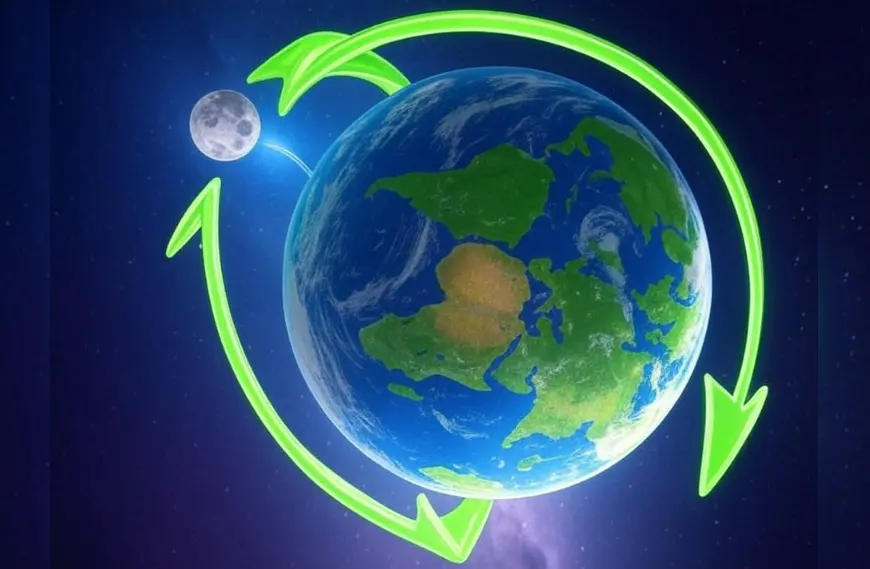
Earth is racing through time. Its spin is accelerating, shaving tiny fractions of a second off days, like August 5, 2025, which will be 1.25 milliseconds shorter than a standard 24-hour day. Similar short days occurred on July 9 and July 22, 2025, with the record set on July 5, 2024, at 1.66 milliseconds faster. This cosmic hurry, ongoing since 2020, defies expectations and raises questions that resonate beyond any single date.
For years, Earth’s rotation was slowing, requiring occasional leap seconds to align with precise atomic clocks. Now, the planet’s unexpected sprint may force a negative leap second by 2029, a first in history. Judah Levine, a timekeeping expert, noted in 2021, “This was unforeseen. We expected slower spins, not faster.” Such a change could disrupt global systems, from satellites to financial networks.
What Fuels This Cosmic Speed?
The reasons behind Earth’s rush are elusive. Scientists suspect the planet’s liquid core might be shifting, speeding up the outer layers. Mass redistribution from melting glaciers or atmospheric shifts, like El Niño, could play a role. The Moon, too, tugs at Earth’s rhythm, especially when farthest from the equator, as it will be on key 2025 dates. Leonid Zotov, a rotation expert, said, “This mystery likely lies deep within Earth. Atmospheric models don’t fully explain it.”
A Timeless Puzzle
This phenomenon isn’t just about one day or year. It’s a window into Earth’s dynamic nature. The planet’s spin reflects forces—core, climate, and cosmos—that shape our world across millennia. Each acceleration hints at processes we’re only beginning to grasp. Will future technologies adapt to a faster Earth? Could timekeeping evolve to match our planet’s rhythm?
The implications are vast. A negative leap second could challenge systems we rely on daily. Beyond that, this mystery invites us to ponder Earth’s place in the universe. It’s a story of a planet in flux, urging us to rethink time itself—relevant today and for generations to come.
Also Read: Life in Bihar’s Pakistan Tola: A Village Left Out of India’s Growth Story
