




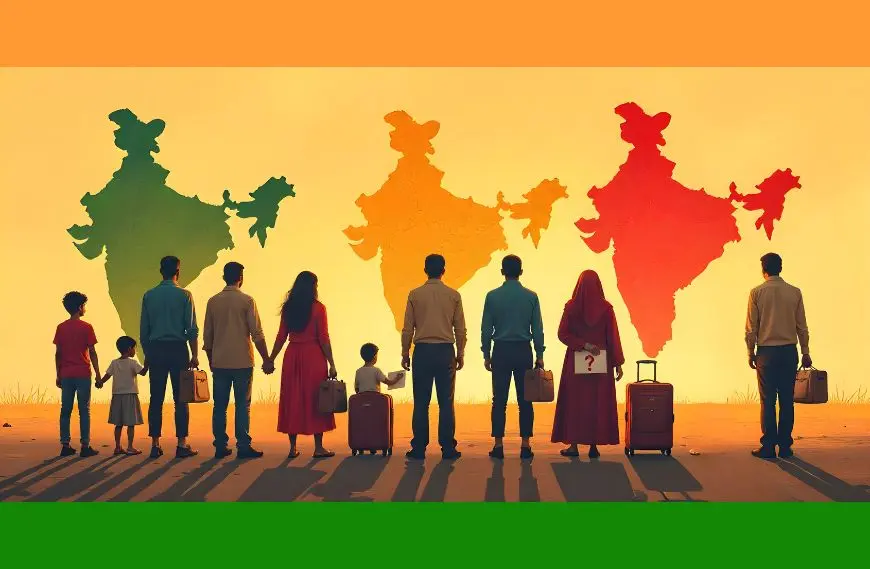
A decision that sits at the crossroads
Have you heard of it? Hindus and Sikhs from Afghanistan, Bangladesh, and Pakistan can now stay in India without a passport.
Yes, that’s right.
The Union Home Ministry has announced that Hindus, Sikhs, Buddhists, Jains, Parsis, and Christians from Afghanistan, Bangladesh, and Pakistan who entered India till December 2024 can now stay without a passport. For thousands of families, this is a lifeline. But it also leaves big questions hanging in the air. The move is part of the new Immigration and Foreigners Act, 2025, and it has sparked relief, hope, and fresh debate about what it really means to live in India without the security of citizenship.
Security vs humanity: India’s balancing act
Every government decision sits somewhere between compassion and caution. On one side, you have families who crossed borders to escape religious persecution. They arrive with little more than hope, looking for safety and dignity. On the other, you have a state that must weigh national security, citizenship rights, and the risk of opening doors too wide.
This order is a clear example of that balancing act. It gives minority migrants breathing space by letting them live legally, yet it stops short of promising them citizenship. In short, India has said: “We won’t push you out, but we’re not promising a new passport either.”
Relief without citizenship
For those living in legal limbo, the fear of deportation is constant. This order changes that, at least for now. It means families who came without valid documents, or whose papers have expired, can stay without looking over their shoulders.
But there’s a catch. Staying without a passport is not the same as becoming a citizen. Without citizenship, many rights — voting, property ownership, or full access to welfare schemes, remain out of reach. So yes, it’s a relief, but it’s also a reminder that these communities still sit on uncertain ground.
Stories of fear and survival
Imagine crossing into India after years of persecution, hoping for safety, only to live in fear that one day officials might knock on your door and ask for documents you don’t have. That has been the reality for thousands.
For Pakistani Hindus who migrated after 2014, this decision feels like an exhale after holding their breath for years. They may not have citizenship yet, but at least they now know they won’t be thrown out for lacking papers. It’s a fragile peace, but peace nonetheless.
Short-term net, long-term questions
This move is part of the Immigration and Foreigners Act, which came into effect this week. It provides short-term protection but leaves long-term questions unanswered.
What happens in 2025? Will those staying without passports be given a pathway to citizenship? Or will they continue to live in limbo, neither fully inside nor fully outside the system? The government has not made that clear, and for the communities affected, uncertainty lingers.
Six communities, three countries
It’s worth pausing to see who exactly this order covers. Six minority groups — Hindus, Sikhs, Buddhists, Jains, Parsis, and Christians. And three countries — Afghanistan, Bangladesh, and Pakistan.
These are communities who, for generations, have found themselves unsafe in their own homelands. They arrive in India seeking shelter, often leaving behind property, relatives, and entire lives. By including all six groups, India has recognised that persecution is not limited to one religion or one border.
Comparing two laws: CAA vs the new Immigration Act
Here’s where it gets interesting. Under the Citizenship Amendment Act (CAA), only migrants who entered India before December 2014 were eligible for citizenship. Anyone who came later was left in limbo.
This new order under the Immigration and Foreigners Act extends protection till December 2024. It does not offer citizenship, but it does mean those who missed the earlier cut-off can legally stay. So while the CAA opened the door to citizenship, this law keeps the door of safety open a little longer, even if it does not take you all the way inside.
Why this matters now
The significance goes beyond paperwork. It’s about India’s role as a refuge in the region. The country has always walked a fine line, protecting its borders while also standing as a safe haven for those who have nowhere else to go.
This decision reflects that dual responsibility. It’s not the final word, but it’s a step that acknowledges the reality on the ground. For the families who risked everything to cross into India, it is a small but meaningful promise: you can stay.
A decision full of hope and uncertainty
So, what does this really mean? In simple terms, thousands of people who once feared being deported can now breathe easier. But the road ahead remains uncertain. Without citizenship, the future of these communities is still unresolved.
India’s message is clear: you have shelter, but not yet a new identity. It’s both a relief and a reminder, compassion has its limits, and the debate over who belongs continues.
