




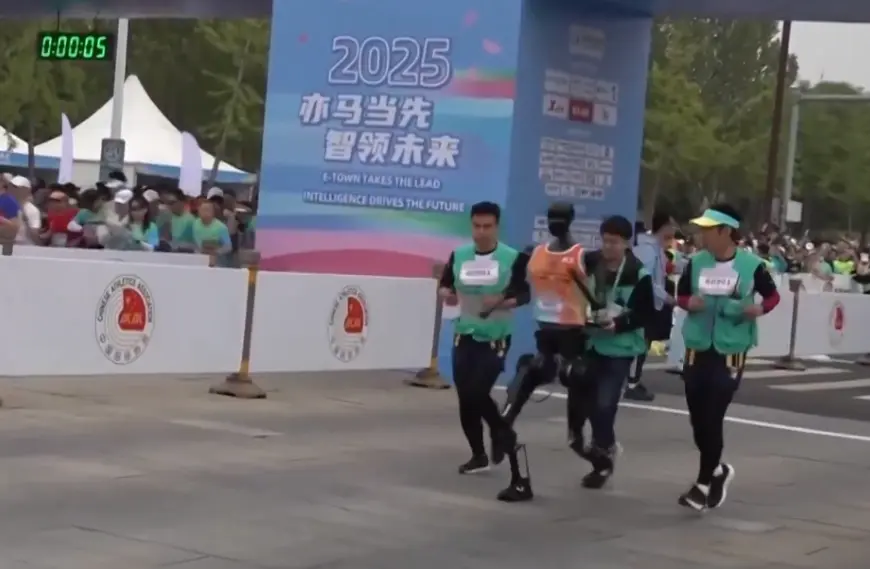
Yes, you heard that right. Humanoid robots have just completed a half-marathon in China — not in a lab, not on a treadmill, but outdoors, running 21 kilometres alongside thousands of human participants.
This happened in Beijing, in the Yizhuang district, which is known for its tech innovation. It was the world’s first-ever humanoid half-marathon, and let me tell you, it wasn’t just for show. It was a real test to see how far robots have come — quite literally — in handling real-world challenges.
Robots vs Humans: who ran better?
Over 20 humanoid robots, all walking on two legs just like us, took part in the event. They ran on a separate, secured track right next to the 12,000 human runners. The route wasn’t easy. There were turns, slopes, and the full 21 kilometres to cover.
While none of the machines came close to beating human runners, this wasn’t about who’s faster. The real aim was to see how well robots could perform in terms of battery life, balance, and movement algorithms.
Meet Tiangong Ultra: the star robot
The big moment came when a robot named Tiangong Ultra crossed the finish line. It’s built by the Beijing Humanoid Robot Innovation Center. Standing at 1.8 metres tall and weighing 52 kilograms, this robot did what no other has done before in a public race — it completed a full half-marathon without being replaced.
It finished the race in 2 hours, 40 minutes, and 42 seconds, which is quite a feat. It needed three battery changes during the run, but it kept going without any backup robot stepping in.
What made Tiangong Ultra stand out was how human-like its running style was. Engineers trained it using data from professional athletes. So the robot didn’t just move its legs, it actually tried to run like a human, adjusting its stride and posture just like we do.
Not all smooth running
Of course, not every robot made it to the end without trouble. Some stumbled. One robot that looked a bit like a Transformer even crashed into a barrier. Another smaller one fell mid-race but managed to get back up on its own — which, honestly, is a big deal in robotics.
Most robots had human supervisors walking behind them. Some were on tethers, just in case they lost balance. A few were being remotely guided, which means they weren’t fully autonomous.
There were rules in place too. Teams could switch out robots, but doing so came with a 10-minute time penalty. That encouraged everyone to keep the same robot going as long as possible.
More than just a race
Now, this wasn’t just a cool tech event or a stunt to grab attention. It’s part of a bigger national strategy in China. The government is pushing hard to become a leader in humanoid robotics. A policy rolled out last year made it clear that China sees this as a key area in future tech competition.
Chinese tech media have been showing off robots doing all sorts of things recently — riding bikes, flipping, even kicking. This marathon is just the latest step in that journey. It’s also a quiet message to the world that China wants to catch up with — and eventually challenge — US robotics firms, which still lead the field.
Human effort still wins (for now)
Let’s not forget though, humans are still ahead. The winner of the men’s race finished in 1 hour and 2 minutes, way faster than any robot. And the world record is even more impressive — 56 minutes and 42 seconds, held by Uganda’s Jacob Kiplimo.
But the organisers made one thing clear: this was more about testing progress than winning. As one engineer put it, it was a chance to push everything from batteries to motor systems under real-world stress.
In the long run, the goal is to build robots that can actually work with us — maybe helping out in factories, hospitals, or homes.And after this 21-kilometre test? Well, they’re not there yet, but they’re getting closer — one step at a time.
