




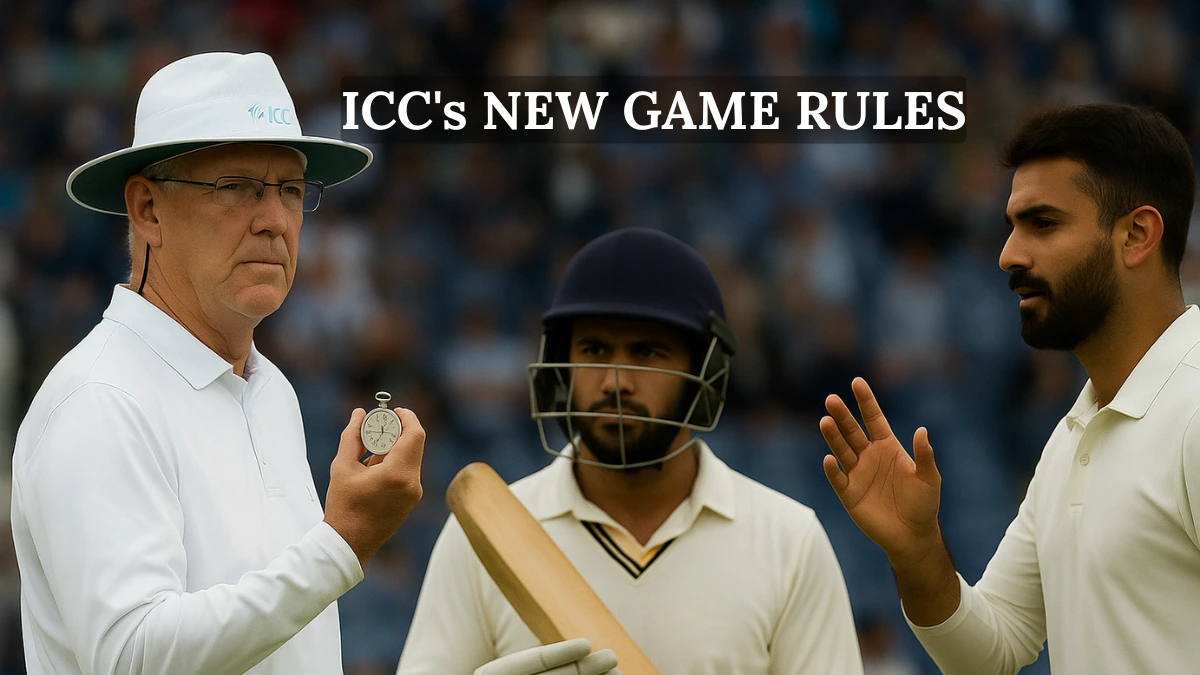
Cricket’s rulebook has long been a blend of timeless tradition and incremental tweaks. But the game today demands more than just subtle adjustments. With pace becoming as critical as precision, and technology reshaping how decisions are made, the International Cricket Council has introduced a fresh set of playing conditions. These updates do not overhaul the sport, but they sharpen its edges, targeting grey areas, reinforcing fairness, and tightening the flow across formats.
Some of these changes reflect lessons learned over years of trial and debate. Others respond to the growing demand from players and viewers for a game that moves swiftly and leaves little room for uncertainty. From how quickly the next over starts, to how reviews are handled, cricket is quietly moving into a more disciplined, transparent era.
Stop Clock Comes to Test Cricket Too
For years, white-ball cricket had tools in place to manage time. Now, Test cricket joins the club. The fielding team must begin a new over within 60 seconds of the last one ending. If they delay, umpires will issue two warnings. A third offence will result in a five-run penalty.
Interestingly, the warnings reset every 80 overs. This adds fairness while keeping players on alert throughout the innings. It is a small change with a big message – Test cricket is no longer exempt from time discipline.
Saliva Still Banned, Ball Change Becomes Flexible
Old habits die hard, but some rules are here to stay. The use of saliva to shine the ball continues to be banned. What has changed is how such incidents are handled. Umpires are no longer required to replace the ball immediately if saliva is applied by mistake.
They will assess whether the ball’s condition has changed significantly. If not, the same ball stays in play. If the ball later behaves unusually, there will still be no replacement. Instead, the batting team will be awarded five penalty runs. It is a sensible approach that avoids disruption while still punishing misuse.
Catches Reviewed Even on No-Balls
In modern cricket, technology is expected to deliver justice, even when the rules get tangled. One such area is catches taken on deliveries that are later called no-balls. Under the new law, the third umpire must still review the catch.
If the catch is clean, the batter is out and only one run is added for the no-ball. If it is not clean, the batter survives and all completed runs are counted. This rule separates the act of catching from the legality of the delivery, which is a fair outcome for both teams.
Secondary Reviews Now Honour Original Decisions
This might seem technical, but it is crucial for accuracy. When a batter is given out caught and goes for a review, the third umpire may discover the ball actually hit the pad. In the past, if the umpire then checked for LBW, it would automatically be ruled not out unless the batter had reviewed for LBW directly.
Now, if the original decision was out, and the ball tracking shows an umpire’s call, the batter remains out. This respects the initial on-field decision and closes a loophole that often confused both teams and fans.
Combined Appeals Follow the Actual Sequence
Sometimes the same delivery results in more than one appeal; for example, an LBW followed by a run-out. The third umpire will now examine these events in the order they occurred.
So if a batter is out LBW, the ball is considered dead, and the run-out will not be reviewed. This logical sequencing keeps the game aligned with how events unfold on the field, reducing unnecessary delays and drama.
Boundary Catch Rule Now Crystal Clear
Mid-air boundary catches have sparked more debate than perhaps any other modern dismissal. The updated rule removes all doubt. If a fielder was last grounded outside the boundary, they must re-establish contact with the ground inside the field before touching the ball again.
This means spectacular but questionable airborne flick-backs from beyond the rope will no longer count unless the fielder has clearly returned inside play first. It brings clarity to one of cricket’s most cinematic but controversial moments.
Third Umpire to Rule on Short Runs
In high-pressure games, even a single short run can change the outcome. The responsibility for spotting these errors has now shifted to the third umpire. With access to replays and angles, the decision is expected to be more consistent and accurate.
Deliberate Short Runs Come with Tactical Penalty
Batters who attempt to steal an extra run by not grounding the bat on purpose will still face a five-run penalty. What is new is that the fielding team now gets to choose who faces the next delivery.
This adds a tactical layer to the punishment. At the same time, if the umpires believe the act was unintentional, no penalty will apply. It is a rule that rewards awareness and punishes slyness.
Trial Rule for Full-Time Injury Replacements
Domestic first-class cricket will trial a system where teams can replace a player fully if they suffer an external injury during play. The injury must be clearly visible, such as being struck by the ball. Internal issues like cramps or muscle pulls do not qualify.
The substitute must be a like-for-like replacement. Boards have the option to adopt this trial. If successful, it could lead to greater player safety and match balance, especially in long-format games.
New Wide-Ball Rule to be Trialled from October
A six-month trial beginning in October 2025 will test a new wide-ball rule in limited-overs formats. It introduces leniency for bowlers when batters move across the crease before or during the delivery.
This is meant to protect bowlers from being unfairly penalised when batters shuffle excessively, and it promotes fairer contests between bat and ball. The outcome of this trial may lead to permanent changes in how wides are judged.
These rule changes may not grab headlines the way a double century or hat-trick does, but they are just as important in shaping the modern game. They reflect a mindset shift- one that values speed, fairness and clear communication.
Whether it is a stop clock ticking between overs or a third umpire tracking multiple appeals, the message is clear. Cricket is embracing smarter play. The game still honours its traditions, but it is no longer willing to be slowed down by them.
