




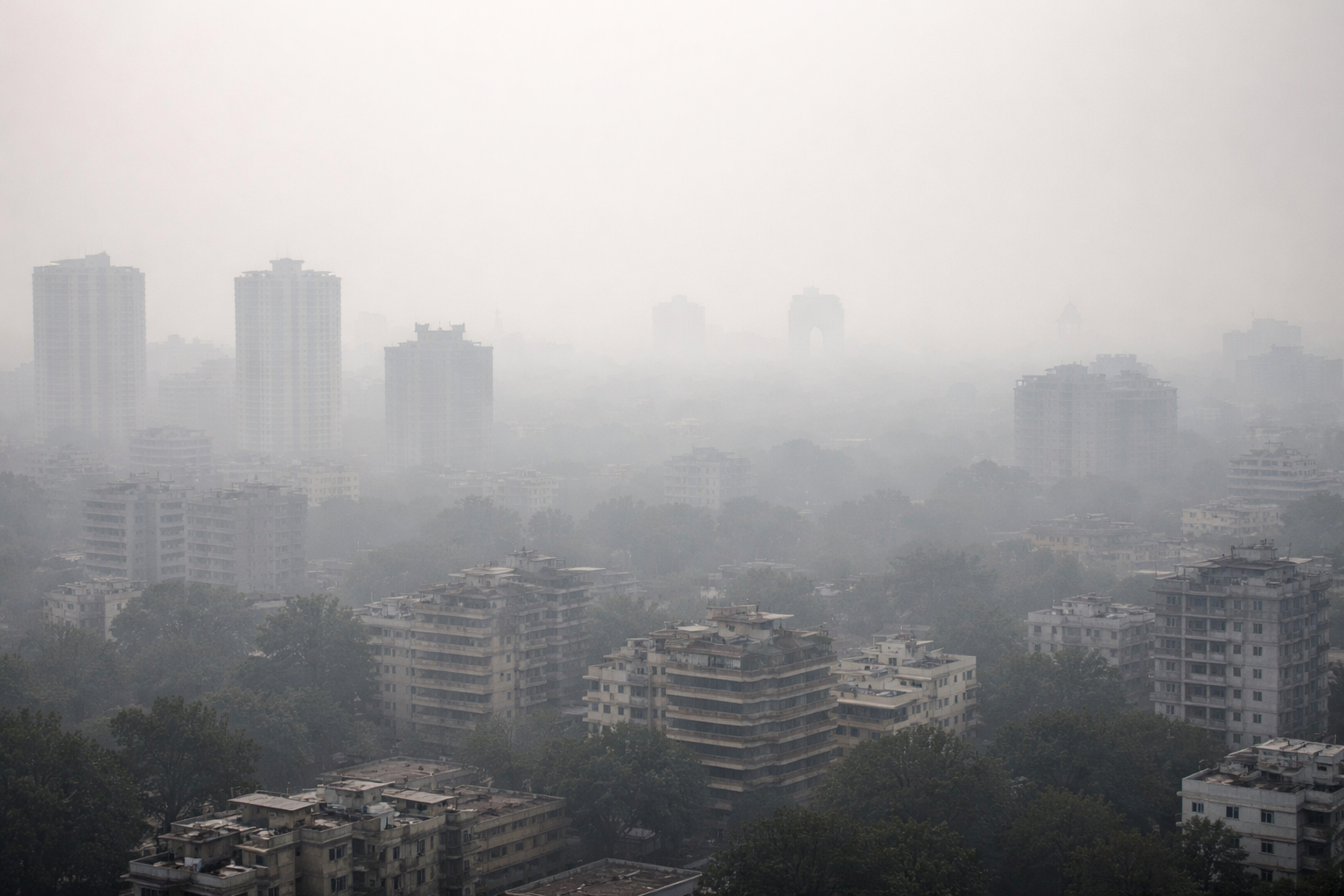
Beijing cleaned up in a decade. Los Angeles took a generation. Delhi and Mumbai are still debating.
On a winter morning in Delhi, the air carries a weight you can feel before you are fully awake. Visibility drops to a few hundred metres. Schools send children home. Hospital wards fill with the elderly and the very young. Politicians call emergency meetings, issue directives, threaten action. And then, in a few weeks, the smog thins slightly, the news cycle pivots, and the city exhales, not from relief, but from exhaustion. Nothing structurally changes.
This has been the story for the better part of two decades.
Meanwhile, halfway across the world, Beijing, once so polluted that its residents coined the term ‘airpocalypse’ to describe mornings when the sky simply ceased to exist, has recorded more than 300 clean air days annually as of 2023. PM2.5 levels, the fine particulate matter that embeds deepest in human lung tissue, have fallen 64% since 2013. Sulfur dioxide is down 89%.
This did not happen incrementally or accidentally. It happened because a government decided it would happen, resourced that decision at scale, and enforced it without allowing exemptions to accumulate into a second crisis.
What Beijing Actually Did
The turnaround began in 1998 but accelerated dramatically under the 2013-2017 Clean Air Action Plan, launched after public anger at choking smog reached a point that Chinese authorities could no longer manage through denial. The plan was not a target document. It was a mandate with penalties attached.
Coal-fired boilers were phased out across the city. Industries were held to ultra-low emission standards, not aspirational ones, but legally binding thresholds with real consequences for non-compliance. High-emission diesel trucks were pulled from roads in phases. Subsidies pushed consumers and fleet operators toward new energy vehicles. A closed-loop monitoring system tracked industrial emissions in real time and triggered enforcement responses automatically.
The investment was approximately $100 billion over the plan’s duration. In 2013, Beijing registered just 13 ‘good air days’ by official measurement. By 2023, that figure had crossed 300.
Crucially, Beijing did not treat air pollution as a city-limit problem. It coordinated across the entire Beijing-Tianjin-Hebei region, a geography of 200 million people, achieving a 25% PM2.5 reduction across that wider area. Pollution moves with wind and weather, not administrative boundaries. Chinese planners understood this in a way that Indian urban governance still largely does not.
One caveat deserves honest acknowledgement: China’s enforcement model operates within an authoritarian political structure that can override local resistance, economic lobbying, and legal challenge in ways that a democracy cannot and should not. India cannot, and should not, replicate the coercive architecture that made Beijing’s cleanup possible at speed. But the underlying technical and policy choices- fuel switching, emission standards, regional coordination, sustained investment- are not contingent on authoritarianism. They are contingent on institutional seriousness. That is a very different problem, and a solvable one.
Los Angeles: A Longer Game, An Equally Clear Lesson
Los Angeles offers a different but equally instructive story. In the summer of 1943, smog was so thick over the city that residents assumed they were under a chemical attack. Visibility in downtown fell to three city blocks. The acrid air burned eyes and throats. Children in the San Fernando Valley were kept indoors for weeks at a stretch as ozone levels spiked to levels that would not be legally permissible today. School sport seasons were cancelled. Doctors advised the elderly not to leave their homes.
The fix took longer than Beijing’s- decades, not years- but it was systematic and it held. California established the nation’s first air pollution control district in 1947. Residential trash incinerators were banned in 1957, eliminating a major source of particulate matter that had been treated as a domestic right. Catalytic converters became mandatory in 1975. Lead was stripped from gasoline. Tailpipe standards tightened repeatedly under the federal Clean Air Act and its 1977 and 1990 amendments.
The results compound across time. Volatile organic compounds, a principal precursor to smog formation, fell 98% since the 1960s, even as fuel consumption in the region tripled. Ozone concentrations improved fivefold since 1980. Today, Los Angeles is transitioning its entire bus fleet to zero-emission vehicles by 2030.
The lesson from LA is not that solutions are fast. It is that solutions work when they are sustained, when enforcement is not negotiable, and when the regulatory architecture is not dismantled each time a new administration takes office.
How the World’s Most Polluted Cities Cleaned Their Air
– and where Delhi and Mumbai still stand
| City | Worst Point | What They Did | Key Results | When |
|---|---|---|---|---|
| Beijing | PM2.5 ~90 µg/m³ – residents called it the airpocalypse | Phased out coal boilers. Bound industries to ultra-low emission standards. Removed high-emission diesel trucks. Subsidised electric vehicles. Coordinated across the wider Beijing-Tianjin-Hebei region. | PM2.5 ↓ 64% · SO2 ↓ 89% · NOx ↓ 54% | 1998-2023 |
| Los Angeles | Smog so thick downtown visibility fell to three city blocks | Banned residential incinerators. Mandated catalytic converters. Removed lead from fuel. Tightened tailpipe standards repeatedly under the Clean Air Act. | VOCs ↓ 98% · Ozone improved fivefold | 1947-ongoing |
| London | The Great Smog of 1952 – over 4,000 dead in five days | Passed the Clean Air Act (1956). Made smokeless fuels mandatory. Created smoke control zones. Subsidised household fuel switching. | Coal-induced fog functionally eliminated within a generation | 1956-ongoing |
| Mexico City | SO2 at ~300 µg/m³ – rated world’s most polluted city | Restricted 20% of vehicles daily. Expanded public transit under ProAire. Imposed stricter industrial standards. Treated restriction as one tool, not the whole solution. | SO2 ↓ over 66% · PM2.5 now below WHO interim target | 1989-ongoing |
| Seoul | PM2.5 twice the OECD average | Banned diesel in public fleets. Partnered with UNEP. Coordinated regionally on transboundary haze. | Overall pollution ↓ 20%+ since 2005 | 2005-2025 |
| Tokyo | Post-war industrial boom | Zero-emission technology incentives. Advanced real-time monitoring. Land-use planning to cut travel distances and fuel consumption. | Low emissions maintained across a metro of 37 million people | Ongoing to 2050 |
| 🔴 Delhi | PM2.5 routinely exceeds 200 µg/m³ in winter | NCAP targets (40% PM cut by 2026 — widely considered unreachable). BS-VI fuel standards since 2020. Partial CNG fleet conversion in the 1990s. Multiple agencies, no unified command. | Minimal sustained gains. Stubble burning, traffic gridlock and industrial non-compliance persist. | 2019-present |
| 🔴 Mumbai | AQI regularly in the 100-200 range | Municipal controls. Some transit upgrades. Construction dust rules unenforced. Accountability split between BMC and state agencies. | Incremental improvements only. Governance fragmentation prevents scale. | Ongoing, fragmented |
How to read this table. The top six cities share one common thread- a single-point authority, binding targets, consistent enforcement, and sustained investment over multiple political cycles. Delhi and Mumbai have the targets. What they have not built is the institutional architecture that turns a target into an outcome.
Other Cities That Got It Right
London’s response to the Great Smog of December 1952- five days in which an estimated 4,000 people died from respiratory and cardiac failure, with later peer-reviewed estimates placing the true toll closer to 12,000- was the Clean Air Act of 1956. Smokeless fuels became mandatory in designated zones. Subsidies helped households convert. The coal-induced fogs that had defined London’s winters for over a century were functionally gone within a generation.
Mexico City, rated the world’s most polluted city in the early 1990s, introduced vehicle rotation restrictions in 1989 under the ‘Hoy No Circula’ programme, keeping 20% of cars off roads on any given weekday. The scheme was imperfect from the start- wealthier residents simply bought second vehicles to circumvent it- and that failure became its own lesson: restrictions without alternatives produce avoidance, not change. What ultimately moved the needle was the accompanying ProAire framework, which expanded public transit, imposed stricter industrial emission standards, and treated the vehicle restriction as one instrument in a broader system rather than a solution in itself. By 2018, sulfur dioxide had fallen from 300 micrograms per cubic metre to under 100.
Seoul focused on diesel bans in public fleets and systematic regional coordination on transboundary haze, achieving pollution reductions of over 20% since 2005. Tokyo, with 37 million residents in its metropolitan area, has committed to zero net emissions by 2050 through integrated monitoring, green technology incentives, and land-use planning that reduces the distance people need to travel- and therefore the fuel they burn.
The pattern across all these cities is not complicated: clear legal targets, institutional authority with teeth, consistent enforcement over political cycles, and sustained public investment. None of them cracked it through good intentions alone.
Where Delhi and Mumbai Are Failing
India’s two most prominent cities do not lack diagnoses. They have reports, government programmes, court orders, and expert committees in abundance. What they have not built is the institutional architecture that turns a target into an outcome.
Delhi operates under the National Clean Air Programme, which set a 40% PM reduction target by 2026. That target is now widely considered unreachable. The programme relies heavily on self-reported emissions data from industrial polluters, carries no binding penalties for non-compliance, and is administered across multiple agencies- the Central Pollution Control Board, the Delhi Pollution Control Committee, various municipal corporations- that do not share data effectively and operate without unified command.
Stubble burning in Punjab and Haryana contributes up to 30% of Delhi’s winter PM2.5 load. Despite years of Supreme Court orders and National Green Tribunal directions, it continues. The reason is not defiance for its own sake. In a village outside Sangrur or Fatehabad, a smallholder farmer with three weeks between the rice harvest and the wheat sowing has no viable, affordable alternative to burning. Happy Seeder machines exist; subsidies exist on paper; but ground-level adoption remains thin because the delivery chain between policy announcement and farmer field has never been made to work. Until it is, the smoke will keep coming.
Vehicular emissions remain a structural problem despite BS-VI fuel standards adopted in 2020. Cleaner fuel and cleaner engines do not overcome gridlocked roads, where vehicles idle for hours at a stretch producing emissions at their worst possible efficiency. Public transport investment has been insufficient to draw private vehicle users off the roads in the numbers required, and old vehicle scrappage- essential to clearing the tail of the fleet- has moved slowly.
Mumbai’s situation is structurally different but equally unresolved. The city’s AQI sits in the ‘moderate to poor’ range through much of the year, driven by coal-based power generation, active port operations, and construction activity that proceeds with minimal dust suppression. Governance is divided between the Brihanmumbai Municipal Corporation and state-level agencies, with accountability for air quality outcomes belonging, in practice, to no single entity. When things go wrong, the architecture is designed, almost perfectly, for diffusion of responsibility.
The Real Obstacle Is Not Technical
India has demonstrated it can act when the political will is present. The conversion of Delhi’s public bus and auto-rickshaw fleet to CNG in the late 1990s- driven by Supreme Court orders and implemented against significant industry resistance- produced measurable, documented improvements in the city’s air quality. It is a proof of concept that sits largely unreferenced in current policy conversations.
The problem is systemic persistence. Gains from a single intervention erode if the surrounding framework does not hold. CNG buses run cleaner than diesel, but if the fleet ages without replacement, if private vehicle numbers double, and if industrial non-compliance goes unenforced, the net effect disappears within a decade. That is, more or less, what happened.
What is structurally missing is a single-point authority in each major city- an institution with genuine legal powers to penalise industrial violators, enforce construction site norms, mandate fleet transitions on a binding schedule, and coordinate across state lines on regional pollution sources. Not an advisory body. Not a committee. An authority with the power to shut operations down and the institutional backing to make that power credible.
Beijing had that authority and deployed it without flinching. Los Angeles built it incrementally over fifty years of regulatory evolution. London created it in direct response to a catastrophe that could not be managed through denial. Each model is different. All of them required someone to be accountable when targets were missed- and to face real consequences for that failure.
Air pollution contributes to more than two million premature deaths in India annually, according to health burden studies. The economic damage- in lost productivity, healthcare costs, and cognitive impairment from childhood exposure- runs into hundreds of billions of dollars. As economist Gita Gopinath has noted, India’s pollution burden may be quietly suppressing growth more than any external tariff shock. It is not a peripheral environmental issue. It is a macroeconomic one, compounding silently with every winter that passes without structural change.
What Needs To Happen
The global record is unambiguous, and it points in one direction. Urban air pollution is beaten through the same combination everywhere it has been beaten: binding timelines for phasing out solid fuel combustion, electrified public transport that is fast and frequent enough to actually compete with private vehicles, industrial emission standards enforced without the grace periods and self-reporting loopholes that make them voluntary in practice, and regional coordination frameworks with enough legal standing to impose obligations on state governments that would otherwise export their pollution downwind and call it someone else’s problem.
And- this is the part Indian governance has historically resisted most- named officials must be held accountable when targets are missed. Not through reshuffles that move the problem laterally, but through institutional consequences that make non-performance professionally costly. Accountability is not a bureaucratic nicety. In every city that has cleaned its air, it was the mechanism that made everything else work.
The citizen pressure to force this exists. It is visible in air quality litigation, in civil society monitoring networks, in the parents who check AQI before deciding whether to let their children play outside. That pressure has not yet been matched by a political response of equivalent seriousness.
Delhi and Mumbai do not need another working group or another five-year plan with targets calibrated to be just achievable enough to avoid embarrassment. They need a decision- taken at the level where decisions actually bind- that clean air is not a goal to be approached indefinitely, but a standard to be met, enforced, and defended year on year.
The science on what works is settled. The models from Beijing, Los Angeles, London, and a dozen other cities are documented and available. The technology exists. The financing, while significant, is not beyond India’s fiscal capacity for a challenge of this scale and consequence.
What remains is the one thing that cannot be imported from any global model: the political will to implement without compromise, enforce without exception, and sustain without losing nerve the moment the next election cycle begins.
Subscribe Deshwale on YouTube
