



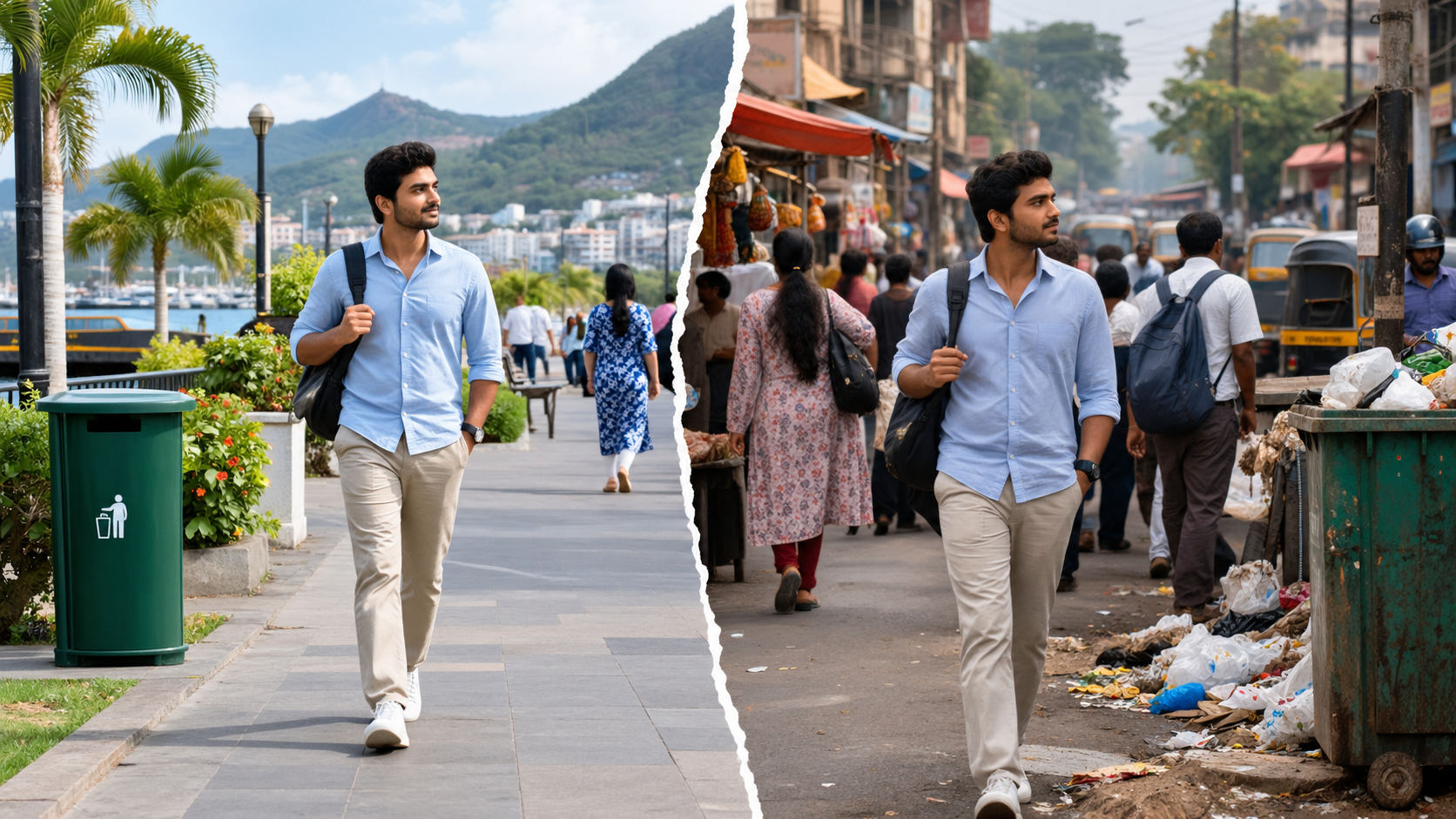
A short video from a trip to Mauritius has quietly turned into one of the more uncomfortable mirrors held up to Indian society this month. Creator Vishal Bhargava, filming his travels on the island, asked a question that most tourists brush aside within minutes of landing: why does a country where roughly two out of every three people trace their roots back to India look nothing like India when it comes to cleanliness.
It is not a small or symbolic majority. Mauritius has a population of close to 1.3 million, and Indian-origin residents make up around 68 percent of it, according to demographic estimates. Descendants of indentured labourers brought over from Bihar, Uttar Pradesh, Tamil Nadu and other regions in the nineteenth century now form the demographic backbone of the island. Their food, festivals, temples and even street names carry unmistakably Indian imprints. What doesn’t carry over, apparently, is the tendency to litter.
Bhargava’s observation was simple. He said he did not see people throwing trash on the streets, and that bins were actually used the way they are meant to be. For anyone who has walked through an Indian market, railway platform or beach, the contrast is jarring enough to sit with.
He pushed the comparison further by bringing Goa into the conversation. If cleanliness in Mauritius could be explained away by its small size or its dependence on tourism, he argued, the same logic should apply to Goa. Both are compact, both survive on visitors, both have a coastline economy. Yet Goa, in his words, has become a mess when it comes to cleanliness. That single comparison is what unravelled the easy explanations and forced a harder question.
The replies to his video read almost like a small crowdsourced research paper on Indian civic behaviour. One recurring theme was upbringing. Several commenters argued that cleanliness habits are formed at home long before they show up in public spaces, and that children absorb what parents actually do, not what they say. If littering is treated as normal indoors, it rarely disappears outdoors.
Another line of reasoning flipped the question entirely. Instead of asking why Indians abroad behave differently, some users asked why the system in Mauritius makes cleanliness the default in the first place. Enforcement, visible infrastructure and consistent social expectation were seen as doing more work than any inherited trait of discipline.
The most concrete example came from within India itself. Several commenters pointed to the Hiranandani townships around Mumbai, where footpaths, gardens and speed breakers are visibly maintained and residents largely follow the rules inside that controlled environment. The implication was hard to ignore: the same Indians who keep a private township spotless may behave completely differently the moment they step outside its gates, into spaces that belong to no one in particular.
That contrast matters more than it first appears. It suggests the problem was never really about identity or culture at all. It is about what a person is walking into. A gated township with visible upkeep, regular maintenance staff and social pressure from neighbours produces one kind of behaviour. An open street with overflowing bins, no real penalty for littering and the sense that “it is not my responsibility” produces another. Somebody pointed out that it often takes just one person littering in an otherwise clean space before others quietly follow, treating the first piece of trash as unspoken permission.
Schools entered the conversation too, with some arguing that civic sense needs to be taught early and repeatedly, not left to occasional public awareness campaigns that fade within a week of airing.
Put together, none of this paints Indians as inherently careless. It paints a picture of a population that responds, quite predictably, to its surroundings. Where the system signals order, cleanliness becomes the path of least resistance. Where the system signals neglect, so does the behaviour of the people living within it.
Bhargava’s video did not really answer his own question. It simply exposed how thin the “Indians are just like this” narrative actually is. The same people who queue patiently at Mauritius airports, use bins on the streets of Port Louis and rarely litter beaches there are the ones stepping over garbage back home. If cleanliness were a fixed trait, that switch would not be possible.
What the video really points to is a maintenance gap, not a character flaw. Mauritius invests in upkeep, enforcement and visible order. India, in most public spaces, does not. Until that gap closes, the debate will keep circling back to the same uncomfortable comparison, one Instagram reel at a time.
Subscribe Deshwale on YouTube
