




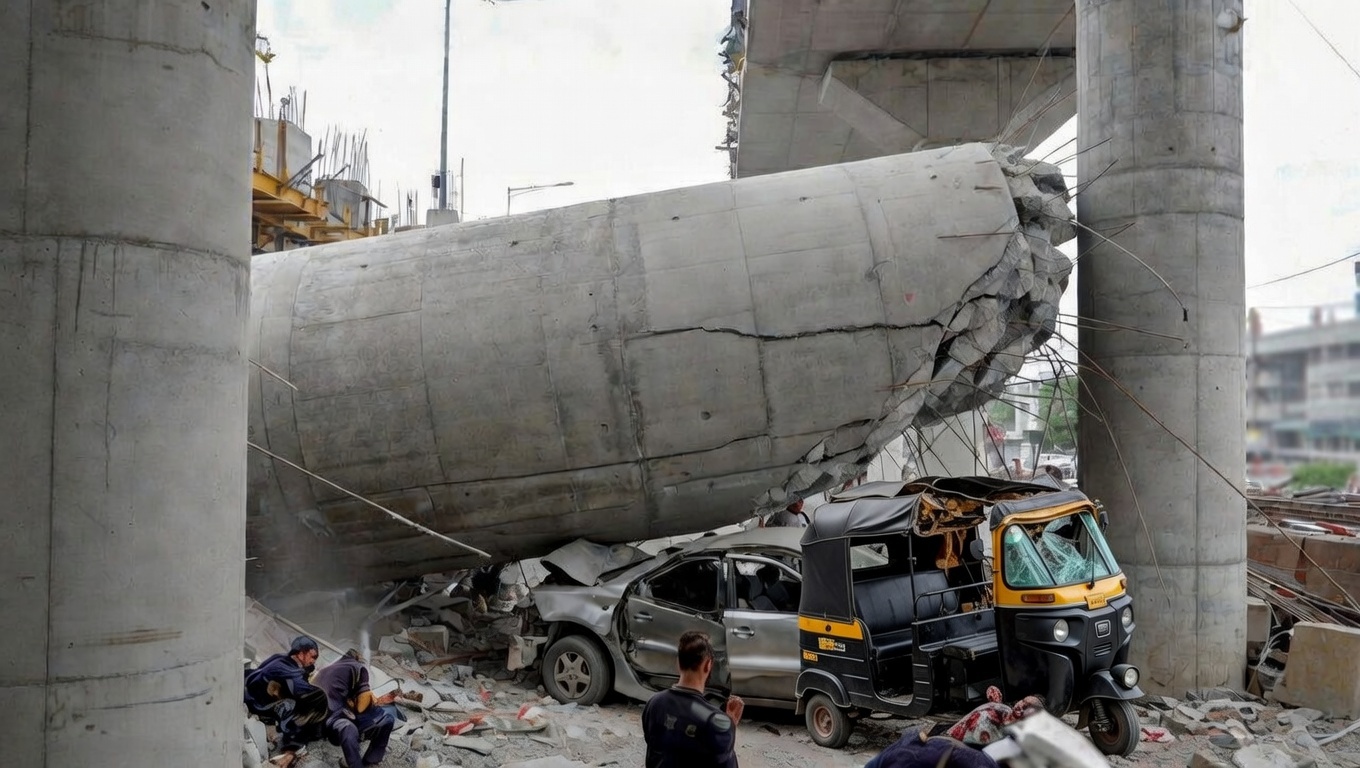
A portion of an under construction metro pillar collapsed in Mulund West on February 14, 2026, injuring several commuters and triggering heavy traffic congestion along LBS Marg. The Mulund Metro pillar collapse occurred during peak daytime movement, when vehicles were passing beneath the elevated structure.
According to civic officials and emergency responders, a segment of the partially built pillar gave way and fell onto the road, striking at least one autorickshaw and a car. Police and fire brigade teams rushed to the spot within minutes. The injured were shifted to nearby hospitals. Authorities have confirmed that Ramdhan Yadav is no more, with Rajkumar Indrajeet Yadav critically injured. Mahendra Pratap Yadav and Deepa Ruhiya are reportedly stable. The authorities of Maharashtra have announced a high-level probe and Rs 5 lakh aid for the family, with MMRDA promising to cover the medical costs and instituting its own enquiry committee.
The Mulund Metro pillar collapse led to immediate traffic snarls in the busy eastern suburb. LBS Marg remained clogged for hours as debris was cleared and damaged vehicles were removed. Commuters were advised to take alternate routes. Local residents expressed concern over safety standards at major infrastructure sites, especially in densely populated neighbourhoods.
Officials from the metro authority said a technical inquiry had been initiated to determine the exact cause of the failure. Preliminary assessments suggested that the collapse involved a structural element still under assembly. Engineers are examining whether the incident was linked to material stress, construction error, or temporary support removal. Work at the site has been paused pending inspection.
Mumbai has been expanding its metro network rapidly over the past decade to ease pressure on overcrowded suburban trains and roadways. Multiple lines are under construction across the metropolitan region. While such projects promise long term relief, they also bring safety challenges. Urban construction sites often operate in close proximity to active traffic corridors, increasing the risk of injury if safeguards fail.
The incident has also revived debate about urban planning around major transport corridors. Experts say that tenements, hawker clusters, makeshift stalls, scrap yards, and informal settlements should not be allowed to mushroom near metro stations or construction zones. Congested surroundings can obstruct emergency access, reduce visibility, and increase the risk to pedestrians. Clear buffer zones, regulated vending areas, and strict enforcement of safety perimeters are often recommended in global transit planning standards. Keeping station areas organised and free from encroachments is seen as essential for commuter safety and disaster response.
This is not the first time a metro related mishap has drawn attention in India or abroad. In 2018, a portion of a metro flyover under construction collapsed in Varanasi, leading to multiple casualties. Internationally, cities such as Mexico City and São Paulo have also witnessed structural failures linked to elevated rail infrastructure. In 2021, an elevated metro line in Mexico City collapsed during operations, prompting a nationwide review of rail safety standards. While circumstances differ from case to case, such incidents underline the importance of rigorous oversight and transparent audits.
Urban transport experts say that fast paced construction must be matched by strict compliance checks. Independent third party inspections are increasingly being recommended for large scale public works. Safety nets, protective barriers, and controlled traffic diversions are also essential when heavy structural components are installed above active roads.
In Mulund, residents gathered near the site soon after the incident, questioning whether adequate barricading had been in place. Some shopkeepers said vibrations from heavy machinery had been noticeable in recent days. Officials, however, urged the public not to speculate until the formal inquiry report is released.
Civic activists have called for periodic safety updates to be made public. They argue that transparency builds trust, especially when projects affect daily commuters. The metro authority has assured citizens that all ongoing construction sites will be reviewed as a precautionary measure.
Mumbai’s infrastructure push remains crucial for the city’s economic growth. Yet Saturday’s collapse is a reminder that safety cannot be secondary to speed. As investigations continue, the focus will remain on accountability, corrective measures, and preventing a repeat of such incidents in one of India’s busiest urban corridors.
Subscribe Deshwale on YouTube
