




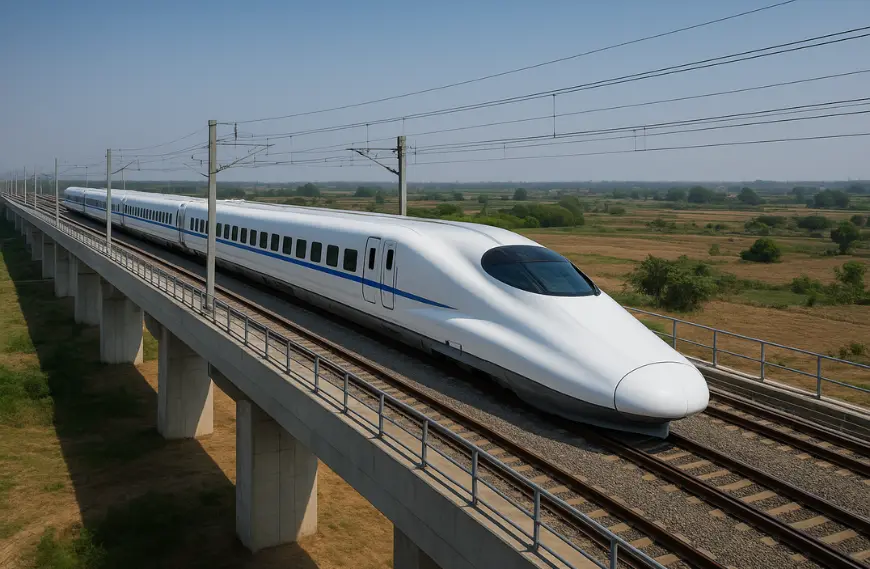
India is on the verge of a major transportation breakthrough with the launch of its first bullet train, connecting Mumbai and Ahmedabad. This project promises to transform travel in the country by offering unprecedented speed, comfort, and efficiency. The Mumbai–Ahmedabad High-Speed Rail (MAHSR) corridor spans approximately 508 kilometers, with trains capable of reaching speeds up to 320 km/h. This will reduce travel time between the two cities to just over two hours, a remarkable improvement over the current journey duration.
The corridor will feature 12 stations 9 in Gujarat and 3 in Maharashtra with the Mumbai station being underground and the others elevated. The project uses advanced Japanese E10 Shinkansen technology, known for its speed, safety, and comfort. Significant progress has already been made, including the completion of 300 kilometers of viaducts and installation of major bridges, such as a 100-meter steel bridge near Bharuch.
In addition to the bullet train, the Indian government has approved four major railway projects across the country with a total investment of ₹24,634 crore (₹246,340,000,000). These projects aim to enhance rail capacity, improve infrastructure, and increase freight movement by 78 million tonnes per year, strengthening economic growth and connectivity across multiple states.
This initiative highlights strong international collaboration, particularly between India and Japan. The Japan International Cooperation Agency (JICA) is funding 81% of the bullet train project, which is estimated at ₹1.08 lakh crore. The Gujarat section of the corridor is expected to be operational by 2027, while the full Mumbai–Ahmedabad route is slated for completion by 2029.
The bullet train is designed to be environmentally friendly, offering a greener alternative to road and air travel. The project also promotes the ‘Make in India’ initiative by utilizing domestically produced materials. In addition to its environmental benefits, the train is expected to boost regional connectivity, facilitate business and tourism, create jobs, and stimulate economic development in surrounding areas.
The Mumbai–Ahmedabad bullet train marks just the beginning of India’s high-speed rail ambitions. Plans are underway to expand such networks to other major cities, positioning India as a leader in modern rail technology. With faster, greener, and more efficient travel on the horizon, the country is truly speeding into the future.
Also read: A Railway Through the Hills: Bairabi–Sairang Line Transforms Mizoram’s Connectivity
Subscribe Deshwale on YouTube
